
Reviewed · TOKYO TRADITIONAL CRAFT WORKSHOPS
Tokyo: 1.5-Hour Edo Kiriko Glass Cutting Workshop in Sumida
Edo Kiriko turns a plain glass into a pattern of light, color, and sharp geometry. In this 90-minute workshop in Sumida, you watch working craftsmen, practice with the tools, then cut your own piece to take home. I like the small group of four and the chance to work in a real studio rather than simply browse a shop. I also like that the glass stock changes daily, so your piece feels personal from the start.
The main drawback is that glass cutting takes a steady hand and close attention. One participant found the relaxed freedom refreshing but thought beginners could use a little more supervision. At $122 per person, this is not a cheap souvenir activity, but it offers instruction, a hands-on craft session, and a finished Edo Kiriko piece.
Key Points at a Glance
- Watch craftsmen at work: The workshop takes place inside an active Edo Kiriko studio, not just a display room.
- Practice before cutting: You use test glasses first, which helps you understand the pressure and motion of the tools.
- Choose from changing stock: The available glasses differ from day to day, so your starting piece is not entirely standardized.
- Small group of four: A limited group makes the English support and hands-on guidance easier to follow.
- Different projects for children: Adults and middle school students cut drinking glasses, while elementary school children decorate lidded containers.
- Browse modern Edo Kiriko afterward: The shop includes classic designs and collaborations with brands such as Starbucks.
Why This Sumida Workshop Is Different
Many craft activities give you a prepared object and let you add a small decoration. Here, you work on the glass itself. Edo Kiriko is made by cutting patterns into glass with a rotating tool, so the final look depends on your control, patience, and design choices.
That makes this a good match for you if you want more than a quick photo stop. You are not expected to arrive with artistic training. The session includes a practice period, and the staff guide you through the basic technique before you work on the piece you will keep.
The setting matters, too. You enter a working studio where craftsmen are actively cutting glass. You can watch their hand movements and see the equipment in use before trying the process yourself. That gives the activity a useful sense of place in Sumida, an area associated with Tokyo’s traditional making trades.
The group is limited to four participants. I consider that one of the strongest features for a craft workshop. You are less likely to feel lost in a crowd, and the English-speaking support has room to address individual questions. The main instructor speaks Japanese, while an English-speaking guide helps translate the explanations.
More Tokyo craft workshops:
- Tokyo Shinjuku Chopsticks Making Class
★ 5.0 · 1,763 reviews - Chopstick Making Workshop in Ginza
★ 4.8 · 1,366 reviews - Kintsugi Experience: Art of Golden Joinery in Tokyo
★ 5.0 · 467 reviews
The First Look at a Working Edo Kiriko Studio
The workshop begins with observation. Rather than sitting down immediately and being handed a tool, you first see Edo Kiriko craftsmen at work. This short demonstration helps you understand that the process requires control, not brute force.
The tools may look simple, but the result depends on how you position and guide the glass. The activity information stresses safe use, and the first practical step is learning how to handle the tools properly. You get a chance to watch the motion before trying it yourself.
This opening is useful for another reason. It lets you see the difference between a finished design and the work needed to produce it. Edo Kiriko pieces can look effortless in a shop display, but cutting the pattern takes dexterity and focus. One participant described the process as demanding concentration while still feeling relaxed and friendly.
Photography is allowed in designated areas. That gives you a chance to record part of the visit, though you should follow the studio’s instructions about where cameras and phones are suitable.
Practice Glasses Make the Workshop Beginner-Friendly
The practice session is one of the most important parts of the experience. You use test glasses before cutting your chosen piece, so your first attempt does not have to carry the pressure of being your final souvenir.
Use this time to get comfortable with the tool and the amount of movement required. You can pay attention to how the glass responds, how much focus the work demands, and how your hand feels while guiding the cut. The aim is not to produce a perfect sample. It is to learn enough to begin your final piece with a sensible plan.
A participant specifically appreciated having test glasses to practice on. That detail makes the workshop more approachable for first-timers, especially if you are worried about making a mistake in front of the instructor.
The teaching style is fairly relaxed. You have room to experiment and make choices for yourself, rather than following a rigid step-by-step design. That freedom is pleasant if you enjoy hands-on activities and want your finished object to show some of your own decisions.
The tradeoff is that you should not expect constant correction. A participant felt that beginners might benefit from more guidance and supervision. If you prefer very structured instruction, ask questions early and use the practice time carefully.
Choosing Your Glass From the Daily Stock
After practicing, you select the glass you will decorate. The available pieces change each day, and each one is described as unique. This choice gives the workshop a personal touch before you make your first cut.
The key practical point is that you are not simply choosing a color from a fixed menu. The exact stock depends on the day you attend. You may find different shapes, colors, or designs available at different times, but the supplied information does not promise a specific selection.
Take a moment before choosing. Think about the shape you would actually use at home, and inspect the surface as you consider where your design might go. Since the finished piece becomes your keepsake, selecting something you like matters as much as the cutting itself.
Adults and middle school students work on drinking glasses. Elementary school children make lidded containers instead. The different projects give younger participants a more suitable object while allowing older participants to create a usable glass.
More hands-on classes and workshops in Tokyo:
- Sushi Making Tokyo Roll and Authentic Japanese Sushi Class
★ 5.0 · 3,971 reviews - Tokyo: Roll and Authentic Sushi Making Class in Asakusa
★ 4.9 · 1,957 reviews - Tokyo: Sushi Making Class in a Happi Coat near a Famous Spot
★ 4.9 · 1,377 reviews - Tokyo Sushi Making Class in Tsukiji with Professional Chef
★ 5.0 · 1,177 reviews
Cutting Your Own Design
Once you have chosen your piece, staff guide you as you cut your pattern. You create an original design rather than simply watching someone else do the work.
That does not mean you are left entirely alone. The workshop provides English-speaking support, and the Japanese-speaking master’s explanations are translated by a guide. The language arrangement worked well for a participant who found the instructions clear enough to follow.
Still, this is a craft session, not a polished stage performance. Your concentration matters. Keep your movements controlled, listen closely to the safety instructions, and do not rush because another person seems faster.
Your final piece may not look exactly like the shop examples. That is part of the point. The workshop lets you feel the skill involved in Edo Kiriko, including the need for dexterity and focus. Small irregularities can remind you that a person made it, though you should keep your expectations realistic if you want a perfect professional finish.
The relaxed atmosphere helps. You are not scolded for mistakes, and the test glasses give you a safe way to learn. At the same time, the open style means you need to take some responsibility for your own progress. If you are unsure about pressure, direction, or pattern placement, ask the guide instead of guessing.
The On-Site Shop and Modern Edo Kiriko
After the practical session, you can browse the studio shop. This is a useful final stop because you can compare your own work with finished Edo Kiriko pieces.
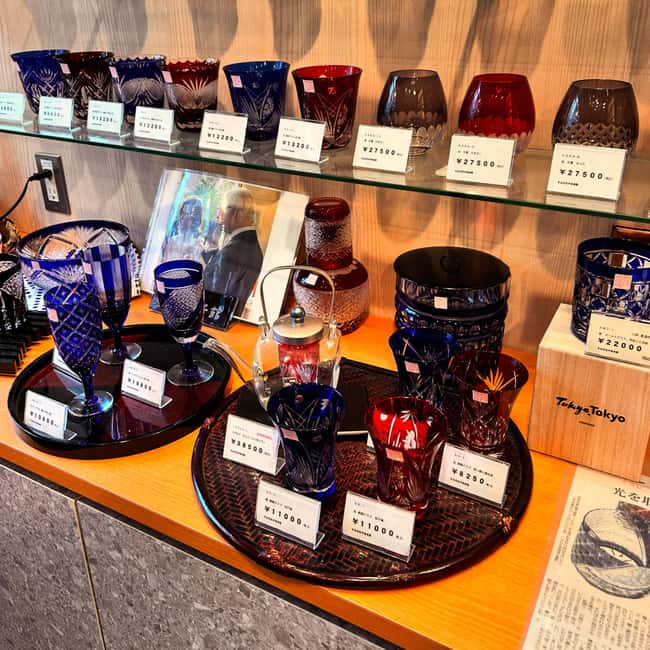
The shop includes colorful designs, traditional-looking patterns, and collaborations with global brands such as Starbucks. That range shows how the craft continues beyond formal or old-fashioned objects. You can see how familiar modern branding fits alongside Edo Kiriko’s cut-glass style.
Purchases at the shop are not included in the activity price. You do not need to buy anything after the workshop, and your handmade piece is already part of the experience. The shop is still worth a look if you want to understand the range of finish and design available from professional makers.
It can also help put your own result in perspective. A shop piece may have cleaner, more complex cutting, while yours records your first attempt. I would treat the display as a way to appreciate the craft, not as a standard you must match.
Is $122 a Fair Price?
At $122 per person, this workshop costs more than a casual Tokyo craft class or a simple museum visit. You are paying for a small group, professional equipment, English support, a practice session, and a glass or lidded container that you decorate yourself.
The value depends on how much you want to participate. If you only want to learn a few facts about Edo Kiriko, the price may feel high. You could get that from looking around a shop. If you want to work with the tools and take home an object you helped create, the cost is easier to justify.
The group size strengthens the value. With no more than four participants, the activity is not built around moving a large crowd through a demonstration. You have more space to focus and more opportunity to ask for help.
The finished piece also gives the workshop lasting value. You are not buying a generic souvenir from a shelf. You choose the glass, cut the design, and carry home the result. It may become a useful drinking glass or a small container, depending on the participant’s age.
I would not book this for a quick budget activity. I would book it for the personal nature of the souvenir and the chance to experience a traditional Tokyo craft directly.
Who Should Book This Experience?
This activity suits adults, solo visitors, couples, friends, and families with older children. It is listed for participants from fourth grade elementary school and older, with adult supervision for children. Children under 9 are not considered suitable, so check the age requirement carefully if you are planning a family outing.
Adults must accompany children. An adult companion may observe without cutting, but companions who do not take part should not expect to make a piece themselves.
The workshop works well for you if you enjoy:
- Hands-on crafts rather than passive sightseeing
- Small groups and close instruction
- Traditional Japanese arts with a modern shop component
- Souvenirs that have a personal story
- Activities that require concentration and careful movement
It may be less suitable if you want a fast, effortless activity or if you dislike the possibility of an imperfect result. The process requires focus, and the relaxed teaching style leaves some room for you to work things out.
The studio is wheelchair accessible, and the activity is indoors. That makes it a practical choice in poor weather, though the information provided does not describe the exact route from public transportation or the layout of the workstations.
Timing, Language, and Practical Details
The workshop lasts 1.5 hours. That is long enough for the demonstration, practice, glass selection, cutting, and a look around the shop without taking up an entire day in Tokyo.
The small group is limited to four people. The live tour support is available in Japanese and English. The master artisan speaks Japanese, and an English-speaking guide provides translation. If precise instructions matter to you, listen closely during the safety explanation and ask for clarification before cutting your final piece.
Food and drinks are not included, and hotel pickup and drop-off are not provided. Plan this as a studio visit that you reach on your own, rather than as a fully escorted sightseeing tour.
Pets are not allowed. Photography is permitted only in designated areas. The activity can be canceled up to 24 hours in advance for a full refund, and you can reserve now while paying later, which may help if your Tokyo schedule is still shifting.
Should You Book the Edo Kiriko Workshop?
Book it if you want to do something tactile and specific in Tokyo. The best parts are the working studio, the test glasses, the small group, and the chance to create a piece that is yours from the choice of glass through the final cut.
Go in expecting a real craft lesson, not a guaranteed showroom-quality object. You will need patience and a steady hand, and the open teaching style may leave you wanting more correction. Still, the English support, relaxed atmosphere, and practice period make it approachable for beginners.
At $122, I would choose this over a standard souvenir stop if Edo Kiriko interests you or if you want a meaningful family or couple activity in Sumida. If price is your main concern, the workshop may not fit your plans. If you value time with a traditional craft and a keepsake you helped make, it is a strong choice.
FAQ
How long does the Edo Kiriko workshop last?
The workshop lasts 1.5 hours, or 90 minutes.
Where does the activity take place?
It takes place in an Edo Kiriko glass studio in Tokyo’s Sumida Ward.
Is English support available?
Yes. The activity offers Japanese and English support. The master artisan speaks Japanese, and an English-speaking guide provides translation.
What do adults make during the workshop?
Adults and middle school students cut drinking glasses.
What do elementary school children make?
Elementary school children decorate lidded containers under supervision.
Can companions attend without cutting?
Yes. Adults must accompany children, and companions may observe without taking part in the glass cutting.
Is the workshop wheelchair accessible?
Yes, the activity is wheelchair accessible.
Newly reviewed around Tokyo
- Tokyo Asakusa:Calligraphy & Make T-shirt Activity★ 5.0 · 62 reviews
- Intercity Shuttle, Tokyo to Haneda /Narita /Yokohama /Makuhari★ 5.0 · 5 reviews
- 1 Hour Travel around Tokyo with a Professional Photographer★ 5.0 · 3 reviews
- Travel Tokyo with Your Own Personal Photographer★ 5.0 · 43 reviews
- Train in Samurai Swordsmanship and Defeat the Demon in Tokyo★ 5.0 · 5 reviews
- Shuttle Van 6hr Tokyo Tour to-and-from Tokyo, Yokohama and Narita★ 5.0 · 9 reviews
- Kickboxing & Body Training with EX-Pro Fighter★ 5.0 · 4 reviews
- Traditional Japanese Knife Sharpening Class★ 5.0 · 18 reviews
Tokyo Traditional Craft Workshops, compared.
Kintsugi Experience: Art of Golden Joinery in Tokyo
Read our review →

Authentic Pure Gold Kintsugi Workshop with Master Taku in Tokyo
Read our review →
Private Handmade Ring Workshop Activity in Tokyo Shibuya
Read our review →
Browse the lists this tour appears in