
Reviewed · TOKYO TRADITIONAL CRAFT WORKSHOPS
Japanese flower arranging (Ikebana) Experience/Workshop in Tokyo
The best part of this 90-minute ikebana workshop is its relaxed approach. You learn about Japanese flower arranging, flower symbolism, and the history behind the art, but you are not boxed in by strict rules. Ruby or Aki guides you, then gives you room to make something that feels like your own.
I like the small-group setting, where personal advice is easy to get, and the chance to work inside a real florist surrounded by flowers and foliage. The main consideration is price: at $100 per person, this is not a cheap craft class, and containers and kenzan are extra if you want to buy your own.
Key points to know before booking
- Creative rather than rigid: You learn ikebana ideas such as asymmetry and flower symbolism without facing a highly formal exam-style lesson.
- Hosted by Ruby or Aki: Both instructors receive strong praise for their clear English, warm manner, and practical flower guidance.
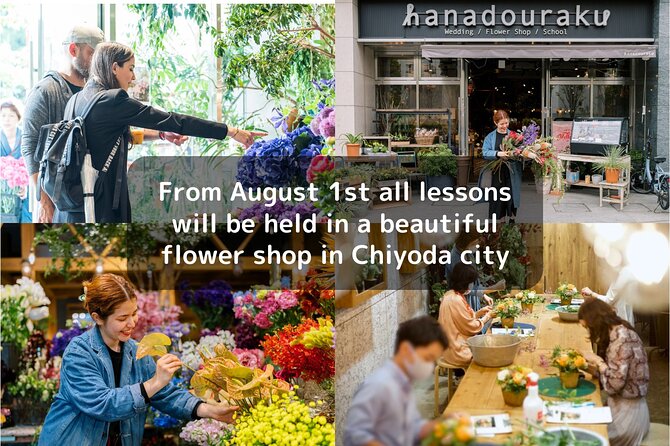
- Held at Hanadouraku florist: The setting is a working flower shop in Tokyo’s Kōjimachi area, not a bare classroom.
- A useful short break: The 1.5-hour format fits neatly into a busy Tokyo day and gives you a quiet change of pace.
- Flowers and tools are supplied: You can begin without packing anything, although containers and kenzan cost extra.
- Photos are included: You receive photos from the activity, giving you a record of the arrangement and the creative process.
Why this Tokyo ikebana class feels different
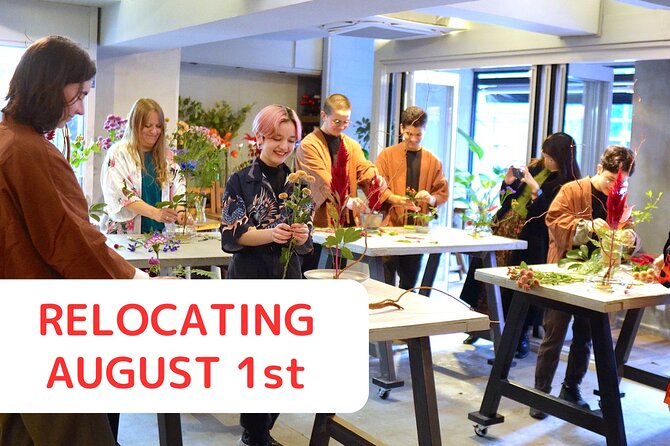
Tokyo can push you along at full speed. Trains arrive, crossings fill, and the day’s plans can become a long list of stations and sights. Ikebana gives you a reason to stop. For an hour and a half, your attention narrows to stems, leaves, shape, balance, and the space around each flower.
This is not presented as a strict lesson for students who already know Japanese flower arranging. The focus is self-expression, with enough instruction to help you understand what you are doing. That balance matters. You get a genuine introduction to ikebana without needing to memorize a long list of formal rules.
The workshop also explains why flowers have mattered to people across history and introduces the meaning attached to different flowers. You learn to look at a bloom as more than decoration. Its line, direction, color, and place in the arrangement all help shape the final result.
That makes the class a good fit if you want more than a quick souvenir activity. You are not simply assembling a bunch of flowers. You are learning to make choices, notice empty space, and work with asymmetry. The result may not look perfect, but that is part of the appeal.
More Tokyo craft workshops:
- Tokyo Shinjuku Chopsticks Making Class
★ 5.0 · 1,763 reviews - Chopstick Making Workshop in Ginza
★ 4.8 · 1,366 reviews - Kintsugi Experience: Art of Golden Joinery in Tokyo
★ 5.0 · 467 reviews
Arriving at Hanadouraku in Kōjimachi
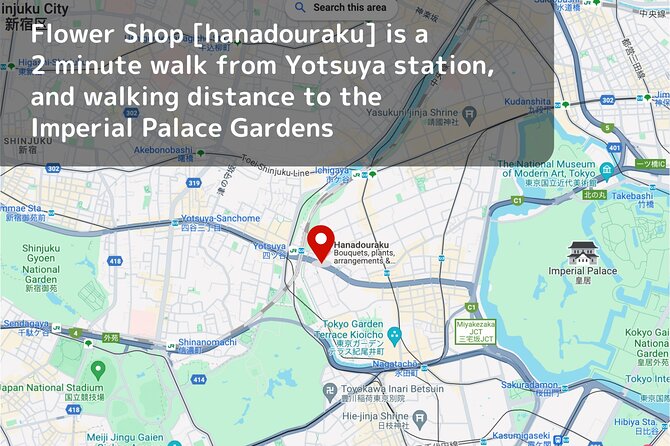
The meeting point is at 6-chōme 46 Kōjimachi, Chiyoda City, Tokyo 102-0083. The activity begins and ends at the same location. It is near public transportation, which makes it practical to fit into a day of sightseeing.
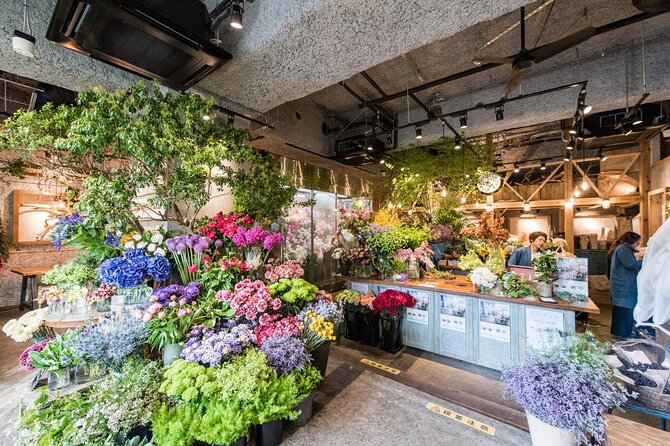
The class takes place at Hanadouraku, a florist filled with flowers and foliage. That setting gives the experience a stronger sense of place than a workshop held in a generic hotel room. You are surrounded by the material you are learning to use, and the shop atmosphere helps the session feel connected to everyday flower culture in Tokyo.
You should allow a little time to find the exact meeting point. The address is specific, but Tokyo addresses can still take a moment to match with a map. A mobile ticket is provided, so you can keep your booking details on your phone rather than carrying printed paperwork.
The location is a practical strength, but this is not a sightseeing tour through famous landmarks. There is no separate garden visit or walking route included. The Japanese garden connection comes through the ideas and forms used in the flower arranging, not through a guided garden stop.
The first lesson: flowers, symbolism, and ikebana ideas
The workshop begins with an introduction to ikebana and the role flowers have played in Japanese culture. Your instructor explains the materials and shows you how the tools work before you start arranging.
Flower symbolism is one of the more interesting parts of the class. It gives you a cultural key for understanding why a particular bloom may feel suited to a certain mood or occasion. The exact flowers available can vary, so you should not expect a fixed list of blooms. Instead, you work with the selection provided at the florist.
The lesson also introduces asymmetry, an important idea for anyone used to arranging flowers in an even, rounded bouquet. Ikebana often gives each stem a clear role and leaves open space around the flowers. This can feel harder than it looks at first, especially when a stem seems to point in an awkward direction.
That slight difficulty is useful. You are encouraged to look at the whole shape rather than simply filling every gap. The arrangement becomes a study in proportion and restraint. You may find yourself moving one branch several times before its angle feels right.
Choosing flowers and making your own arrangement
All flowers used in the arrangement are included, as are the ikebana tools and necessary equipment. You do not need prior experience, and the workshop welcomes children and families.
The creative freedom is one of the class’s strongest features. You receive direction, but you are not forced to copy one exact model. The instructors help you understand how to use the stems and support your decisions instead of taking over the arrangement.
Aki is praised for explaining the flowers, their background, and how to use the equipment. Ruby is described as an experienced florist who communicates clearly in English and offers coaching when you want it. That combination is useful for beginners. You can ask for help with a difficult stem, but you can also spend time experimenting.
The class may include enough time to make more than one arrangement. One participant completed two designs with Aki’s advice, while another had plenty of time to create a single arrangement in a private-feeling session. The exact pace depends on the group and your own working style.
Do not expect to produce a museum-quality design immediately. Ikebana is more demanding than placing flowers in a vase. You may need to trim stems, adjust angles, and rethink the balance several times. The satisfaction comes from seeing the arrangement gradually settle into shape.
More hands-on classes and workshops in Tokyo:
- Sushi Making Tokyo Roll and Authentic Japanese Sushi Class
★ 5.0 · 3,971 reviews - Tokyo: Roll and Authentic Sushi Making Class in Asakusa
★ 4.9 · 1,957 reviews - Tokyo: Sushi Making Class in a Happi Coat near a Famous Spot
★ 4.9 · 1,377 reviews - Tokyo Sushi Making Class in Tsukiji with Professional Chef
★ 5.0 · 1,177 reviews
Personal guidance from Ruby and Aki
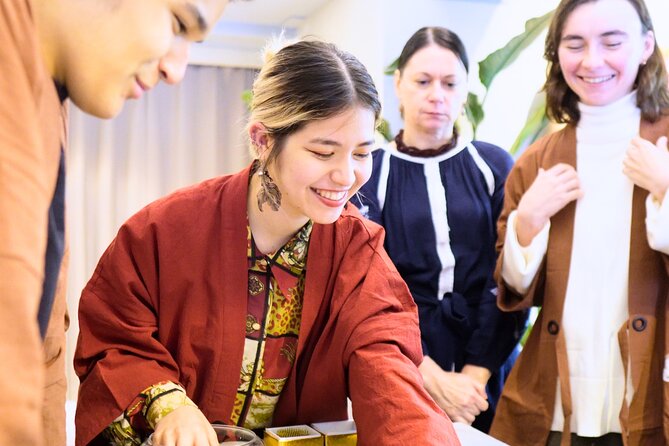
The instructor can make or break a short workshop. Here, the named hosts are Ruby and Aki, and both have received especially strong praise for their teaching.
Ruby is an accomplished florist with strong flower knowledge and clear English communication. Her teaching style allows you to ask for plenty of coaching or take a more independent approach. That is a good match for mixed groups, since one person may want step-by-step help while another prefers to experiment.
Aki is praised for her insight, gentle direction, and ability to explain the flowers and the ideas behind ikebana. Her guidance focuses on helping you connect with each bloom rather than simply correcting every technical detail.
The instructors also bring warmth to the session. That matters when you are working with unfamiliar tools or worrying that your arrangement looks wrong. The tone is encouraging, not formal or intimidating.
The maximum group size is 15 people. That is still a reasonably small class for a hands-on activity, although the amount of one-to-one time can vary if the session is full. If you want the most personal attention possible, a smaller group will naturally be an advantage. One class had only one participant, but you should not assume that level of privacy every time.
What is included, and what costs extra
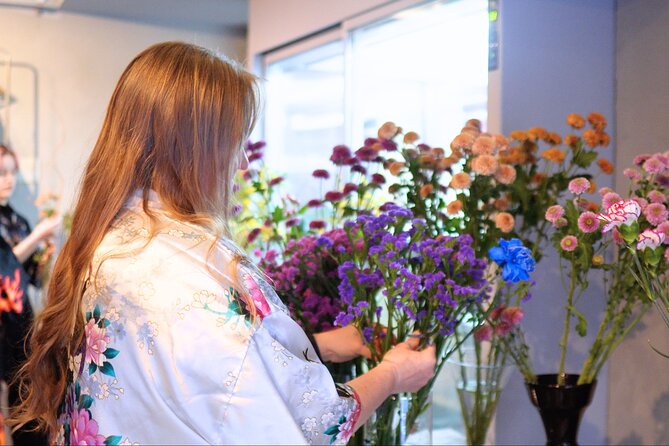
The $100 price includes the flowers, use of ikebana tools, and photos taken during the event. Those inclusions make the price easier to understand, especially if you value the instruction and the setting rather than only the finished arrangement.
The main extra costs are the container and the kenzan. A kenzan is the spiked base that holds stems upright in a shallow container. These items are available for purchase, but they are not part of the listed price.
This is worth planning for before you arrive. If you want to keep arranging flowers at home, buying a container and kenzan turns the workshop into the start of a new hobby. If you only want to try ikebana once, you can skip the added purchase and treat the class as a one-time cultural activity.
One participant bought vases and carried the arrangements back to an Airbnb for the rest of the stay. That can be a nice option if your accommodation allows flowers and you are staying in Tokyo for a while. The activity does not state that every finished arrangement is designed for long-distance transport, so ask about care and transport before you leave.
The photos add value in a different way. You receive a record of yourself working, not just a picture of the final flowers. That is helpful if you want a visual memory of the process or plan to use the class as a special family activity.
A calm activity for families and busy schedules
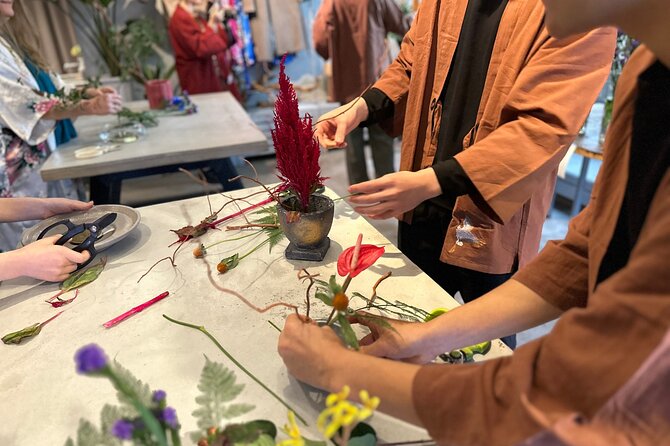
At roughly 1 hour and 30 minutes, this workshop is short enough to fit between larger Tokyo plans. You can use it as a quieter break after a morning of sightseeing or as a gentle first activity when you arrive in Japan.
The class welcomes children and families, and pets are listed as welcome. Service animals are allowed. If you are bringing a pet, it is sensible to confirm that the specific booking time suits your group, since the activity takes place in a florist with delicate materials.
Most people can participate, and the activity is near public transportation. No special skill level is required. You need only be willing to handle flowers and try a visual art form that may feel unfamiliar at first.
This is also a good choice for people who do not usually book cultural workshops. The relaxed style keeps the session from feeling like a formal school lesson. You learn enough context to understand the activity, then spend most of the time making something.
The drawback is that the class may not satisfy someone looking for a traditional, highly structured ikebana certification lesson. The description makes clear that the teaching is playful and expressive rather than built around strict precision. That is a benefit for many people, but a limitation if you want formal training in a particular ikebana school.
Is $100 a fair price for 90 minutes?
The price sits in the premium range for a short activity. At $100 per person, you are paying for more than the flowers. The fee covers instruction, equipment, the florist setting, the creative experience, and shared photos.
I think the value works best if you care about personal guidance and a memorable cultural activity. The chance to learn directly from a florist, choose and shape flowers, and leave with an arrangement or the option to buy one of the key tools gives the class more substance than a quick demonstration.
The value is weaker if you are mainly looking for inexpensive flowers. You will need to pay extra for the container and kenzan, and the class lasts only about 90 minutes. A formal ikebana student may also prefer a longer course with a set curriculum.
For a special occasion, family activity, or creative break from Tokyo’s busy sightseeing rhythm, the price can make sense. For a budget-focused schedule, compare it with the many free or low-cost things you can do in the city before booking.
Who should book this flower arranging experience?
I would point this class toward:
- First-time visitors who want a Japanese cultural activity outside the usual temple and food stops
- Couples or friends looking for a calm shared project
- Families seeking an activity that welcomes children
- Solo visitors who enjoy hands-on creative work
- Flower lovers who want to learn about symbolism and asymmetry
- Anyone with limited time who cannot commit to a full-day class
It may not be the best match for you if you dislike hands-on activities, want a major sightseeing stop, or need a formal course with strict technical rules. The experience depends on your willingness to make choices and accept that the first arrangement may take some adjusting.
You should also consider the group size. A maximum of 15 is manageable, but it is not a guaranteed private lesson. If personal attention is your top concern, ask about the expected group size when booking.
Booking, cancellations, and practical details
Confirmation is provided when you book, and the mobile ticket makes arrival simple. The meeting point is in Kōjimachi, and the session returns to that same location.
Free cancellation is available if you cancel at least 24 hours before the start time. Changes or cancellations made less than 24 hours ahead are not accepted for a refund. The cut-off uses Tokyo local time, so check the time carefully if you are booking from another country.
The activity requires a minimum number of participants. If that minimum is not reached and the session is canceled, you are offered another date or experience, or a full refund.
Should you book this Tokyo ikebana workshop?
Book it if you want a thoughtful, hands-on introduction to Japanese culture and like the idea of slowing down for an hour and a half. The strongest reasons are the flower-filled florist setting, the warm guidance from Ruby or Aki, and the freedom to create rather than copy a rigid design.
At $100, it is a considered purchase, especially once you add a container or kenzan. Still, the class offers more than a basic craft session: you get cultural context, fresh flowers, tools, personal advice, and photos of the experience.
For a relaxed family outing, a creative date, or a break from Tokyo’s fast pace, I would book it. If your goal is formal ikebana study or the lowest possible price, choose another class.
FAQ
Where does the ikebana workshop take place?
The workshop takes place at Hanadouraku florist in Kōjimachi, at 6-chōme 46 Kōjimachi, Chiyoda City, Tokyo 102-0083.
How long does the activity last?
The workshop lasts approximately 1 hour and 30 minutes.
What is included in the price?
The price includes the ikebana flowers, use of ikebana tools, necessary equipment, and photos taken during the activity.
Are containers included?
No. Containers used for the arrangement are not included, but they are available to purchase.
Is the kenzan included?
No. The kenzan is not included in the price, but you can purchase one during the activity.
Who teaches the workshop?
The experience is provided by Ruby. The named instructors include Ruby and Aki, both of whom guide participants through the flower arranging process.
Do I need previous ikebana experience?
No previous experience is required. The workshop is designed as a relaxed, playful introduction and provides instructor guidance.
Are children and families welcome?
Yes. Children and families are welcome to take part.
Are pets and service animals allowed?
Pets are listed as welcome, and service animals are allowed.
What is the maximum group size?
The activity can have a maximum of 15 participants.
Can I cancel for a full refund?
Yes, if you cancel at least 24 hours before the experience start time. Cancellations or changes made less than 24 hours before the start time are not refunded.
Newly reviewed around Tokyo
- Tokyo Asakusa:Calligraphy & Make T-shirt Activity★ 5.0 · 62 reviews
- 1 Hour Travel around Tokyo with a Professional Photographer★ 5.0 · 3 reviews
- Travel Tokyo with Your Own Personal Photographer★ 5.0 · 43 reviews
- Intercity Shuttle, Tokyo to Haneda /Narita /Yokohama /Makuhari★ 5.0 · 5 reviews
- Train in Samurai Swordsmanship and Defeat the Demon in Tokyo★ 5.0 · 5 reviews
- Shuttle Van 6hr Tokyo Tour to-and-from Tokyo, Yokohama and Narita★ 5.0 · 9 reviews
- Kickboxing & Body Training with EX-Pro Fighter★ 5.0 · 4 reviews
- Traditional Japanese Knife Sharpening Class★ 5.0 · 18 reviews
Tokyo Traditional Craft Workshops, compared.

Kintsugi Experience: Art of Golden Joinery in Tokyo
Read our review →

Authentic Pure Gold Kintsugi Workshop with Master Taku in Tokyo
Read our review →
Private Handmade Ring Workshop Activity in Tokyo Shibuya
Read our review →
Browse the lists this tour appears in