
Reviewed · TOKYO CALLIGRAPHY CLASSES
Authentic Japanese calligraphy class in Tokyo! Kanji your name
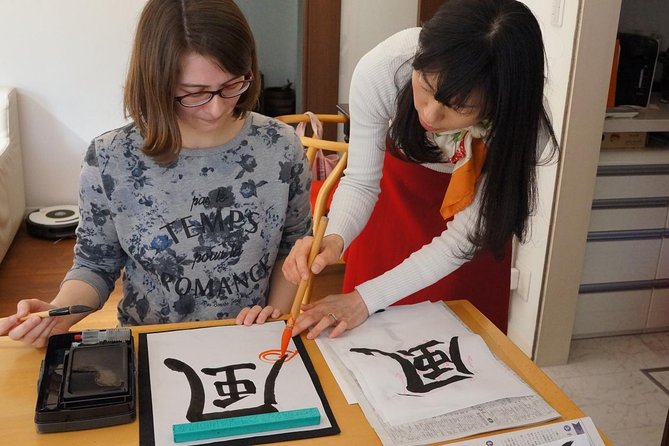
Japanese calligraphy becomes much easier to appreciate when you are holding the brush yourself. Near Yoga Shrine, Maki welcomes you into her home for a private, hands-on lesson covering Japanese writing systems, posture, brush control, and the careful rhythm behind each stroke.
I like the one-to-one teaching, which gives you room to repeat a technique without feeling rushed. I also like the personal setting and the useful keepsake: you practice on ordinary paper, then create a finished piece on colored paper or a fan. The main consideration is that this is a focused 90-minute lesson, not a sightseeing tour, and transportation to the meeting point is your responsibility.
Key points before you book
- Private lesson with Maki: Your group receives direct instruction rather than sharing a large class.
- Learn the basics properly: Maki explains writing systems, tools, posture, and how to hold the brush.
- Practice, then create: You work on practice paper before making a final piece on traditional paper.
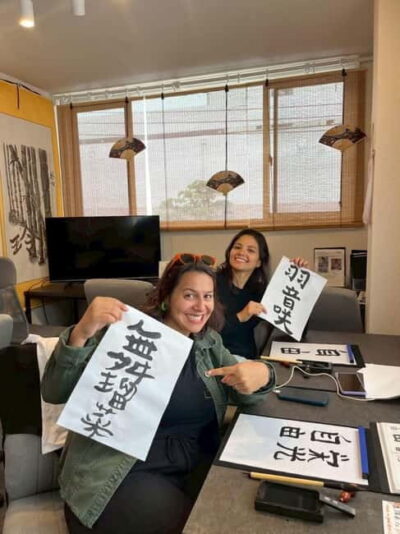
- Home-based setting: The class takes place in Maki’s living room, giving the lesson a friendly local feel.
- Take-home artwork: Your finished calligraphy can be kept as a souvenir, with a colored paper or fan available.
- Easy cancellation terms: You can receive a full refund if you cancel at least 24 hours before the start time.
A quiet Tokyo class with a brush in your hand
This experience offers a side of Tokyo that can be easy to miss. Instead of passing through a major attraction, you spend time with a local instructor and learn one of Japan’s most recognizable arts in a private home.
The class lasts about 1 hour and 30 minutes. That is enough time to hear a short introduction, learn the basic mechanics, practice several times, and produce a finished character or word. You will not leave as a calligraphy master, but you should leave with a better understanding of why each stroke matters.
Maki teaches in English and explains the process carefully. The class is suitable for beginners, including people who have never held a calligraphy brush. Her teaching style is systematic, and she is comfortable repeating an explanation until the movement makes sense.
The atmosphere is informal without losing the seriousness of the craft. Drinks may be offered during the session, and Maki also uses the class to explain parts of Japanese culture connected to calligraphy. That makes this more than a craft activity. It gives you a small, practical introduction to how written characters are formed and why their appearance depends on movement, pressure, and order.
More Tokyo calligraphy classes:
- Tokyo: Calligraphy on Kanji Fan & Scroll with Drink
★ 5.0 · 210 reviews - Let’s experience calligraphy in YANAKA, Taito-ku, TOKYO !!
★ 5.0 · 127 reviews - Experience all of Japanese culture and Japanese food experience classes “origami, udon, Japanese food, green tea, calligraphy” in 4 hours
★ 5.0 · 105 reviews
Meeting near Yoga Shrine and Yoga Station
The meeting point is at 2 Chome-39 Yoga, Setagaya City, Tokyo, near Yoga Station. The itinerary lists Yoga Shrine as the first stop, but the heart of the experience is the calligraphy lesson itself rather than a wider walking tour of the area.
You should allow enough time to reach the meeting point by public transportation. Private transportation is not included, and the activity ends back at the same meeting point. The location is near public transportation, which makes it a manageable addition to a Tokyo day, but you will need to plan your own route.
This setting is worth understanding before booking. You are not meeting at a large studio with a reception desk, a row of instructors, or a set of tourist displays. You are going to a local home. That is part of the appeal, but it also means you should follow the meeting instructions closely and arrive ready for a personal, home-based lesson.
First lesson: writing systems and calligraphy tools
Maki begins by introducing the different writing systems used in Japan and explaining the basic tools of calligraphy. This background matters because Japanese writing is not simply a matter of copying attractive symbols.
You will see how the brush, ink, paper, and writing surface work together. The tools may look simple, but the brush responds to pressure and movement in ways that a pencil or marker does not. A small change in the angle of your hand can alter the width and character of a stroke.
This introduction helps you understand why traditional calligraphy takes patience. You are not just drawing a picture. You are following an established form, with attention to stroke order, balance, spacing, and rhythm.
The class includes the calligraphy tools, practice paper, colored paper or a fan, and other consumable supplies. You do not need to bring your own equipment. That is useful for visitors who want to try the art without purchasing a complete brush and ink set before knowing if they enjoy it.
Posture and brush control come before beautiful characters
A good calligraphy lesson starts with the body, not the finished design. Maki explains the correct posture and shows you how to hold the brush. This may sound basic, but it is one of the most useful parts of the session.
A loose, controlled grip gives the brush room to move. Sitting or standing in the proper position helps you guide the stroke instead of forcing it with your fingers. Maki’s approach is careful and participatory, so you should expect to practice the same movement more than once.
This is where private instruction has real value. In a large class, a teacher may demonstrate once and move on. Here, you can receive individual corrections and repeat an explanation when your hand does not quite follow the instruction. Maki is described as patient about repeating techniques, which is especially helpful for first-time students.
Do not expect every first attempt to look polished. The point is to learn how the brush behaves and to notice how a stroke begins, changes direction, and ends. Calligraphy rewards control more than speed.
More hands-on classes and workshops in Tokyo:
- Sushi Making Tokyo Roll and Authentic Japanese Sushi Class
★ 5.0 · 3,971 reviews - Tokyo: Roll and Authentic Sushi Making Class in Asakusa
★ 4.9 · 1,957 reviews - Tokyo Shinjuku Chopsticks Making Class
★ 5.0 · 1,763 reviews - Tokyo: Sushi Making Class in a Happi Coat near a Famous Spot
★ 4.9 · 1,377 reviews
Practice paper gives you room to make mistakes
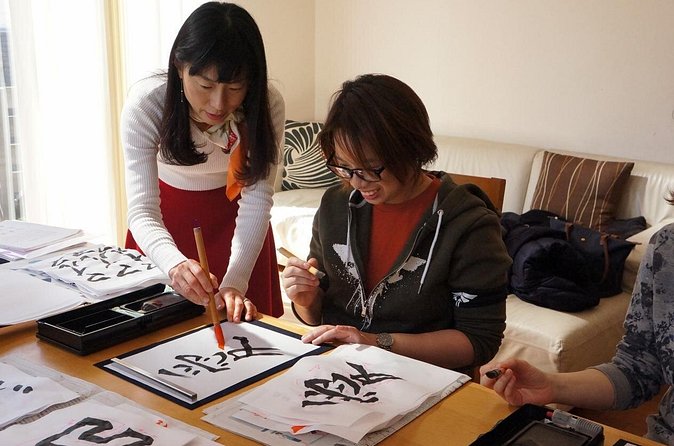
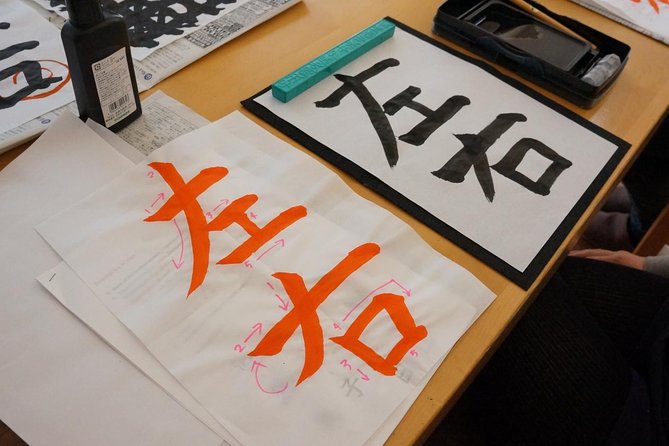
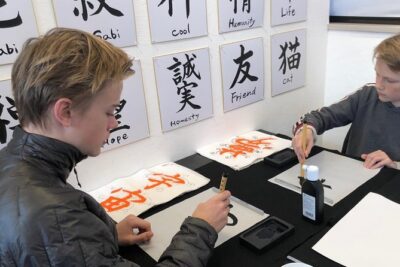
After the introduction, you practice on ordinary paper before working on the final piece. This is a sensible order. You can concentrate on posture, grip, and brush movement without worrying about wasting the paper you plan to take home.
The practice stage also gives Maki a chance to adjust your technique. You might find that a character looks unbalanced, a line is too heavy, or the brush is moving too quickly. Those small corrections are easier to make before you switch to the finished paper.
The class is described as step-by-step rather than observational. You will not simply watch Maki write a character and then copy it from a distance. You will take part throughout the lesson, with opportunities to repeat the process and ask questions about the language and culture connected with the writing.
That hands-on format makes the activity a good choice for families, couples, friends, and solo visitors. It also works well as a birthday gift. Maki has prepared something special for a birthday participant in the past, so the class can suit a small celebration, although any special request should be arranged with the provider rather than assumed.
Creating your own kanji on traditional paper
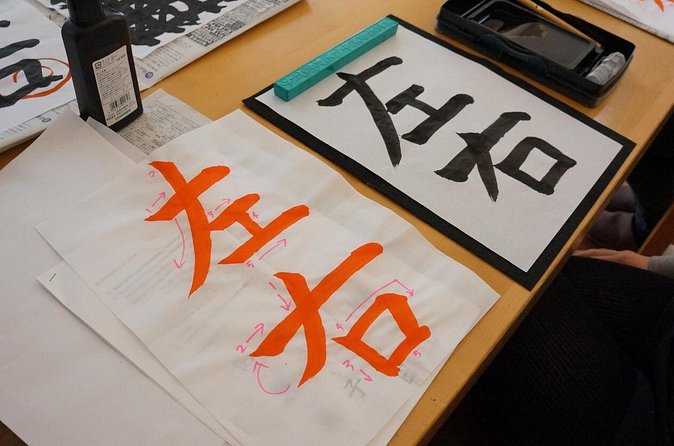
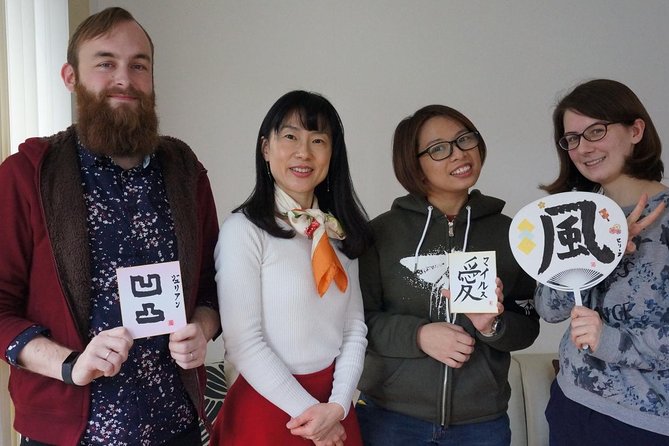
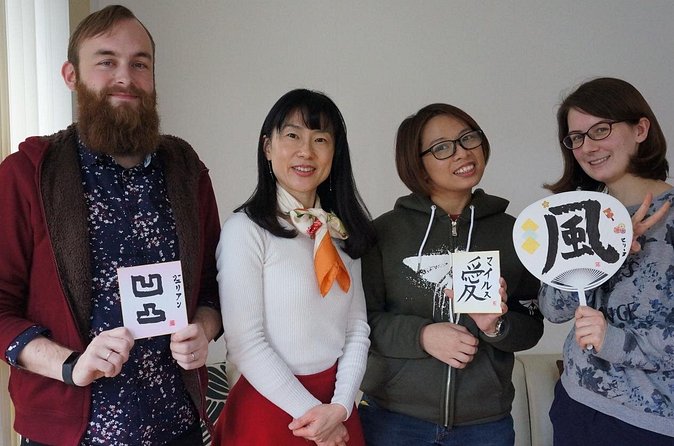
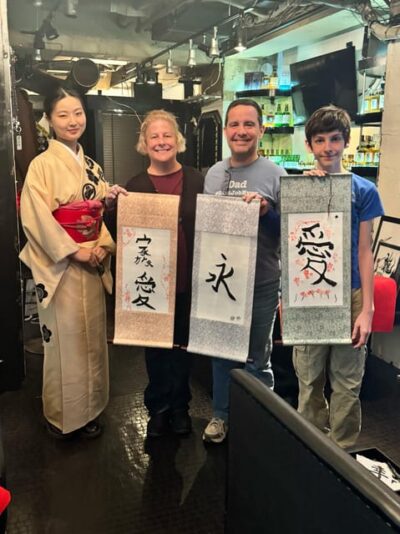
The final stage is the reason many people choose this experience. After practicing, you write a word or character on Japanese traditional paper. Depending on the arrangement, your finished work may be presented on colored paper or a fan.
This is not a mass-produced souvenir. You make it yourself, with guidance from the instructor. It may not be perfect, and that is part of its charm. The brush marks show where you were learning, and the finished item carries a memory of the class rather than simply a shop receipt.
The activity is especially appealing if you want a small, easy-to-pack reminder of Japan. A fan or piece of paper takes up very little room in luggage, yet it has a clear connection to the place and the activity. You can also use the lesson to write a word or character with personal meaning, though the supplied details do not specify a fixed menu of choices.
Ask Maki during the lesson if you want to understand the meaning or cultural context of the word you choose. She is open to explaining Japanese culture, and that conversation is one of the advantages of a private class.
What makes Maki’s teaching effective
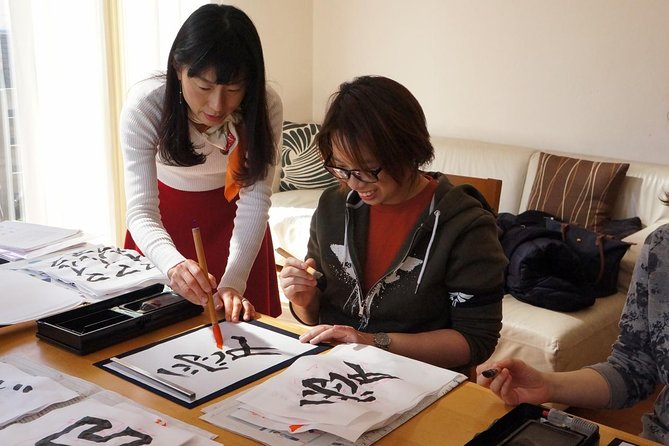
Maki’s strongest feature as an instructor is her personal attention. She speaks English well enough to explain the techniques carefully and to discuss the cultural background of calligraphy. Her teaching is described as friendly, professional, and clear.
I would especially value her willingness to repeat instructions. Brushwork can feel unfamiliar at first, and a single demonstration may not be enough. A teacher who calmly shows the movement again can make the difference between feeling clumsy and beginning to understand the art.
The setting also shapes the lesson. The living room is not a formal cultural institution, but it gives you a direct connection to a local host. You can ask questions in a relaxed way, try drinks, and talk about Japan beyond the narrow mechanics of writing.
That personal tone does not mean the class is casual in a careless way. Maki lays out the equipment and guides the session in an organized order. You learn the tools, posture, brush grip, practice method, and final writing process as connected steps.
Is $56 a fair price?
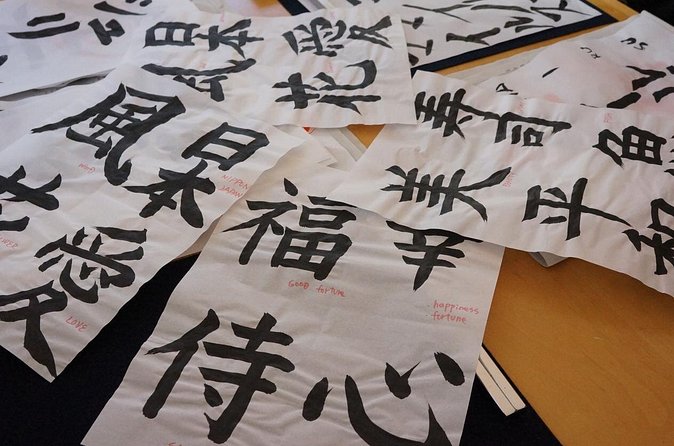
At $56, the experience costs more than a basic souvenir workshop, but the comparison is not quite fair. You are paying for a private 90-minute lesson, the instructor’s time, all calligraphy equipment, practice supplies, a final paper or fan, and consumption tax.
The private format is the main value. If you are traveling with a small group, the lesson gives your party direct access to the teacher rather than placing you in a crowded class. That can make the instruction more useful, especially for complete beginners.
The keepsake adds value, too. You are not only watching a demonstration or taking a few practice strokes. You finish with your own piece of calligraphy. For someone interested in Japanese culture, that personal result may be worth more than a standard purchased souvenir.
The price may feel less attractive if you only want a quick photo opportunity or a short introduction. The class requires concentration and participation. You should book it because you want to learn the basics and make something, not because you expect a fast stop between major Tokyo sights.
Who will enjoy this private class?
This experience suits you best if you want a cultural activity with real instruction. It is a good match for:
- First-time visitors who want more than temples, shopping, and food
- Families looking for a quiet activity everyone can try
- Couples seeking a personal souvenir made during the trip
- Solo visitors who enjoy learning directly from a local teacher
- People already interested in Japanese calligraphy or writing
- Anyone who prefers a small private group to a large workshop
Children and adults can participate, since most participants are able to take part and the activity is private. The supplied information does not set a minimum age, so check directly if you are booking for very young children.
You should think twice if you need a fully scheduled sightseeing experience. There is no private transportation, and the activity is centered on a 90-minute lesson at the meeting point. It is best treated as a cultural appointment, not a general Tokyo tour.
Practical details for a smooth visit
Confirmation is provided when you book. The experience is private, so only your group participates. That gives you more freedom to ask questions and work at a comfortable pace.
The activity begins and ends at the meeting point near Yoga Station. Plan your public transportation separately, since private transfers are not included. The address is in Yoga, Setagaya City, at 2 Chome-39 Yoga, Tokyo 158-0097.
All the main supplies are included: the experience fee, calligraphy tools, colored paper or a fan, practice paper, consumable materials, and consumption tax. You do not need to buy ink, brushes, or paper in advance.
The cancellation terms are straightforward. You can cancel for a full refund up to 24 hours before the experience start time. Cancellations or changes made less than 24 hours before the start time are not accepted for a refund, and the cut-off follows local Tokyo time.
Should you book this calligraphy experience?
Book it if you want a calm, personal introduction to Japanese culture and would like to make something with your own hands. Maki’s patient English instruction, private format, and home setting give the lesson a personal quality that a standard demonstration cannot provide.
The best reason to go is the combination of careful technique and local contact. You learn how to hold the brush and form a character, but you also have time to ask about Japanese writing and daily culture. The finished paper or fan gives you a physical reminder of that effort.
Skip it if you are looking only for a short activity near a major attraction, or if you would rather spend your Tokyo time moving between sights. For everyone else, $56 is a reasonable price for 90 minutes of individual guidance, included materials, and a handmade souvenir that you create yourself.
FAQ
How long does the Japanese calligraphy class last?
The activity lasts approximately 1 hour and 30 minutes.
Where does the class take place?
The class takes place in Maki’s home near Yoga Station in Setagaya City, Tokyo. The meeting address is 2 Chome-39 Yoga, Setagaya City, Tokyo 158-0097, Japan.
Is this a private experience?
Yes. Only your group participates in the activity.
What will I learn during the class?
You will learn about Japanese writing systems and calligraphy tools, along with correct posture and how to hold the brush. You will also practice writing a word or character on traditional Japanese paper.
Are calligraphy supplies included?
Yes. The experience includes calligraphy tools, practice paper, colored paper or a fan, consumable supplies, and consumption tax.
Is transportation included?
No. Private transportation is not included. The activity begins and ends at the meeting point near Yoga Station.
Can I cancel for a full refund?
Yes. You can cancel at least 24 hours before the start time for a full refund. Cancellations or changes made less than 24 hours before the start time are not accepted for a refund.
Newly reviewed around Tokyo
- Tokyo Asakusa:Calligraphy & Make T-shirt Activity★ 5.0 · 62 reviews
- Intercity Shuttle, Tokyo to Haneda /Narita /Yokohama /Makuhari★ 5.0 · 5 reviews
- 1 Hour Travel around Tokyo with a Professional Photographer★ 5.0 · 3 reviews
- Travel Tokyo with Your Own Personal Photographer★ 5.0 · 43 reviews
- Train in Samurai Swordsmanship and Defeat the Demon in Tokyo★ 5.0 · 5 reviews
- Shuttle Van 6hr Tokyo Tour to-and-from Tokyo, Yokohama and Narita★ 5.0 · 9 reviews
- Kickboxing & Body Training with EX-Pro Fighter★ 5.0 · 4 reviews
- Traditional Japanese Knife Sharpening Class★ 5.0 · 18 reviews
Tokyo Calligraphy Classes, compared.
Let’s experience calligraphy in YANAKA, Taito-ku, TOKYO !!
Read our review →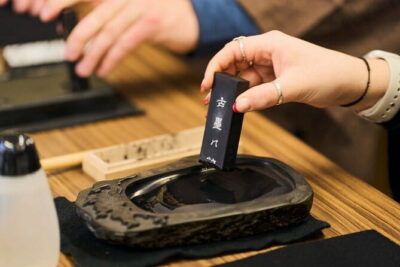
Calligraphy Workshop & Original T-Shirt Creation
Read our review →
Calligraphy Workshop & Original T-Shirt Creation
Read our review →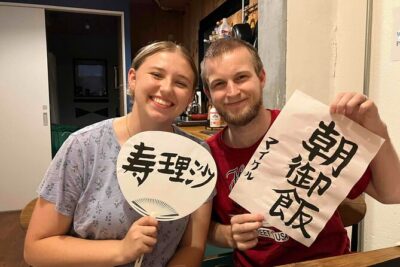
Calligraphy &Make your original folding fan in Asakusa
Read our review →
Tokyo Asakusa:Calligraphy & Make T-shirt Activity
Read our review →Browse the lists this tour appears in