
Reviewed · TOKYO IMPERIAL PALACE TOURS
Tokyo Imperial Palace with Kagurazaka Alley Tour
Tokyo’s grand center and its quiet old lanes rarely appear in the same walking tour. This one links Tokyo Station and the Imperial Palace with Kagurazaka, a former geisha district where narrow alleys, small eateries, and old castle-era traces give you a different feel for the city.
I like the small maximum of eight people, which leaves room for questions and makes a private tour possible if no one else books. I also like the guides’ personal touch. Sho has led lively palace walks, Aya has helped with group photos, and another guide connected plant life, Buddhist tradition, and architecture in a way that made the setting easier to understand.
The main drawback is simple: the Imperial Palace itself is not open to the public, so this is a walking tour around palace grounds and related landmarks, not a palace interior visit. The 3.5-hour route also involves steady walking and ends in Kagurazaka, far from the starting point.
Key points before you book
- A rare Tokyo pairing: Begin beside Tokyo Station and the Imperial Palace, then finish among Kagurazaka’s narrow old lanes.
- A maximum of eight people: The small group suits anyone who wants to ask questions without shouting over a crowd.
- Guides add cultural context: Expect more than dates and names, with explanations of Japanese history, shrine customs, architecture, plants, and local life.
- Kagurazaka is the tour’s special turn: Geisha Alley, Hyogo Yokocho, and Kakurenbo Yokocho offer a look at old Tokyo away from the main road.
- The route is one-way: You start at the Shin-Marunouchi Building at 9 a.m. and finish near a FamilyMart on Kagurazaka’s main street.
- Plan ahead: The tour is often booked about 42 days before the start date, and free cancellation is available until 24 hours before departure.
Starting beside Tokyo Station at 9 a.m.
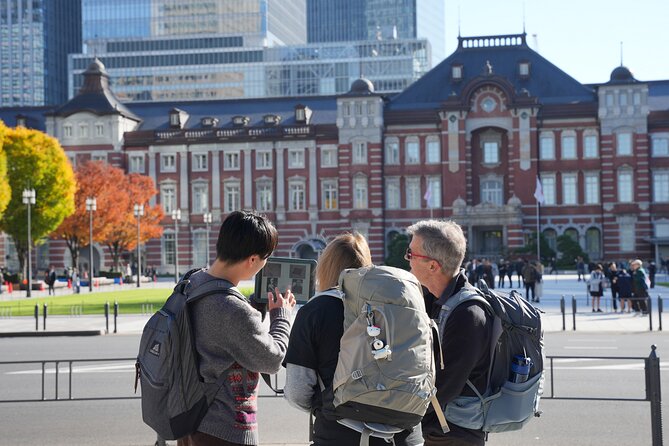
Meet at the Shin-Marunouchi Building, 1-chōme-5-1 Marunouchi, at 9 a.m. This is a useful place to begin because Tokyo Station gives you an immediate sense of the capital’s scale. Rail lines from across Japan converge here, yet the Marunouchi district around the station has broad streets, office towers, and formal civic buildings.
The first stop lasts only about five minutes, so treat it as an orientation rather than a full station visit. Your guide can help place Tokyo Station within the city before the walk moves toward the Imperial Palace.
That short opening also keeps the tour from spending too much time in a place you can easily revisit alone. If you want extensive photographs of the station façade or time inside the station’s shops, arrive early. The scheduled walk is designed to keep moving.
More Imperial Palace tours in Tokyo:
- Tokyo: Imperial Palace and Shogun Historical Walking Tour
★ 5.0 · 2,251 reviews - Tokyo: Imperial Palace Japanese History Walking Tour
★ 4.9 · 987 reviews - Tokyo: Imperial Palace and Shogun Walking Tour
★ 4.9 · 935 reviews
What the Imperial Palace stop really offers
The Imperial Palace is the official residence of Japan’s emperor. It sits at the center of Tokyo, surrounded by moats, gardens, broad park areas, and reminders of the former Edo Castle.
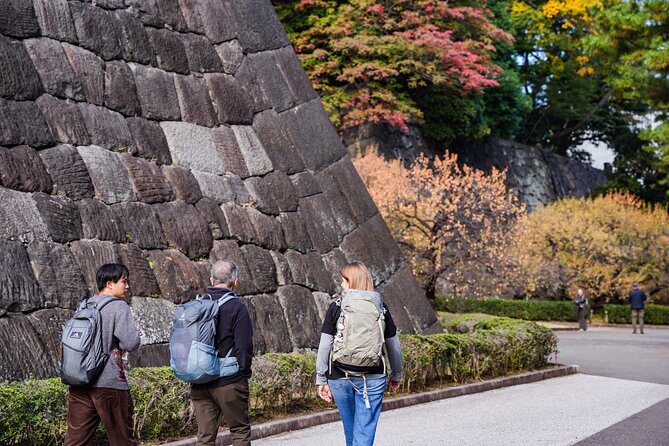
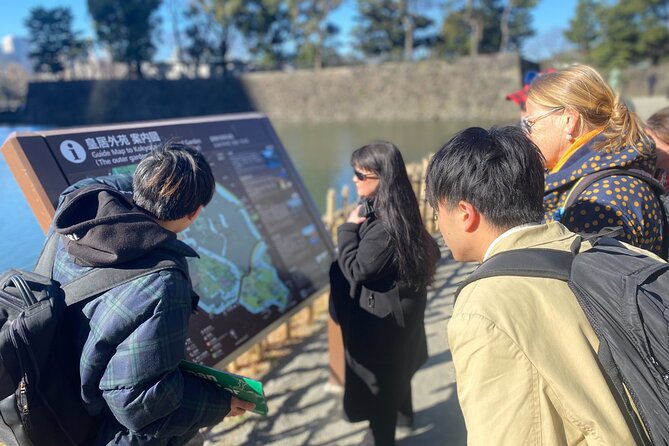
You will not enter the palace itself on this experience. That matters if you are hoping to see imperial rooms or indoor palace displays. Instead, the guide explains the setting from accessible areas and helps you read the moats, gates, stonework, gardens, and surrounding spaces.
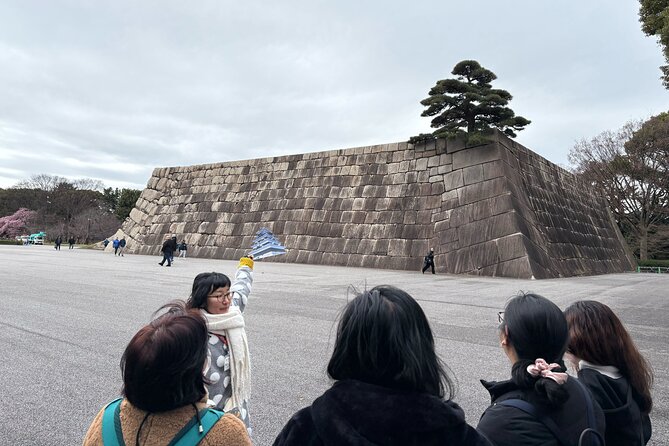
The scheduled palace portion lasts about 55 minutes, making it the longest single stop. That gives your guide time to explain how the Tokugawa Shogunate shaped Edo, the former name for Tokyo, and how the city grew around the castle.
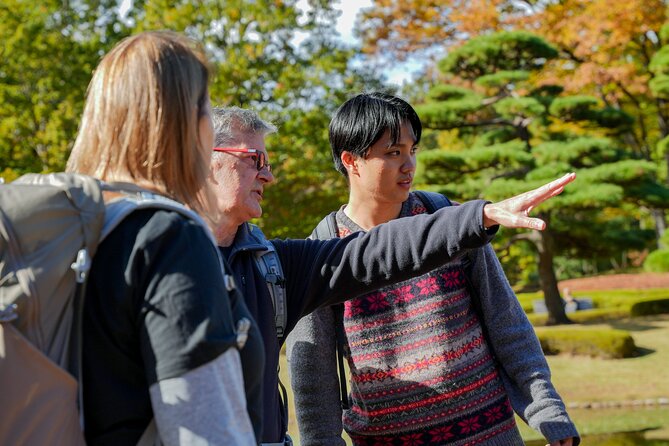
This is where a good guide makes a real difference. A palace wall can look like just another handsome piece of masonry if you do not know what it protected or how it fitted into castle defenses. One guide, Sho, has been praised for bringing both palace and wider Japanese history to life, even on a chilly morning. Another guide has pointed out details such as the meaning of fish decorations on rooftops, the sort of small symbol you could easily miss on your own.
You may also hear about the gardens and plant life around the palace. A young guide on one walk used plants and Buddhist tradition to explain the link between nature, architecture, and religious ideas. The value here is not simply seeing a famous site. It is learning what to look for.
A brief look at the Nippon Budokan
The route includes the Nippon Budokan in Kitanomaru Park. It was built in 1964 for martial arts events during the Tokyo Olympics and is now used for many kinds of events, including concerts.
The timing for this stop is not listed, so expect it to be a brief look rather than a full arena visit. Its place on the route adds useful modern context. The Imperial Palace area is not frozen in the Edo period. It also contains major public buildings tied to Japan’s postwar identity and popular culture.
If you are especially interested in the Budokan as a concert venue or martial arts site, ask your guide about it during the walk. The small group makes that sort of question practical.
Tokyo Daijingu and the rhythm of a Shinto shrine
Tokyo Daijingu is scheduled for about 15 minutes. The shrine was established in 1880 and is dedicated to Amaterasu, the sun goddess, along with spirits connected to Japan’s imperial family.
A short shrine stop can be more useful than a long one if your guide explains what you are seeing. You might learn how the shrine fits into Japanese religious life, how its imperial connections differ from the palace’s political role, and how to behave respectfully in a Shinto setting.
Do not expect a huge complex or a long ceremony. The appeal is the contrast. After the formal scale of the palace grounds, Tokyo Daijingu offers a more focused place to pause and consider the spiritual side of the capital.
The visit also helps bridge the two halves of the day. The palace area introduces power and government. The shrine brings in worship, tradition, and daily custom. Then the tour heads toward Kagurazaka, where old entertainment districts and ordinary neighborhood life take over.
A completely different kind of day in Tokyo:
- Mt Fuji and Hakone 1-Day Bus Tour Return by Bullet Train
★ 5.0 · 26,383 reviews - 1-Day Tokyo Bus Tour
★ 5.0 · 14,250 reviews - Tokyo: teamLab Planets TOKYO Digital Art Museum Entry Ticket
★ 4.6 · 9,779 reviews - Mt Fuji & Hakone Cruise, Drum Show Bullet Train 1 Day from Tokyo
★ 4.0 · 7,413 reviews
Entering Kagurazaka’s former geisha district
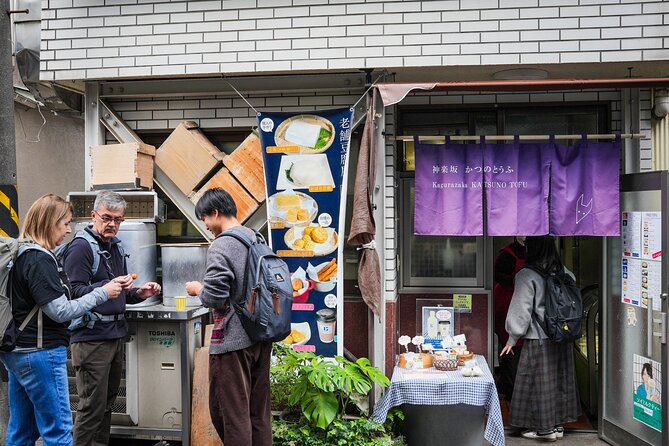
Kagurazaka is the part of the route that most clearly changes the pace. Its main street has restaurants, cafés, and shops, but the side lanes are the real reason to come. They twist away from the traffic into a quieter setting of narrow passages and traditional-looking buildings.
The neighborhood was once associated with geisha culture. Today, it mixes old lanes with contemporary dining and small businesses. That mixture makes it a useful place to understand Tokyo as it exists now, not as a museum display.
The scheduled Kagurazaka stop lasts about 30 minutes, followed by several smaller places of interest. That does not sound long, but a walking tour can cover a lot in a compact district. Your guide points out the lanes and explains their connection to the Edo period and the Tokugawa Shogunate.
The route ends at 3-chōme-2-202 Kagurazaka, near the main street and close to a FamilyMart convenience store. This is a practical finish. You can continue exploring, stop for food, or use local transport after the guided walk.
Geisha Alley, Hyogo Yokocho, and Kakurenbo Yokocho
Geisha Alley retains a nostalgic feel, with narrow lanes and traditional teahouses. The name points to the neighborhood’s former entertainment culture, though today you should think of it as a historic street rather than a guaranteed place to see geisha.
Hyogo Yokocho has an old-fashioned character, with small eateries and traditional shops tucked into a tight passage. It is the kind of place that rewards a slower walk and a guide who can explain what the lanes once meant within the city.
Kakurenbo Yokocho is another narrow alley lined with small bars and eateries. Its quiet, intimate mood differs from the large dining streets elsewhere in Tokyo. You will not be stopping for a full meal as part of the tour, but the guide can help you notice places worth returning to later.
These lanes are also working neighborhoods. Be considerate with cameras, keep your voice down, and avoid blocking entrances. A guided visit is useful here because it helps you see the area without treating it like a stage set.
The old castle gate at Ushigome Mitsuke
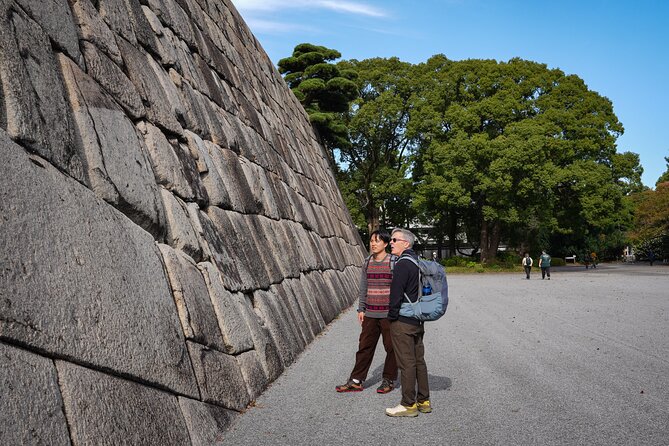
Ushigome Mitsuke was once one of the gates of Edo Castle. The gate itself is gone, but the site remains a clue to how the old castle city was organized and defended.
This is a good example of the tour’s wider approach. You are not only visiting complete monuments. You are learning to read traces, locations, and street patterns. A vanished gate may sound less impressive than a surviving castle wall, but it can explain why a neighborhood developed where it did.
The exact time at Ushigome Mitsuke is not given, so regard it as part of the walking route rather than a separate long stop. Comfortable shoes matter. You will cover a mixture of major avenues and compact lanes over roughly three and a half hours.
How much personal attention should you expect?
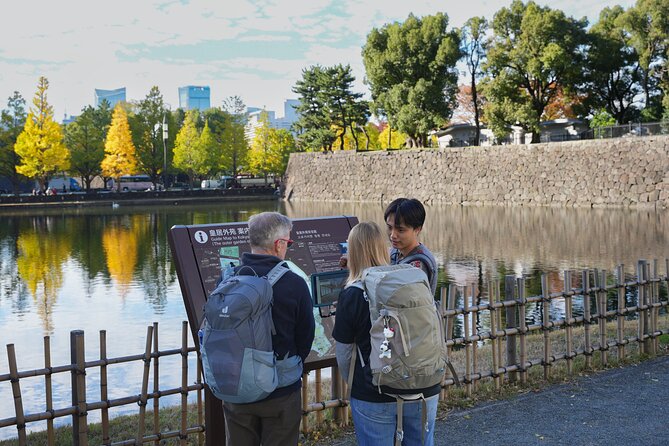
The group is limited to eight people. That is small enough for a guide to answer individual questions and adjust explanations when the group shows interest in a certain subject.
The experience can occasionally become a private tour if you are the only booking. One person had that experience and found the extra question time especially useful. You should not book on the assumption that the tour will be private, but the possibility is a pleasant benefit.
The guides also seem to bring different strengths. Sho has been described as energetic and strong on palace and Japanese history. Aya has been praised for her experience and for taking useful group pictures. Another guide brought together botany, Buddhist tradition, and architecture.
Since guide assignment is not specified in advance, you should view these names as examples of the kind of host you may receive, not a guarantee. The important point is the style of guiding: explanation, conversation, and attention to small details rather than a fast march from one photo stop to the next.
Is $52.84 a fair price?
At $52.84 per person, this is not the cheapest way to see the Imperial Palace area. You can walk around many of these public areas on your own at no admission cost.
The value comes from the route and the interpretation. You are paying for a three-and-a-half-hour walk that connects places you might otherwise visit separately: Tokyo Station, the palace area, the Nippon Budokan, Tokyo Daijingu, and the Kagurazaka lanes.
The price makes the most sense if you want context. A self-guided walk can show you a moat, shrine, alley, and old castle site. A good guide explains why they matter, points out architectural symbols, and helps connect Edo-period power with present-day Tokyo.
It is also useful early in a Japan trip. The local tips can help you understand shrine manners, neighborhood food streets, and the city’s historical layout. If you already know Tokyo well and prefer wandering alone, the fee may feel high because the stops themselves are free.
The small group improves the value. Eight people is far more manageable than a large coach group, and the chance of a private departure adds some flexibility.
Timing, walking, and practical details
The tour starts at 9 a.m. and lasts about 3 hours 30 minutes. A morning start suits the palace area, and the route finishes around lunchtime in Kagurazaka, where you can continue with your own plans.
The tour uses a mobile ticket. Confirmation arrives when you book, and the route is near public transportation. The end point is close to a FamilyMart on Kagurazaka’s main street, which makes it easier to identify than a vague alley entrance.
Most people can take part, but you should be ready for a sustained city walk. The route includes broad streets, park areas, palace surroundings, and narrow lanes. Weather can affect comfort. One praised walk took place on a chilly morning, so bring layers when temperatures are low.
Plan ahead if your dates are fixed. This experience is often booked about 42 days in advance, and the group limit is eight. You can cancel for a full refund up to 24 hours before the start time. Changes or cancellations inside that window are not accepted.
Who should book this Tokyo walk?
I would choose this tour if you want history explained in plain language, prefer small groups, and like seeing how famous sights connect to ordinary neighborhoods.
It suits first-time visitors who want a strong central Tokyo orientation, especially those curious about the Edo period, the Tokugawa Shogunate, Shinto practice, and old entertainment districts. It also works well for repeat visitors who have seen the major areas but have not explored Kagurazaka’s back lanes.
I would skip it if your main goal is entering the Imperial Palace, spending hours inside Tokyo Station, or visiting the Nippon Budokan for a full event or tour. None of those is the central purpose here.
Should you book the Imperial Palace and Kagurazaka tour?
Book it if you value a guide’s explanations as much as the sights themselves. The strongest part is the contrast between imperial grounds and quiet Kagurazaka alleys, with Tokyo Daijingu and old castle defenses filling the gap.
At $52.84, the tour is worth it for personal context, a small group, and an efficient route through several parts of central Tokyo. Just remember that the palace interior is not included, the walk is one-way, and much of the appeal comes from looking closely rather than checking off grand attractions.
FAQ
Where does the tour start?
It starts at 9 a.m. at the Shin-Marunouchi Building, 1-chōme-5-1 Marunouchi, Chiyoda City, Tokyo 100-6590, near Tokyo Station.
Where does the tour end?
The tour ends at 3-chōme-2-202 Kagurazaka, Shinjuku City, Tokyo 162-0825, near Kagurazaka’s main street and close to a FamilyMart convenience store.
How long does the tour last?
The experience lasts approximately 3 hours and 30 minutes.
How many people can join?
The tour has a maximum of eight participants.
Can I enter the Imperial Palace?
The Imperial Palace itself is not open to the public on this experience. The tour visits the surrounding palace area, gardens, moats, and related landmarks.
Is the tour available with a mobile ticket?
Yes. A mobile ticket is provided, and confirmation is received at the time of booking.
Can I cancel for a full refund?
Yes. You can cancel at least 24 hours before the experience start time for a full refund. Cancellations or changes made less than 24 hours before the start time are not accepted.
Newly reviewed around Tokyo
- Tokyo Asakusa:Calligraphy & Make T-shirt Activity★ 5.0 · 62 reviews
- Intercity Shuttle, Tokyo to Haneda /Narita /Yokohama /Makuhari★ 5.0 · 5 reviews
- 1 Hour Travel around Tokyo with a Professional Photographer★ 5.0 · 3 reviews
- Travel Tokyo with Your Own Personal Photographer★ 5.0 · 43 reviews
- Train in Samurai Swordsmanship and Defeat the Demon in Tokyo★ 5.0 · 5 reviews
- Shuttle Van 6hr Tokyo Tour to-and-from Tokyo, Yokohama and Narita★ 5.0 · 9 reviews
- Kickboxing & Body Training with EX-Pro Fighter★ 5.0 · 4 reviews
- Traditional Japanese Knife Sharpening Class★ 5.0 · 18 reviews
Tokyo Imperial Palace Tours, compared.

Imperial Palace and Shogun Historical Walking Tour
Read our review →
Imperial Palace East Garden and Edo Castle Walking Tour in Tokyo
Read our review →
Imperial Palace, Sensō-ji Temple, & Tokyo Tower Tour
Read our review →
Tokyo Castle, Imperial Palace, Shogun & Garden Walking Tour
Read our review →
Edo Castle & East Garden of the Imperial Palace Tour
Read our review →Browse the lists this tour appears in