
Reviewed · TOKYO IMPERIAL PALACE TOURS
Imperial Palace run with fun trivia by an Imperial Palace geek
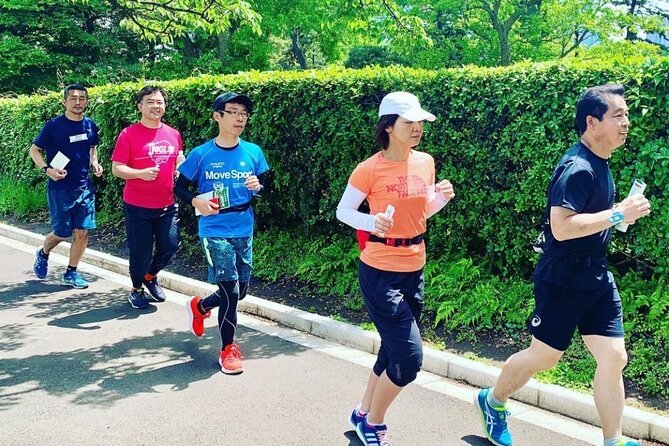
The best part of this experience is that it turns Tokyo’s famous Imperial Palace running route into a guided history walk with exercise mixed in. You run, walk, pause for stories, and take photos instead of simply circling the palace on your own. Guide YUKO brings particular enthusiasm to the palace and its running culture.
I like the small maximum group of eight, which gives you room to ask questions. I also like the early 8:30 a.m. start, when the route should feel calmer and cooler than it does later in the day. The main drawback is the price: $90 is a serious charge for a run, especially since locker and shower use costs another ¥1,500.
Key points to know
- A run with regular stops: You will not run continuously for two and a half hours. The route includes walking, photo stops, explanations, and pauses at major sights.
- Guide YUKO’s Imperial Palace focus: Expect trivia about gates, clocks, Edo Castle, cherry trees, Tokyo Station, the Emperor, and the Tokyo Marathon.
- Early start at 8:30 a.m.: This helps avoid some daytime crowds and gives you a useful start to your Tokyo sightseeing day.
- East Gardens included: You enter through Otemon Gate and see Fujimi-yagura and the stone base of the former Edo Castle keep.
- Japanese and simple English: The tour works for Japanese speakers and for visitors comfortable with straightforward English.
- Bring extra money for JOGLIS: Lockers and showers cost ¥1,500, while running clothes, shoes, and towels can also be rented for a fee.
Why this Imperial Palace run is different
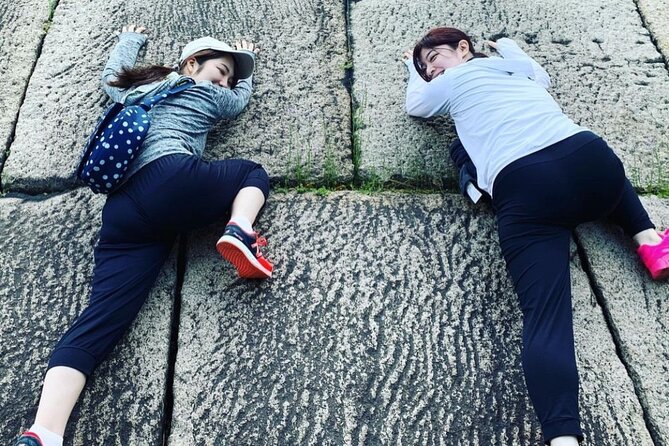
Many visitors see the Imperial Palace from the outside, take a photo at Nijubashi Bridge, and move on. This activity gives you a more active way to understand the area. You follow part of the well-known Imperial Palace running route, but the guide breaks it up with history, local customs, and small details that are easy to miss alone.
The tone is casual rather than athletic. You need a moderate level of fitness, but the plan is not a race. You can walk if running is not your thing, and the schedule allows plenty of time to stop. That makes it a good choice if you want exercise but do not want to spend the morning trying to keep up with a serious runner.
The group limit of eight matters. A small group makes it easier to hear the guide near busy roads and palace gates. It also means you can ask direct questions about the palace, Japanese attitudes toward running, or the sights along the route without waiting for a large crowd to settle down.
More Imperial Palace tours in Tokyo:
- Tokyo: Imperial Palace and Shogun Historical Walking Tour
★ 5.0 · 2,251 reviews - Tokyo: Imperial Palace Japanese History Walking Tour
★ 4.9 · 987 reviews - Tokyo: Imperial Palace and Shogun Walking Tour
★ 4.9 · 935 reviews
Starting at JOGLIS in Kojimachi
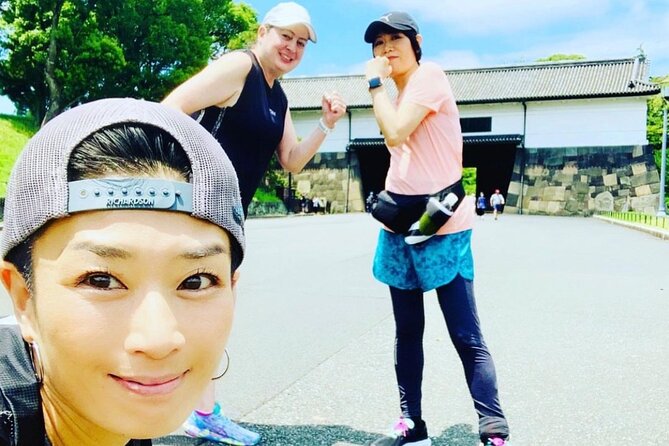
Meet at JOGLIS, at FM Center Basement 1F in Kojimachi, Chiyoda City. The tour begins at 8:30 a.m. with a briefing about the Imperial Palace, the route, and the rules for running around the palace.
JOGLIS is also the practical base for your morning. If you want to change clothes, use a locker, or shower afterward, the facility costs ¥1,500 per person. That fee is not included in the tour price. Running clothes, shoes, and towels are available to rent for an additional charge, so check your needs before arriving.
The meeting point is useful for anyone who wants to begin the day already dressed for exercise. If you are carrying luggage or sightseeing gear, the locker fee may be worth paying. If you can arrive in running clothes with only a small bag, you may prefer to skip the extra cost.
Hanzomon Gate and Miyake-zaka
The route begins near Hanzomon, one of the Imperial Palace entrances. From here, you see the National Theatre and the Diet Building as you descend Miyake-zaka.
The slope is described as one of Tokyo’s most beautiful, and this opening section gives the tour a strong sense of place before the palace walls and gates take over. You are not simply looking at an isolated monument. You are moving through the government district, the former castle grounds, and the modern capital at the same time.
This is also where the relaxed pace becomes clear. The route uses running, walking, and stops rather than one constant speed. If you prefer a gentle morning outing, you can focus on the explanations and treat the exercise as a bonus.
Sakurada-mon Gate and the runner’s clock
Sakurada-mon is the largest gate on the route. Passing beneath it gives you a close look at the scale of the old defensive entrance, and the guide connects the area with Japanese beliefs about Mount Fuji and the idea of the Imperial Palace as a place that can restore energy.
Near the gate, you stop again to hear about a clock in Sakuradamon Square. This is the sort of small detail that gives the route its personality. You may run past a clock or a meeting point without wondering why it matters. With a guide, ordinary features become part of the running culture around the palace.
The repeated stops also mean you should not expect a personal best time. If your main goal is speed or uninterrupted training, this format will frustrate you. If you want sightseeing with movement, the pauses are exactly what make the activity work.
A completely different kind of day in Tokyo:
- Mt Fuji and Hakone 1-Day Bus Tour Return by Bullet Train
★ 5.0 · 26,383 reviews - 1-Day Tokyo Bus Tour
★ 5.0 · 14,250 reviews - Tokyo: teamLab Planets TOKYO Digital Art Museum Entry Ticket
★ 4.6 · 9,779 reviews - Mt Fuji & Hakone Cruise, Drum Show Bullet Train 1 Day from Tokyo
★ 4.0 · 7,413 reviews
Nijubashi Bridge and Gyoko-dori Avenue
Nijubashi, or the Two-tiered Bridge, is one of the palace area’s most recognizable photo spots. The tour pauses here for a commemorative picture, giving you time to enjoy the view without trying to photograph it while moving.
You then continue to Gyoko-dori Avenue, associated with the finish area of the Tokyo Marathon. Here, the guide discusses secrets connected with Tokyo Station, the Emperor, and the marathon. You also get the chance to pose as if you have just crossed a marathon finish line.
This section is especially useful if you are interested in how Tokyo uses the same central spaces for ceremony, daily commuting, tourism, and mass sporting events. The route connects grand symbols with practical city life. You get a photo stop, but you also learn why this stretch matters to runners.
Entering the East Gardens through Otemon Gate
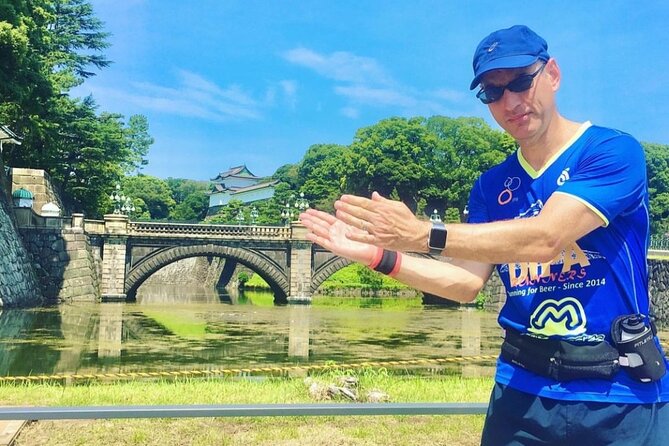
At Otemon Gate, you enter the East Gardens of the Imperial Palace. This was the main gate of Edo Castle, so the setting changes from an urban running route to the remains of a major castle complex.
Before entering, you go through a baggage inspection. Allow time for this pause and keep your belongings manageable. The inspection is a normal part of entering the garden, but it means the tour is not simply a free-flowing run.
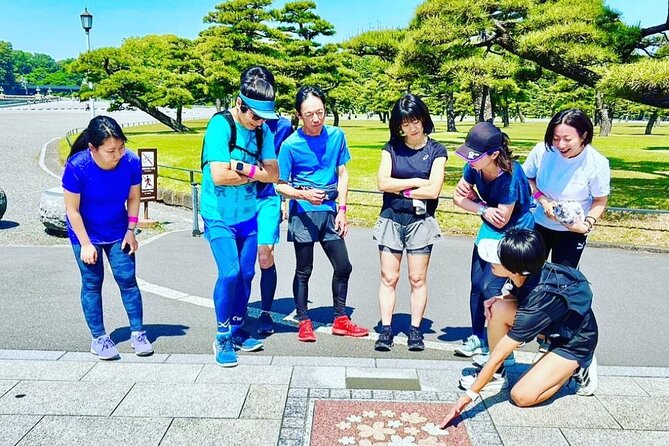
Inside, you see a shachihoko, the fish-shaped roof ornament associated with Edo Castle. It is a compact but memorable detail, especially if you have seen similar ornaments on Japanese castles or temples. The guide uses these features to connect what remains today with the former castle compound.
Fujimi-yagura and the old castle keep
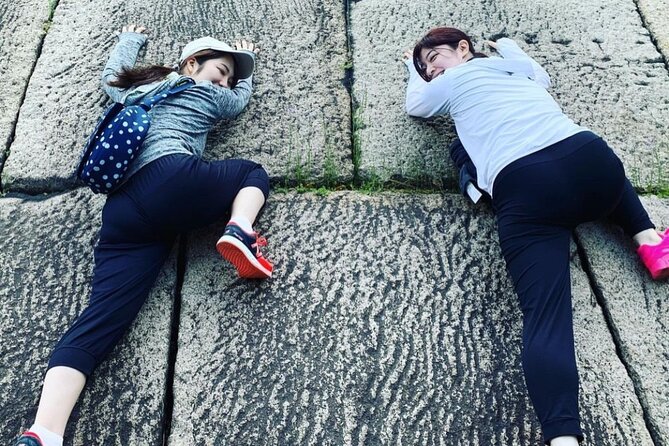
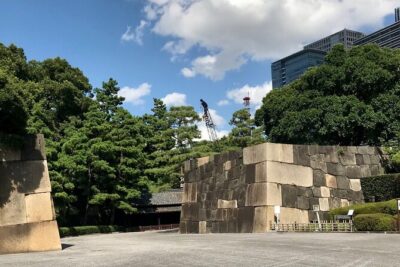
Fujimi-yagura is a surviving turret and is treated on the tour as a small castle. It helps you picture the defensive structures that once filled the Edo Castle grounds.
The next major stop is Tenshudai, the remains of the main tower. The original castle keep was destroyed by fire, so you will not see a standing tower. Instead, you see the stone walls and a reconstructed model that helps explain the scale of what once occupied the site.
This is one of the strongest reasons to choose the guided version rather than simply running around the palace. The surviving stones can look abstract if you do not know what they represent. A guide’s explanation turns them into evidence of the castle that once dominated the center of Tokyo.
Kitahanebashi Gate and the uphill return

You leave the East Gardens through Kitahanebashi Gate, once connected with the drawbridge of Edo Castle. After this point, the route begins to climb.
The guide lets you run at your own pace on the uphill section. That is helpful because the group may include people with different fitness levels. You can slow down, walk, or keep moving without treating the climb as a test.
This portion also gives the outing a more genuine running feel. The earlier sections are full of stops and stories, while the return includes a stretch where you can settle into your own rhythm. You should still expect the group to regroup as needed.
Daikancho-dori and Chidorigafuchi
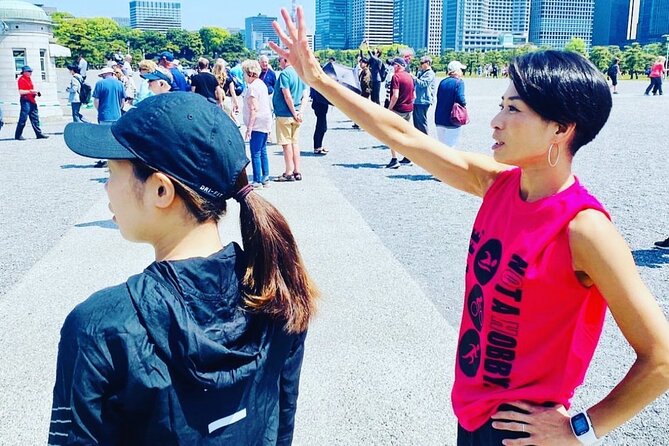
Daikancho-dori follows a street associated with daimyo residences during the Edo period. It is also known as a cherry blossom viewing area, so the guide adds context about how Japanese people value cherry trees.
The route continues to Chidorigafuchi Park, another famous cherry blossom spot. Even outside blossom season, the explanation helps you understand why the area matters. The tour does not rely only on the palace buildings. It also shows how historic streets, parks, seasonal customs, and exercise fit together around the moat.
For many visitors, this will be a quieter and more reflective part of the circuit. The route has already covered major gates, bridges, castle remains, and city landmarks. These final stops bring attention to the trees and open spaces that make the palace route popular with local runners.
What the two and a half hours feel like
The advertised duration is about two hours and thirty minutes. The listed stops add up to a full morning with briefing, running, walking, explanations, inspections, photos, and time in the East Gardens.
Do not read the word run as a promise of nonstop exercise. The schedule includes many ten-minute stops, a twenty-minute introduction at Hanzomon, a twenty-minute visit around the castle keep, and a five-minute finish at JOGLIS. The result is closer to a guided active tour than a formal training session.
That balance is a strength for casual runners and first-time visitors. You can learn the route without feeling pressured. It also helps if you want to ask questions. The tradeoff is that serious runners may find the pace too broken up for a proper workout.
Language, group size, and physical demands
The tour is conducted in Japanese and simple English. This makes it suitable for Japanese speakers and for English speakers who are comfortable with clear, basic explanations. The subject matter includes history and trivia, so you should be ready for some information delivered at a straightforward pace.
The maximum group size is eight. That is small enough for personal questions and for the guide to keep track of the group during road crossings, gates, garden entry, and uphill sections.
You should have a moderate level of physical fitness. The route includes running and an uphill return, but you can walk if needed. Wear suitable running shoes and clothes, or arrange rentals through JOGLIS for a fee. A towel is also available to rent if you need one.
Is $90 good value?
At $90, this is not a cheap way to circle the Imperial Palace. You are paying for a small-group guide, a structured route, access to the East Gardens portion of the outing, and the chance to ask questions along the way.
The value is strongest if you would otherwise run alone and miss the historical details. It is also useful if you want a morning activity that combines sightseeing with exercise and removes the guesswork from finding the route.
The value is weaker if you only want a quick look at Nijubashi Bridge or a simple run. You can see several exterior palace sights without booking a guided experience. Add the ¥1,500 JOGLIS charge if you need a locker and shower, plus any rental fees for clothes, shoes, or towels.
The small group and the guide’s enthusiasm help justify the cost for people who care about the palace, Edo Castle, or Tokyo’s running culture. Guide YUKO clearly treats the Imperial Palace as a personal specialty, and that focus is central to the character of the tour.
Who should book this morning outing?
I would choose this for a casual runner who wants context, a visitor with one free morning in central Tokyo, or anyone who likes active sightseeing more than a standard bus or walking tour. It also suits a first-time Imperial Palace runner who wants to learn the rules and route before setting out alone.
You do not need to be a marathon runner. In fact, the frequent pauses make the tour friendlier to ordinary fitness levels. The ability to walk gives you some control over the pace.
I would skip it if your priority is a fast training run, a late start, or a low-cost palace visit. The 8:30 a.m. meeting time is fixed, and the tour’s educational stops are part of the product, not an interruption to it.
Cancellation is free up to 24 hours before the start time. Changes or cancellations inside 24 hours are not refunded, and poor weather may lead to a different date or a full refund.
Should you book the Imperial Palace run?
Book it if you want to combine exercise, palace history, and a small-group experience in one morning. The route gives you more than a loop around the moat, with Sakurada-mon, Nijubashi, Gyoko-dori, Otemon Gate, Fujimi-yagura, the old castle keep, Kitahanebashi, and Chidorigafuchi all included.
The smartest way to approach it is as a guided run-walk, not a workout class. Bring suitable clothes, decide in advance if you need the JOGLIS locker and shower, and arrive ready for a few hours of movement and frequent stops. For an Imperial Palace enthusiast, the chance to ask questions and hear YUKO’s trivia may be worth the price. For everyone else, compare the cost with a self-guided run before booking.
FAQ
Where does the Imperial Palace run begin?
The activity begins at JOGLIS, at FM Center Basement 1F, 1-chome 7 Kojimachi, Chiyoda City, Tokyo 102-0083.
What time does the tour start?
The tour starts at 8:30 a.m.
How long does the experience last?
The experience lasts approximately two hours and thirty minutes.
Does the tour finish at the starting point?
Yes. The activity ends back at JOGLIS.
Can I walk instead of run?
Yes. The experience is suitable for casual runners, and you can walk if running is not your preference.
What languages are used?
The tour is conducted in Japanese and simple English.
How many people can join?
The maximum group size is eight people.
Are lockers and showers included?
No. Locker and shower use at JOGLIS costs ¥1,500 per person.
Can I rent running clothes or equipment?
Yes. Running clothes, shoes, and towels are available to rent for an additional fee.
What happens if the weather is poor?
The experience requires good weather. If it is canceled because of poor weather, you will be offered another date or a full refund.
Newly reviewed around Tokyo
- Tokyo Asakusa:Calligraphy & Make T-shirt Activity★ 5.0 · 62 reviews
- Intercity Shuttle, Tokyo to Haneda /Narita /Yokohama /Makuhari★ 5.0 · 5 reviews
- 1 Hour Travel around Tokyo with a Professional Photographer★ 5.0 · 3 reviews
- Travel Tokyo with Your Own Personal Photographer★ 5.0 · 43 reviews
- Kickboxing & Body Training with EX-Pro Fighter★ 5.0 · 4 reviews
- Train in Samurai Swordsmanship and Defeat the Demon in Tokyo★ 5.0 · 5 reviews
- Shuttle Van 6hr Tokyo Tour to-and-from Tokyo, Yokohama and Narita★ 5.0 · 9 reviews
- Traditional Japanese Knife Sharpening Class★ 5.0 · 18 reviews
Tokyo Imperial Palace Tours, compared.
Imperial Palace and Shogun Historical Walking Tour
Read our review →
Imperial Palace East Garden and Edo Castle Walking Tour in Tokyo
Read our review →
Imperial Palace, Sensō-ji Temple, & Tokyo Tower Tour
Read our review →
Tokyo Castle, Imperial Palace, Shogun & Garden Walking Tour
Read our review →
Edo Castle & East Garden of the Imperial Palace Tour
Read our review →Browse the lists this tour appears in