
Reviewed · TOKYO GO-KART TOURS
Tokyo: Asakusa, Skytree & Akhihabara Go-Kart City Experience
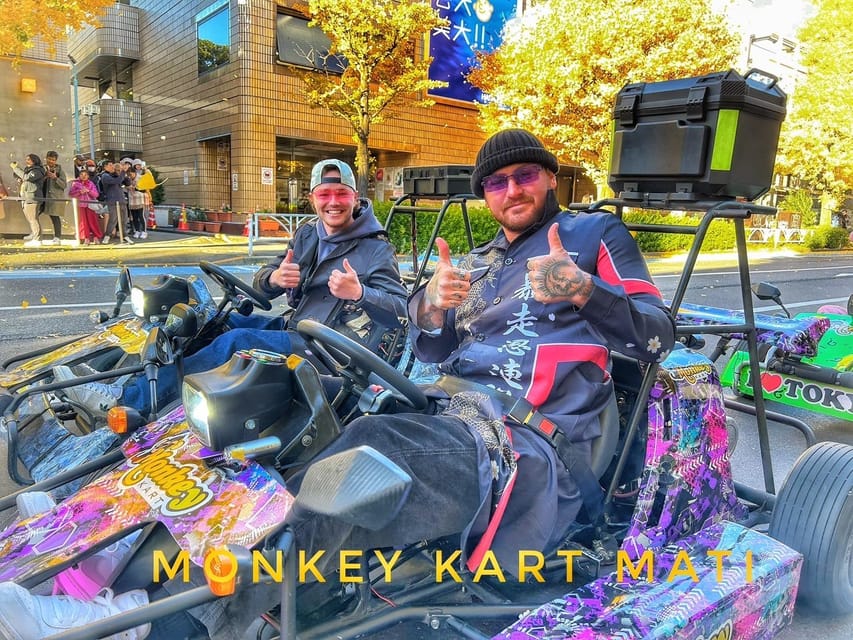
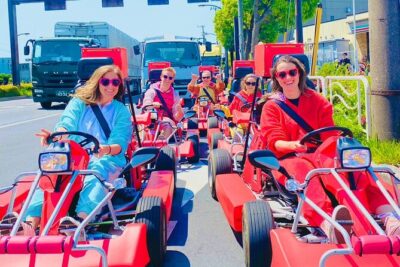
Tokyo looks different from a low-slung kart. You are not simply stopping at the Skytree or peering at Akihabara from a bus window. You are part of the moving street scene, with the wind in your face, city lights around you, and pedestrians waving as your small convoy passes. The costume choice makes the whole thing even more playful.
I like the small group size, capped at eight, and the fact that your guide handles the photos while you concentrate on driving. The 70-minute route gives you a proper taste of Tokyo without taking up half a day. Guides including Adam, Shoma, Hannah, Luis, and Matias have been singled out for calm instruction and friendly help.
The catch is simple but important: you need the right Japanese driving paperwork before you arrive. A soft copy will not work, and rain can force a schedule change. The height limit of 180 centimeters and the ban on pregnant participants also narrow the audience.
Key points at a glance
- Street-level Tokyo route: Drive around Asakusa, pass Tokyo Skytree, and head toward the Akihabara area.
- Up to eight people: The small group keeps the convoy easier to manage and gives you more contact with the guide.
- Costumes and photos included: Choose a character costume, then receive guide-taken photos and one hard-copy picture.
- Driving documents matter: Bring a hard-copy 1949 Geneva Convention International Driving Permit, or the approved Japanese translation where required.
- Best timing: A late afternoon departure can give you daylight, sunset, and Tokyo’s lights in one outing.
- Good value for a novelty experience: At $96, the price covers the kart, guide, costume, water, photography, and camera mount.
Why this go-kart route feels different from ordinary sightseeing
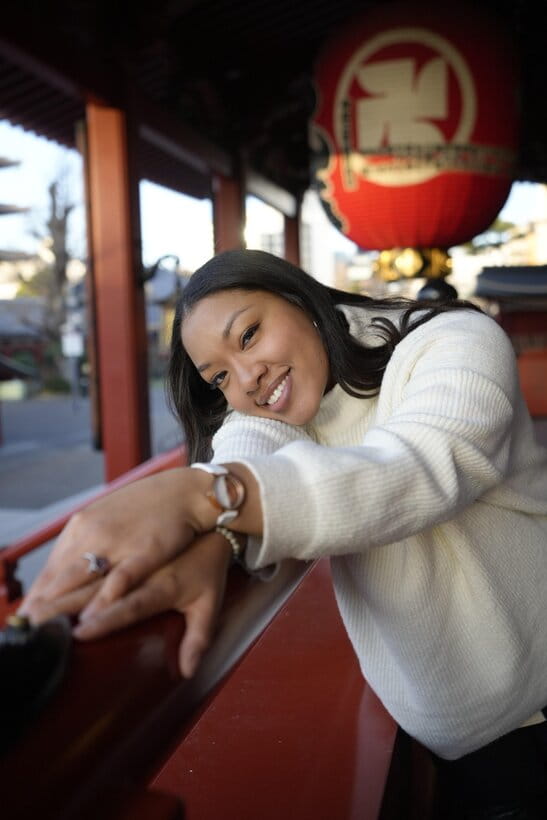
Tokyo is easy to see from trains, sidewalks, observation decks, and tour buses. This experience gives you something none of those can offer: you drive through the city yourself, in formation behind a guide.
That changes the mood. You are watching traffic, following signals, and getting a close look at the streets rather than simply passing through them. You also become part of the scene. Several people describe pedestrians waving or giving thumbs-up as the karts go by, which adds a light, theatrical touch to the ride.
This is not a racing session. The guide leads the group at a controlled pace, and the safety briefing comes before you leave. You need to pay attention, especially to hand signals from the lead guide. One person found those signals difficult to see from several karts back, so staying alert and keeping a safe distance matters.
The activity suits someone who wants sightseeing with a bit of nerve and silliness. If you prefer a quiet walking tour or detailed commentary at every stop, this may feel too fast. If you want a memorable story from Tokyo, it offers something far less ordinary than another train ride.
More Tokyo Skytree tickets:
- Tokyo: Meiji Shrine, Asakusa, Skytree Bus Tour and Cruise
★ 4.7 · 1,986 reviews - Tokyo Panoramic 1 Day: Meiji Shrine, Asakusa, Odaiba and SKYTREE®
★ 4.5 · 1,222 reviews - Tokyo Go Kart: Asakusa, Skytree, and Akihabara **IDP MUST**
★ 5.0 · 988 reviews
Meeting at Oshiage and getting ready to drive
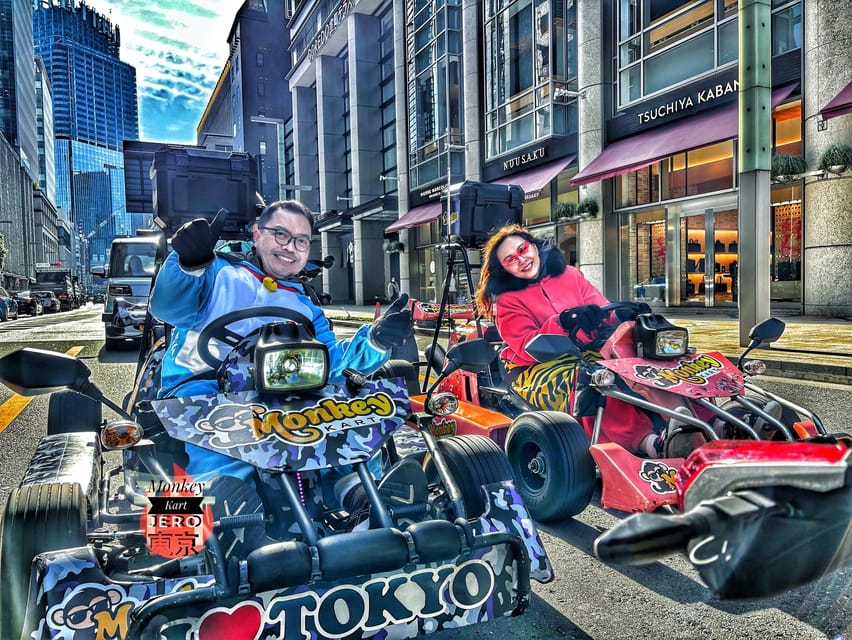
The starting point is at 4-chōme-9-9 Yokokawa, about a seven-minute walk from Oshiage Station. You should arrive 20 minutes before your booked time. That early arrival is not a minor suggestion. You need time for registration, paperwork checks, costume selection, and the safety briefing.
Staff welcome you at the shop and prepare the group before departure. The karts are described as custom-built and street-legal, and several people found them comfortable and well maintained. Water is included, and gloves have been provided on cold days, though I would still dress for the forecast rather than rely on borrowed gear.
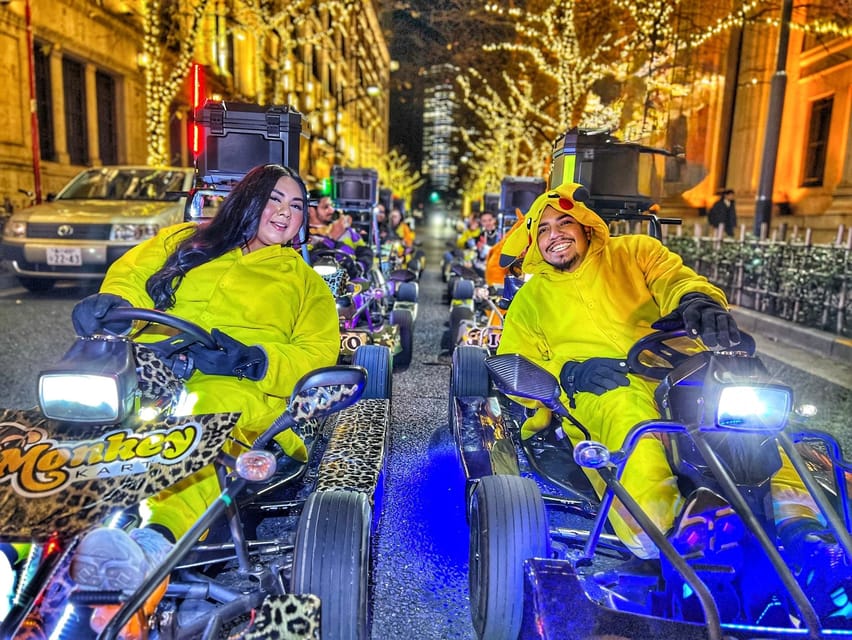
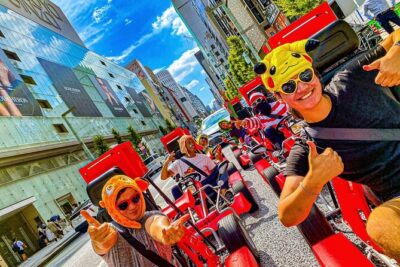
Costumes are optional in spirit, but they are part of the fun. The selection lets you choose a character-style outfit for the ride and for the photos. You are not visiting an attraction where you pose for five minutes and leave. You wear the costume while moving through Tokyo, which explains why the pictures become such a central part of the experience.
The karts include an action camera or Insta360 mount. A small pouch on the front has also been useful for holding a phone, though you should never let taking pictures distract you from traffic or the guide’s signals. The operator includes a photoshoot, so you do not need to spend the whole ride trying to document yourself.
The safety briefing is short, but take it seriously
The safety briefing covers the basic controls and the way the group will move through the streets. Guides such as Adam, Shoma, Hannah, Luis, and Matias have been praised for patient explanations and for helping nervous drivers settle down.
You do not need to arrive as a karting expert. People who were anxious about driving reported that the instruction made the first few minutes easier. Still, this is a public-road activity, not a closed course. You must follow the guide, watch the traffic, obey signals, and stay with the group.
The hand signals deserve special attention. If you are near the back, make sure you can see what is happening ahead and do not rely only on a gesture from several places away. Ask for clarification before departure if anything is unclear.
The experience is not suitable for pregnant women, people over 150 kilograms, or people taller than 180 centimeters. Those limits are strict enough that you should check them before paying. You must also be over 18.
Passing Tokyo Skytree from the road
Tokyo Skytree Town is the route’s clearest visual marker. The tower is easy to recognize from a distance, but seeing it while driving gives the stop a different quality. You are not spending a long time inside a viewing platform. Instead, you pass through the area, pause for photos, and take in the scale of the tower from street level.
The supplied route information lists a photo stop, sightseeing, and a pass-by around Tokyo Skytree. That means you should think of this as a moving city tour with brief photography moments, not a full Skytree visit. Your kart tour does not include entry to an observation deck.
This section can be especially good near sunset. A departure around 4 p.m. may give you changing light as the ride progresses, although exact conditions depend on the season and the day. By the time you return, Tokyo may have shifted from afternoon traffic to glowing signs and illuminated streets.
The guide takes pictures at useful points, so you can enjoy the view without trying to hold a phone while driving. You receive the images afterward through AirDrop or email, along with one hard-copy photo. Ask about the transfer method at the end if your phone cannot accept AirDrop.
More Asakusa and Sensoji tours:
- Tokyo: Japanese Dance Cabaret Theater Asakusa-Kaguwa Ticket
★ 4.8 · 2,270 reviews - Tokyo: Roll and Authentic Sushi Making Class in Asakusa
★ 4.9 · 1,957 reviews - Tokyo: Asakusa Walking Tour with Sensoji Temple Visit
★ 4.8 · 1,583 reviews - Tokyo Asakusa Rickshaw Tour
★ 5.0 · 1,375 reviews
Asakusa gives the route its old Tokyo setting
Asakusa adds a historic side to the ride. The district is known for traditional streets and major sightseeing landmarks, and the kart gives you a quick street-level look at that contrast with modern Tokyo.
You should not expect a walking tour through temple grounds or time to study individual buildings. The appeal here is the change of scene as the convoy moves from the Skytree area through one of Tokyo’s best-known older districts. From a kart, you notice traffic flow, shopfronts, signs, and the way the modern city meets its older neighborhoods.
The guide’s role is important during this part of the ride. You may hear names and brief explanations as you pass key areas, but the main experience is visual and active. Several people have praised guides for sharing local-life details and pointing out what they were seeing without slowing the ride into a formal lecture.
If you want long photo stops, you may find the pace brisk. If you like seeing several parts of Tokyo in one compact outing, the route uses its 70 minutes well.
Akihabara adds lights, signs, and pop-culture energy
The Akihabara section brings a very different mood. This is Tokyo’s famous center for electronics, games, anime, manga, and character culture. The streets are packed with signs and visual detail, making them well suited to a costume-clad convoy and quick guide-taken photos.
The route does not turn you loose for shopping. You pass through the area as part of the drive, so plan a separate visit if you want electronics, arcades, themed cafés, or anime stores. That separation is useful. You get the ride first, then you can return on foot when you have time to browse properly.
The costume makes more sense here than it might in a regular sightseeing vehicle. You are already in a pop-culture district, and the outfit turns a simple drive into a small public performance. Some people will love that attention. Others may feel self-conscious. If you dislike being photographed or noticed, think carefully before booking.
The photos are more than a small extra
Photography is one of the strongest parts of the package. Your guide stops or positions the group at suitable points and takes pictures while you focus on driving. That solves a common problem with active tours: you can either enjoy the activity or constantly reach for your phone.
The included images are shared after the tour by AirDrop or email, and one hard-copy photo is included. An action camera or Insta360 mount is also provided, giving you the option of recording part of the ride if the equipment is available and ready for use.
Bring a fully charged phone if you want to receive files easily. One person specifically advised checking the camera charge before setting off. That is sensible advice, since the photos are a major part of what you are paying for.
The guide’s timing matters. Ken was praised for choosing good moments for pictures, while Jerome was noted for taking many useful shots. Names and staff can change, but the standard to look for is clear: a guide who watches the road, keeps the group together, and still finds good angles.
Choosing daylight, sunset, or nighttime
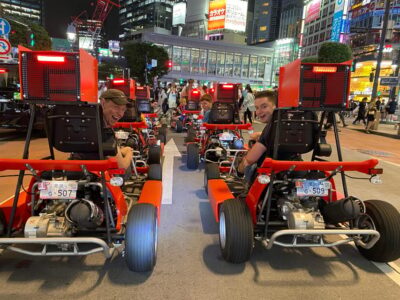
The time of day can shape the outing. A morning departure gives you clear daylight and may feel calmer. An afternoon departure can combine daylight, sunset, and the first city lights. A night ride brings the signs and illuminated streets of Akihabara into sharper focus.
The tour lasts 70 minutes, so you will not get every stage of the day in one ride. Around 4 p.m. has been suggested as a good compromise, but sunset changes throughout the year. Check the available starting times against the season of your visit.
Night rides may feel more dramatic, but they can also be colder. In winter, gloves were supplied on at least one outing, yet warm clothing remains wise. In summer, the heat can be tiring, especially when you are waiting at signals. Staff have been praised for being attentive on hot days and offering water.
Rain is the main weather concern. The tour may be rescheduled if conditions are poor. Keep some flexibility around this booking rather than placing it immediately before a flight or a fixed dinner reservation.
What $96 buys you
At $96 per person, this is not a cheap way to cover Tokyo’s sights. Public transport and walking cost far less. You are paying for the unusual format, the street-legal kart, the guide, costume use, water, photography, one printed photo, and a small group limited to eight.
The price makes more sense if you value the experience itself rather than simply counting landmarks. You are not paying for entry to Skytree, a long cultural lecture, or a meal. You are paying for 70 minutes of driving, the feeling of being part of a guided convoy, and a set of photos that would be difficult to create on your own.
I would consider it good value for a couple, a group of friends, or a first-time visitor who wants one high-energy activity among more traditional sightseeing days. It is less convincing for a strict budget visitor or anyone mainly interested in detailed history.
Optional insurance is not included. Read the conditions carefully and decide if you want that extra protection before departure.
The driving permit rules can make or break your booking
This is the most important practical matter. Every driver needs a hard-copy paper booklet of a 1949 Geneva Convention International Driving Permit issued by the official agency in their country. A digital permit, online image, or soft copy is not valid.
Japan does not recognize permits issued under the 1968 Vienna Convention for this activity. Permits from FIA, IDA, and IAA are also listed as unrecognized. You should obtain the correct document before leaving home, not try to solve it after reaching Japan.
Drivers with licenses from France, Switzerland, Taiwan, Germany, Monaco, or Belgium need a Japanese translation of the local license. The physical translation can be obtained through the Japan Automobile Federation. The information also warns that licenses from Indonesia, Pakistan, Saudi Arabia, Mexico, Brazil, Costa Rica, Colombia, Kuwait, Qatar, and some other countries may not be accepted, so check your own country’s position before booking.
Bring the required license, your passport if requested during the paperwork process, and the original documents. This is not the sort of activity where a photo of your license on your phone will save the day.
Who will enjoy this most
I would point this tour toward adults who want a playful, photo-friendly way to see Tokyo. Couples can make a date of it. Friends can enjoy the costumes and group pictures. Families with adult children may like it too, provided every driver meets the age, height, weight, and licensing rules.
It works well for a repeat visit, since you can see familiar districts from a new angle. It also suits a first visit when you want one activity that feels distinct from temples, department stores, and train stations.
I would hesitate if you are uncomfortable driving in city traffic, dislike public attention, need a relaxed pace, or want detailed time at each landmark. You should also skip it if you cannot secure the accepted permit. No costume or photo package compensates for arriving without valid documents.
Should you book the Asakusa, Skytree, and Akihabara route?
Book it if you want an active Tokyo memory rather than a standard sightseeing loop. The strongest reasons are the small group, friendly English-speaking guides, well-timed photos, and the chance to combine Asakusa, Tokyo Skytree, and Akihabara in one compact ride.
Choose an afternoon start if you want a chance at sunset and evening lights. Arrive early, dress for the weather, bring the correct hard-copy permit, and listen closely to the hand signals. With those details handled, the $96 price buys a distinctive hour on Tokyo’s streets and a photo record to take home.
FAQ
How long does the go-kart tour last?
The experience lasts 70 minutes, including the guided drive through the Tokyo districts on the route.
Where does the tour start?
It starts at 4-chōme-9-9 Yokokawa, about a seven-minute walk from Oshiage Station.
Which areas does the route visit?
The route covers the Asakusa area, passes Tokyo Skytree, and continues toward the Akihabara area before returning to the starting point.
How early should I arrive?
You should arrive 20 minutes before your booked departure time.
What driving permit do I need?
You need a hard-copy paper booklet of a 1949 Geneva Convention International Driving Permit issued by the official agency in your country. Soft copies and online versions are not valid.
Do some countries need extra paperwork?
Yes. Drivers with licenses from France, Switzerland, Taiwan, Germany, Monaco, and Belgium need a Japanese translation of their local license. The physical translation can be obtained from the Japan Automobile Federation.
Are photos included?
Yes. The guide takes photos during the tour, and the images are shared through AirDrop or email. One hard-copy photo is also included.
Can I cancel the booking?
You can cancel up to 24 hours in advance for a full refund. The reserve-now, pay-later option is also available.
More Tokyo go-kart tours
- Flagship 2-Hours Official Street Go-Kart Tour – Tokyo Bay Shop
★ 5.0 · 4,974 reviews - Official Street Go-Kart in Shibuya
★ 5.0 · 3,435 reviews - Official Street Go-Kart Tour – Akihabara
★ 5.0 · 1,578 reviews - Tokyo: Street Kart Experience in Shibuya
★ 4.9 · 1,484 reviews
Newly reviewed around Tokyo
- Tokyo Asakusa:Calligraphy & Make T-shirt Activity★ 5.0 · 62 reviews
- Intercity Shuttle, Tokyo to Haneda /Narita /Yokohama /Makuhari★ 5.0 · 5 reviews
- 1 Hour Travel around Tokyo with a Professional Photographer★ 5.0 · 3 reviews
- Travel Tokyo with Your Own Personal Photographer★ 5.0 · 43 reviews
- Train in Samurai Swordsmanship and Defeat the Demon in Tokyo★ 5.0 · 5 reviews
- Shuttle Van 6hr Tokyo Tour to-and-from Tokyo, Yokohama and Narita★ 5.0 · 9 reviews
- Kickboxing & Body Training with EX-Pro Fighter★ 5.0 · 4 reviews
- Tokyo History: Sensoji Temple & Asakusa District Private Tour★ 5.0 · 28 reviews
Tokyo Go-Kart Tours, compared.
Flagship 2-Hours Official Street Go-Kart Tour – Tokyo Bay Shop
Read our review →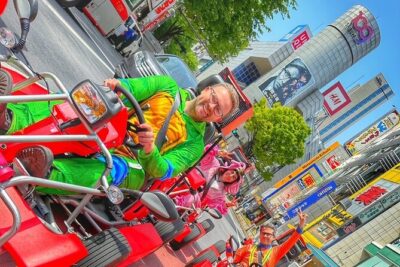
Tokyo Go Kart: Asakusa, Skytree, and Akihabara **IDP MUST**
Read our review →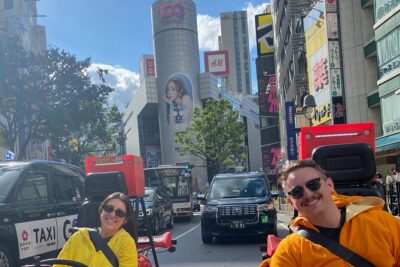
Shibuya Official Street Go-Kart in Shibuya Annex
Read our review →
Premium Go-Kart Tour with Tower & Shibuya Crossing
Read our review →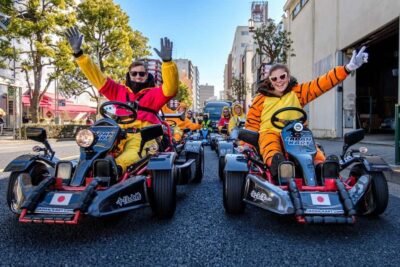
Browse the lists this tour appears in