
Reviewed · TOKYO GO-KART TOURS
Tokyo Oldtown: Historic Landmarks Go Kart Tour (100 Minutes)
Tokyo’s old neighborhoods look different from behind a steering wheel. This 100-minute route links Tokyo Skytree, Asakusa, Ueno, Akihabara, Tokyo Station, and the Imperial Palace in one moving tour, with a guide leading the group by two-way radio. You are not racing. You are rolling through public streets at an easy pace, with time to see Tokyo at street level.
I like the comfortable, stable karts, especially for first-time drivers or larger riders. I also like the live commentary, since guides such as Satar, Travis, and Hiro have been praised for clear instructions, strong English, and helpful license guidance. The main catch is paperwork: overseas drivers need the correct license and International Driving Permit, and you cannot bring a backpack into the kart.
Key points to know before booking
- Tokyo sights in one ride: The route connects Skytree, Ryogoku, Asakusa, Ueno, Akihabara, the Imperial Palace, and Tokyo Station.
- Beginner-friendly driving: Hydraulic brakes, suspension, and stable handling make the karts easier to control than ordinary recreational models.
- Small group format: The tour accepts no more than 10 participants, with a guide leading the entire ride.
- Photos are included, memory card is not: Camera equipment and photos are provided, but you must buy a Micro-SD card for the Insta360 camera.
- Strict driving documents: Bring your passport, valid local license, and an eligible 1949 Geneva Convention IDP, unless you qualify under one of the listed exceptions.
- Good value for active sightseeing: At $90 per person, the tour costs more than a simple bus ride, but it combines transport, guiding, equipment, insurance, photos, and a rare view of Tokyo from the road.
What this Tokyo go-kart tour is really like
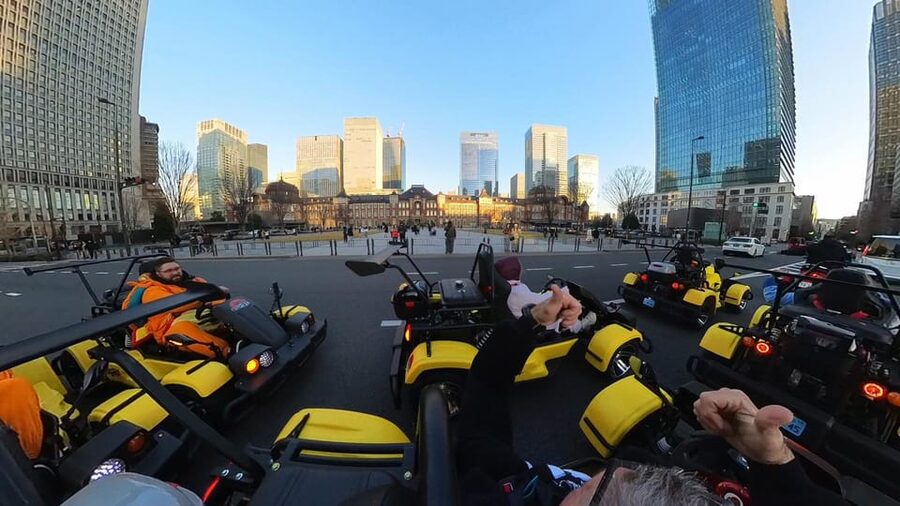
This is best understood as a guided road tour with go-karts, not a visit where you stop and explore each landmark on foot. You begin at Kartzilla Go Kart Tokyo, receive a safety briefing and driving instructions, then follow your guide through a long loop around eastern and central Tokyo.
That distinction matters. You should not expect to enter Senso-ji, tour the Japanese Sword Museum, or walk around the Imperial Palace grounds during the 100 minutes. The value comes from seeing a large slice of the city in one outing, with stories and directions delivered as you drive.
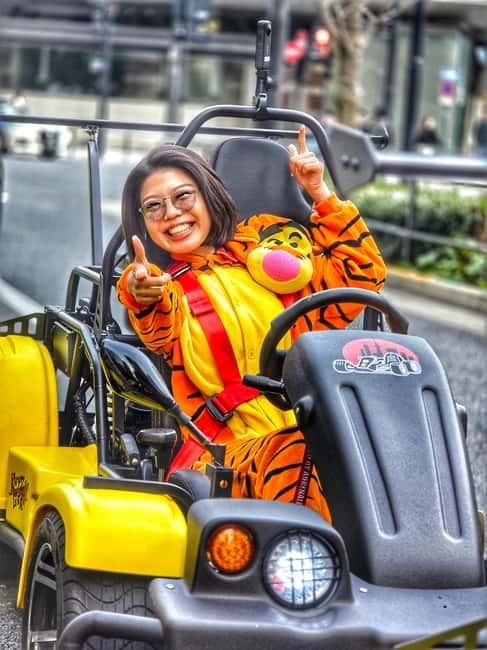
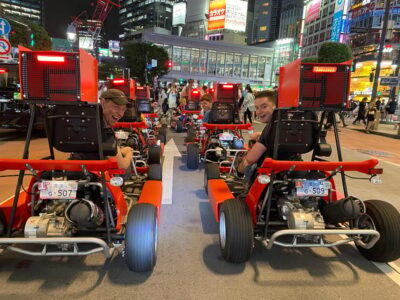
The karts are built for city use. Advanced suspension helps soften the ride, hydraulic brakes give you controlled stopping, and reinforced frames are designed to accommodate big and tall riders. The company also describes the handling as stable for first-time drivers. That will not remove the need to pay attention, of course, but it should make the first few minutes less nerve-racking.
A two-way radio keeps you connected to the guide. You can hear safety instructions and cultural background while staying with the group. This is one of the strongest parts of the experience because driving through Tokyo can be distracting. A guide who gives clear directions makes the ride feel organized rather than chaotic.
More Tokyo go-kart tours:
- Flagship 2-Hours Official Street Go-Kart Tour – Tokyo Bay Shop
★ 5.0 · 4,974 reviews - Official Street Go-Kart in Shibuya
★ 5.0 · 3,435 reviews - Official Street Go-Kart Tour – Akihabara
★ 5.0 · 1,578 reviews
Starting at Yotsugi, near Tokyo Skytree
The facility is less than 10 minutes on foot from Yotsugi Station on the Keisei Line. The building has Kartzilla signs, and Google Maps should take you to the entrance. Pick-up from your hotel is not included, so plan the trip to the meeting point carefully.
You need to arrive with your passport and driving documents. Japanese citizens and foreign residents of Japan need a valid license issued in Japan. Overseas visitors who do not live in Japan need their passport, a valid local driving license, and an International Driving Permit issued under the 1949 Geneva Convention.
There are specific exceptions. Citizens of Switzerland, Germany, France, Belgium, Monaco, and Taiwan may drive with a Japanese translation of their license. The information also lists a special option for U.S. Forces personnel using a SOFA permit or a state license together with an active-duty military ID.
Do not treat this as a minor detail. If your documents are not accepted, you cannot drive. If you are unsure, contact the provider well before your visit. The company specifically asks people who need help with a Japanese translation to get in touch about a month ahead.
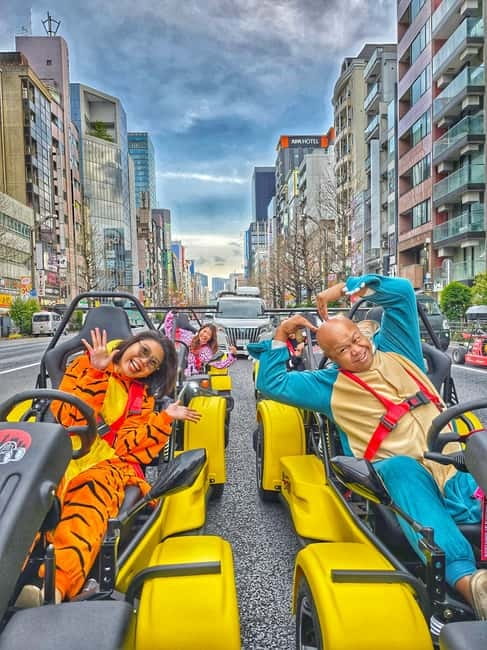
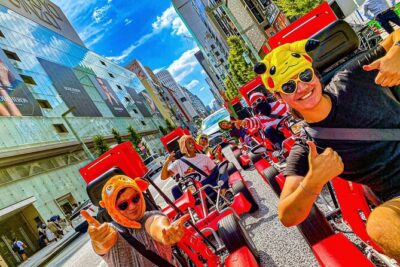
After the paperwork, you receive a safety briefing and simple driving instructions. You also get a costume, which adds a playful touch to the photos. The group is limited to 10 people, so the guide can keep an eye on the formation and communicate with everyone.
Tokyo Skytree and the first taste of the route
Tokyo Skytree is the natural opening landmark. Rising high above the eastern side of the city, it gives the route an immediate sense of scale. From ground level, you get scenic views on the way rather than a long stop at the tower itself.
This is also a useful warm-up section. You are getting used to the steering, brakes, radio instructions, and the rhythm of city driving. First-time drivers should focus on staying with the group and following the guide’s signals instead of trying to take in every detail at once.
The route begins near Skytree, so this stop is especially convenient if you are already planning to visit the tower. The ride itself does not replace a trip to the observation decks. Think of it as a street-level look at the district.
Sword culture and sumo around Ryogoku
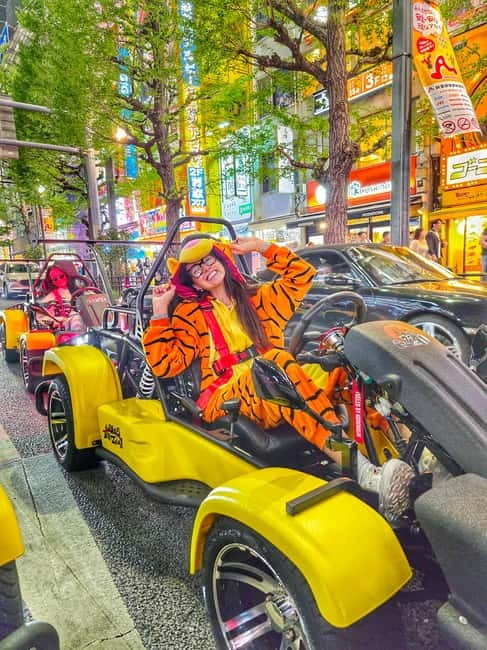
The Japanese Sword Museum brings a more specialized cultural note to the route. It represents Japan’s craftsmanship and martial traditions, though the drive gives you an outside view and guide commentary rather than a museum visit.
Soon after, the route reaches the Ryogoku Kokugikan area. Ryogoku is closely linked with sumo, Japan’s national sport, and the Kokugikan is the district’s best-known arena. Seeing it from the road helps connect Tokyo’s modern streets with older Japanese customs that remain part of daily public life.
These sights are useful because they add variety. Skytree is a modern landmark, the Sword Museum points toward traditional craftsmanship, and Ryogoku brings in sumo. In a conventional sightseeing plan, you might spread these across different parts of the day. Here, they form part of one continuous ride.
The trade-off is simple: you will not have time to pause for a museum tour or a sumo event. If those are major interests, plan separate visits. The go-kart ride gives you context and a look at the districts, not a full cultural program at each stop.
A completely different kind of day in Tokyo:
- Mt Fuji and Hakone 1-Day Bus Tour Return by Bullet Train
★ 5.0 · 26,383 reviews - 1-Day Tokyo Bus Tour
★ 5.0 · 14,250 reviews - Tokyo: teamLab Planets TOKYO Digital Art Museum Entry Ticket
★ 4.6 · 9,779 reviews - Mt Fuji & Hakone Cruise, Drum Show Bullet Train 1 Day from Tokyo
★ 4.0 · 7,413 reviews
Tokyo Station and the Imperial Palace
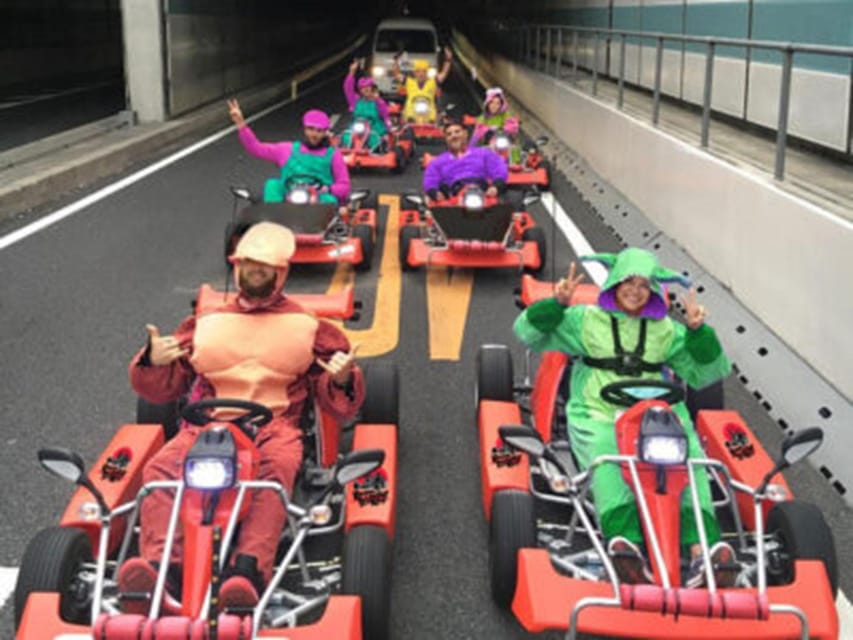
The route then heads toward central Tokyo, with Tokyo Station and the Imperial Palace included among the main landmarks. This section gives you a sharp contrast with eastern Tokyo.
Tokyo Station is known for its grand brick exterior and role as one of the city’s main transport centers. From a go-kart, the interest is the changing streets around it and the feeling of moving into central Tokyo. You see the city as a working place, not just a set of attractions.
The Imperial Palace area adds another layer of Tokyo’s story. The palace grounds are tied to the Japanese imperial family, and the surrounding roads offer a more formal setting than the older shopping streets of Asakusa. Again, this is a scenic drive and guided pass-by, not a palace entry.
I would not book this tour as your only palace visit. Instead, use it to get your bearings and note which areas deserve a return visit on foot. The route covers a lot of ground, but the pace means the sights pass quickly.
Akihabara, Ueno, and the changing face of Tokyo
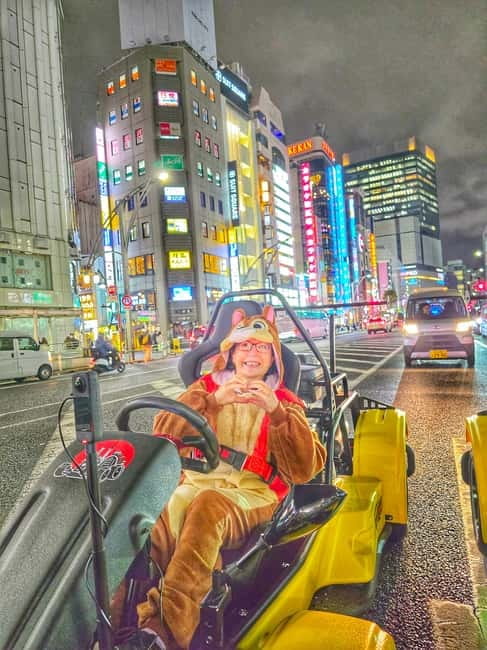
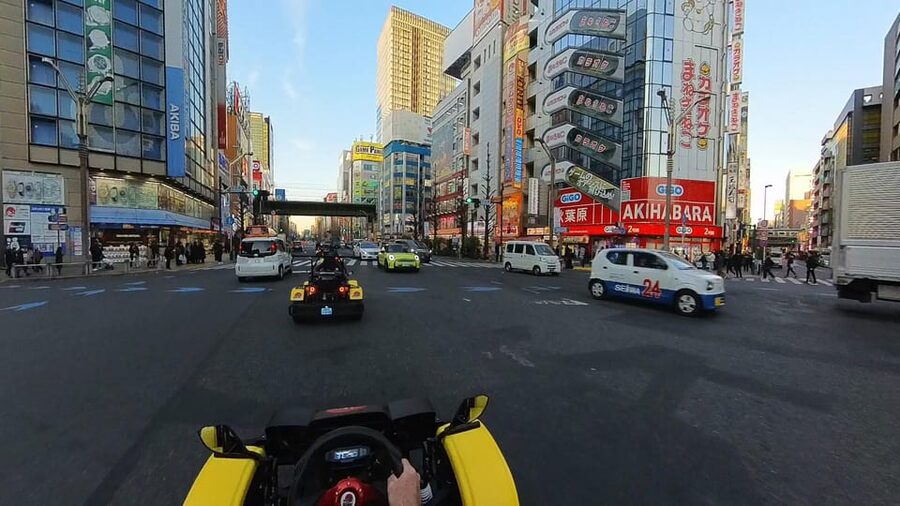
Akihabara brings a very different mood. The district is famous for electronics, games, anime, manga, and colorful commercial streets. It is one of Tokyo’s clearest examples of how the city can change character within a few blocks.
Ueno adds another shift. The area is known for cultural attractions, shopping, and access to Ueno Park. During the drive, you get a glimpse of a district that feels more local and layered than the polished central business areas.
These sections are valuable because they keep the tour from becoming a single-theme ride. You see modern pop culture, central business streets, older neighborhoods, and traditional districts in one circuit. The guide’s live explanation helps you understand why each area feels different.
Still, you should manage your expectations. The tour does not include time to shop in Akihabara or visit Ueno’s museums and park. If you want to buy electronics or browse specialty stores, return later with comfortable walking shoes.
Asakusa is the cultural heart of the ride
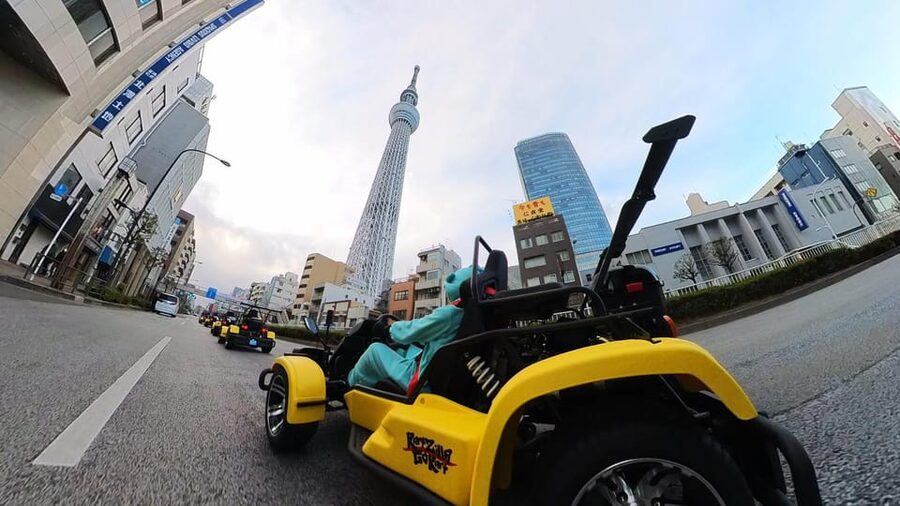
Asakusa is the most important stop on the Old Town route. The district is home to Senso-ji, Tokyo’s oldest Buddhist temple, along with traditional streets, shops, temples, and neighborhood buildings that reflect the city before its modern skyline took over.
From the kart, you experience Asakusa at street level. You see the approach to the temple area and the surrounding streets as part of everyday city life. That is different from arriving by subway and heading straight into the temple grounds. The moving view helps you understand how the old district fits into present-day Tokyo.
Senso-ji itself deserves a separate visit if you have the time. The go-kart route cannot give you a proper temple visit, time for prayer, or a close look at the buildings and shopping lanes. What it does give you is a strong introduction and a reason to return.
This is where the title Old Town makes the most sense. Asakusa links sacred places, traditional commerce, and ordinary city movement. The route does not turn the area into a museum. You see it as a living part of Tokyo.
Why the guide makes a difference
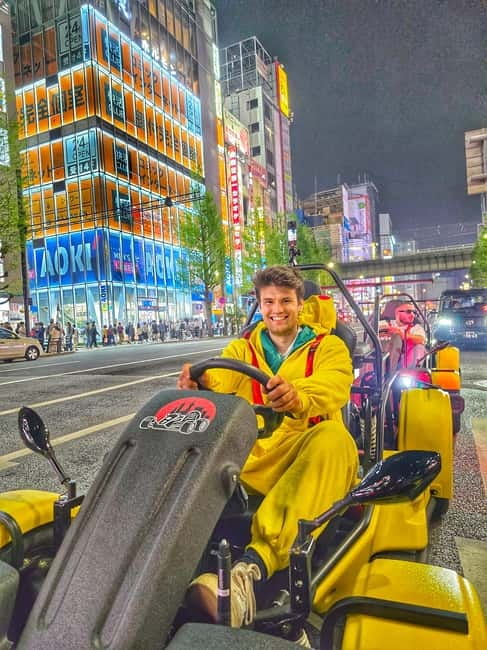
A guide is essential here. Driving through Tokyo while trying to identify landmarks, understand local customs, and follow traffic instructions would be too much to handle alone.
The two-way radio lets the guide provide live safety advice and keep the group moving together. Guides named Satar and Travis received especially strong praise for clear instructions and friendly help, while Hiro was singled out for assisting with the translation of a driving license. These details matter because the practical side of the tour is just as important as the sightseeing.
The listed languages are English, German, and Persian. You should check the available language when booking if that matters to you. The guide leads the route at all times, and the experience is described as relaxed, with no racing.
That no-racing rule is important. This is not a competition and should not be treated as one. Your job is to follow the guide, obey road rules, watch traffic, and enjoy the changing neighborhoods.
Cameras, costumes, and what you receive
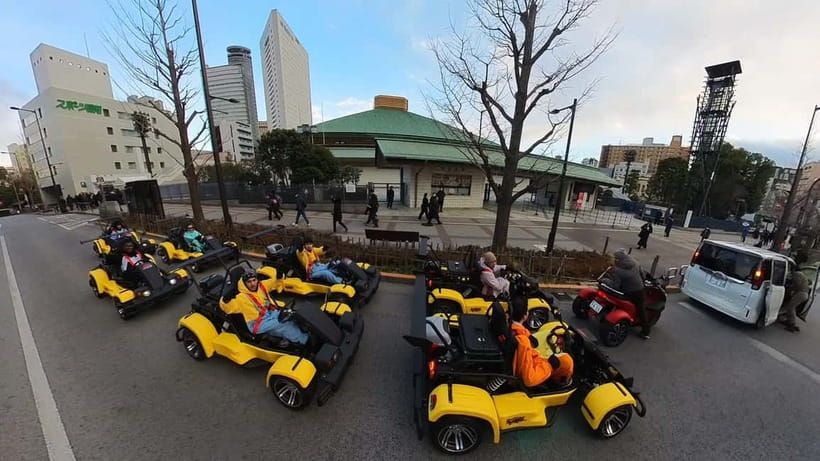
Each kart can use an on-board Insta360 camera. The camera works hands-free, so you can record the road, landmarks, and your own driving without holding a phone.
The camera equipment is free, and photos are included. You must purchase a Micro-SD card for the camera, though, so budget for that extra cost. This is worth sorting out before departure because the camera will be most useful when you can record the entire ride rather than only a few clips.
The supplied costume adds a lighthearted element to the experience. It is not the reason to book, but it makes the photos more distinctive and fits the playful nature of driving a go-kart through Tokyo.
Drinks, fuel, accident insurance, the kart, and the guide are included. Meals are not. There is also no locker space, and backpacks are not allowed in the vehicle. Keep your belongings to a minimum and ask the facility ahead of time how to handle anything you cannot carry.
Is $90 a fair price?
At $90 per person, this is not cheap transportation. You could see many of these districts by train for far less. But the comparison is not really train versus kart. You are paying for a guided small-group activity, a purpose-built vehicle, safety equipment, fuel, insurance, a costume, photos, and a distinctive route through several parts of Tokyo.
The value is strongest if you want an active experience and have already seen Tokyo’s major sights in the usual way. You get a broad city overview without planning several train connections, and the guide adds context while you drive.
The price is less attractive if you mainly want detailed time at each landmark. A standard walking tour or private guide would give you more time at Senso-ji, the Imperial Palace area, or a museum. This tour is about movement, variety, and the unusual view from the road.
Free cancellation up to 24 hours before departure and the option to reserve now and pay later make booking less risky. Starting times vary, so check availability for your date.
Who should book this ride?
I would recommend it to adults who enjoy trying a city in an unusual way, can meet the licensing rules, and are comfortable paying attention in traffic. It suits couples, friends, and small groups who want a shared activity rather than another museum or food stop.
It is especially useful early in your Tokyo visit. The route can help you identify places to revisit, including Asakusa, Ueno, Akihabara, and Ryogoku. Night rides can also be appealing, since one of the strongest personal recommendations described the activity as particularly good after dark, but you should choose a starting time that fits your comfort level.
It is not suitable for children under 18, wheelchair users, visually impaired people, people over 95, or drivers under 18. Pets, alcohol, drugs, food, drinks, baby carriages, bare feet, backpacks, and loose plans for storing luggage are all non-starters.
Should you book the Tokyo Old Town route?
Book it if you want Tokyo sightseeing with a steering wheel in your hands, a small group, live guidance, and a route that reaches well beyond one neighborhood. The comfortable karts, clear instructions, and strong guide support make this more approachable than it may first sound.
Skip it if you want long visits inside temples, museums, or palace grounds, or if arranging the correct driving documents will be difficult. At $90, the tour earns its price through the unusual format and the amount of Tokyo it covers, not through extended time at any one sight.
For the right person, this is a memorable way to connect Skytree, Ryogoku, Asakusa, Ueno, Akihabara, and central Tokyo in one outing. Just bring your passport, license, IDP if required, a light load, and the attention needed for real city driving.
FAQ
How long is the Tokyo Old Town go-kart tour?
The tour lasts 100 minutes, including the guided drive through Tokyo’s historic and central districts.
Where does the tour start?
It starts at Kartzilla Go Kart Tokyo, located less than 8 to 10 minutes on foot from Yotsugi Station on the Keisei Line.
What landmarks are included on the route?
The route passes Tokyo Skytree, the Japanese Sword Museum, Ryogoku Kokugikan, Tokyo Station, the Imperial Palace, Akihabara, Ueno, and Asakusa before returning to the Kartzilla facility.
Do I need a driver’s license?
Yes. Japanese citizens and foreign residents of Japan need a valid license issued in Japan. Overseas visitors need a valid local driver’s license, passport, and an accepted International Driving Permit.
Which International Driving Permit is accepted?
Only an International Driving Permit issued by a signatory to the 1949 Geneva Convention is accepted for driving in Japan.
Can citizens of Germany, France, or Taiwan drive in Japan?
Citizens of Switzerland, Germany, France, Belgium, Monaco, and Taiwan may drive when they have a Japanese translation of their driving license. Contact the provider in advance if you need help with a translation.
What languages are available?
The listed guide languages are English, German, and Persian.
Are photos and videos included?
Photos are included, and the camera equipment is free. You must purchase a Micro-SD card if you want to use the on-board Insta360 camera.
Is hotel pick-up included?
No. You must make your own way to the Kartzilla Go Kart facility near Yotsugi Station.
What happens if I need to cancel?
You can cancel up to 24 hours before the activity for a full refund. You can also reserve now and pay later, subject to the booking conditions.
More history and heritage tours in Tokyo
- Tokyo: Imperial Palace and Shogun Historical Walking Tour
★ 5.0 · 2,251 reviews - Tokyo: Imperial Palace Japanese History Walking Tour
★ 4.9 · 987 reviews - Tokyo: Shinjuku Historical Walking Tour & Secret Backstreets
★ 5.0 · 530 reviews - Yanaka Walking Tour: Historic and Traditional District of Tokyo
★ 5.0 · 530 reviews
Newly reviewed around Tokyo
- Tokyo Asakusa:Calligraphy & Make T-shirt Activity★ 5.0 · 62 reviews
- Intercity Shuttle, Tokyo to Haneda /Narita /Yokohama /Makuhari★ 5.0 · 5 reviews
- 1 Hour Travel around Tokyo with a Professional Photographer★ 5.0 · 3 reviews
- Travel Tokyo with Your Own Personal Photographer★ 5.0 · 43 reviews
- Train in Samurai Swordsmanship and Defeat the Demon in Tokyo★ 5.0 · 5 reviews
- Shuttle Van 6hr Tokyo Tour to-and-from Tokyo, Yokohama and Narita★ 5.0 · 9 reviews
- Kickboxing & Body Training with EX-Pro Fighter★ 5.0 · 4 reviews
- Traditional Japanese Knife Sharpening Class★ 5.0 · 18 reviews
Tokyo Go-Kart Tours, compared.
Flagship 2-Hours Official Street Go-Kart Tour – Tokyo Bay Shop
Read our review →
Tokyo Go Kart: Asakusa, Skytree, and Akihabara **IDP MUST**
Read our review →
Shibuya Official Street Go-Kart in Shibuya Annex
Read our review →
Asakusa, Skytree & Akhihabara Go-Kart City Experience
Read our review →
Premium Go-Kart Tour with Tower & Shibuya Crossing
Read our review →Browse the lists this tour appears in