
Reviewed · YOKOHAMA TOURS FROM TOKYO
【50 mins】 City lights HelicopterTour: Tokyo and Yokohama plan
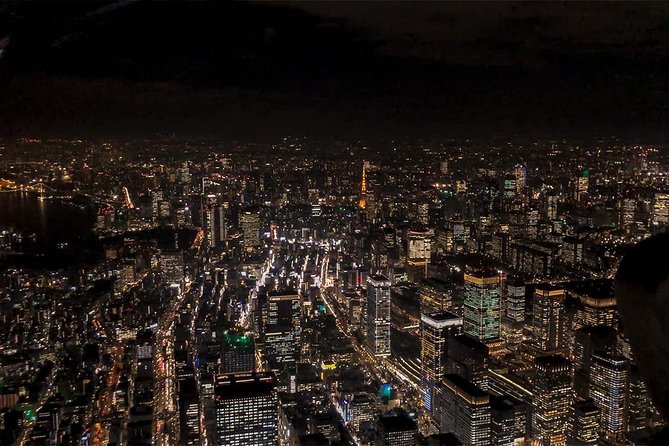
Tokyo looks different from a helicopter. Instead of seeing one tower or one street at a time, you get the full spread of Tokyo’s night lights, from Tokyo Skytree and Rainbow Bridge to Tokyo Tower, Shinjuku, and Yokohama Harbour. The route gives you two major cities in one flight, with more than 50 minutes in the air.
I like two things right away: the private format for up to three people, and the generous flight time. This is not a quick loop around one landmark. I also like that sunset can be requested as a viewing period, since the last daylight and first city lights can make the skyline especially striking.
The main drawback is the price, listed at $2,002.26 per group. It makes more sense when split among three people, but it remains a major splurge. You also need to reach Funabashi Heliport, outside central Tokyo, and the flight depends on good weather.
Key points at a glance
- More than 50 minutes in the air: The flight is long enough to cover both Tokyo and Yokohama rather than focusing on a single district.
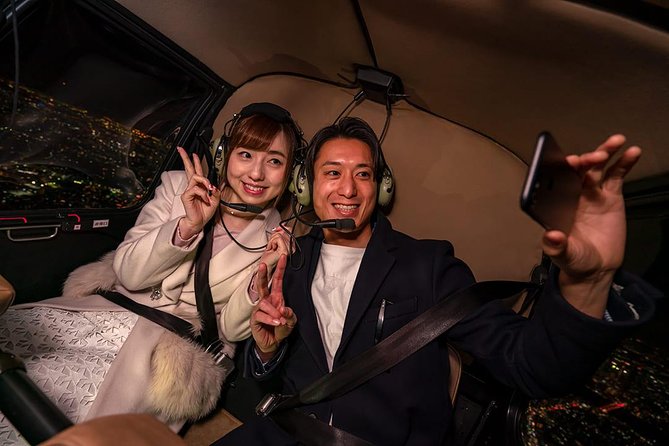
- A private flight for up to three people: Your group flies together, making this well suited to a proposal, anniversary, or small family celebration.
- Tokyo and Yokohama in one route: The sights include Tokyo Skytree, Rainbow Bridge, Tokyo Tower, Shinjuku, and Yokohama Harbour.
- Night views with an optional sunset advantage: A departure around sunset can give you fading daylight, illuminated streets, and glowing buildings in one outing.
- Departures from Funabashi Heliport: The meeting point is in Funabashi, Chiba, so you need to allow time to reach the heliport.
- Strict flight and passenger limits: The total flight weight is capped at 220 kilograms, with a stated passenger limit of 120 kilograms, or about 265 pounds, per person.
Why this flight feels different from a city observation deck
Tokyo has several excellent high viewpoints, but a helicopter gives you motion and scale. From a fixed observation deck, you look outward from one building. Here, the view changes as the aircraft moves across the city, letting you connect separate landmarks in one sweep.
That matters in Tokyo, where the city is too large to understand from a single point. You may see Tokyo Skytree, then the waterways and bridge lights, then Tokyo Tower and the dense glow around Shinjuku. The flight continues toward Yokohama Harbour, adding another city’s waterfront to the evening.
The view is also unlike looking down from an airliner. A passenger plane gives you a distant view during takeoff or landing, usually with limited time and a fixed direction. This flight is designed around the city itself. The point is not simply getting from one place to another. The city is the subject.
The 50-minute flight time is the key figure to watch. The full activity lasts about 1 hour 30 minutes, but only the flight portion is spent above the city. That is still a substantial amount of air time for a private sightseeing trip.
More Yokohama trips from Tokyo:
- Narita Airport: One Way Private Transfer to Tokyo|Yokohama Hotels
★ 4.5 · 69 reviews - Tokyo: Private One-Way Transfers to/from Yokohama Port
★ 4.5 · 50 reviews - Private Car Tour to see Highlights of Kamakura, Enoshima, Yokohama from Tokyo
★ 5.0 · 48 reviews
Leaving Funabashi Heliport for the Tokyo skyline
The tour begins at Funabashi Heliport, at 1-chōme-44-2230 Kanasugi, Funabashi, Chiba 273-0853. The activity ends back at this same meeting point, so you do not need to arrange a separate pickup after landing.
The heliport is near public transportation, but the information provided does not specify travel times or a transfer service. I would plan the journey carefully and avoid arriving at the last minute. A helicopter flight has less flexibility than a museum visit, and late arrival can create a real problem.
Once airborne, the route is presented as a sightseeing circuit over the major sights of Tokyo and Yokohama. Exact timing and angles can change with flight operations, weather, and air traffic, so you should think of the listed landmarks as the intended viewing highlights rather than guaranteed photo stops.
Tokyo Skytree from above
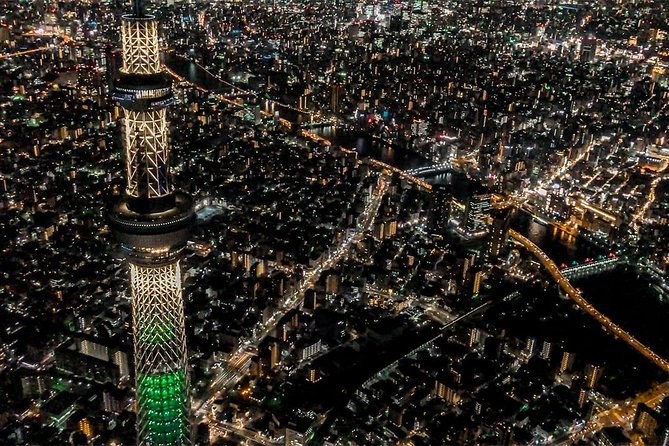
Tokyo Skytree is one of the first major sights that gives this trip a sense of scale. At 634 meters, it is easy to recognize from many parts of the city, but seeing it from a moving helicopter adds depth to the view.
You can appreciate how the tower relates to the surrounding city rather than seeing it only as an isolated structure. At night, the tower becomes one bright reference point among countless streets and buildings.
If Skytree is your main reason for booking, keep your expectations practical. This is not a landing or a stop at the tower, and the aircraft will continue along its route. You’ll see it while cruising, so your best views may last only for part of the flight.
Rainbow Bridge and the Tokyo waterfront
Rainbow Bridge is one of the most photogenic parts of the route. Its lights trace the crossing over Tokyo Bay, while the water creates a darker gap between the city districts.
From the air, the bridge’s shape makes more sense than it does from street level. You can see the connection between the waterfront areas and the spread of lights around the bay. This is also one of the places where a night flight earns its price, since the illuminated bridge and dark water create a clear visual contrast.
The helicopter’s height and movement can make photography tricky. Reflections, cabin windows, and low light are all factors, so you should enjoy the view first and treat photographs as a bonus.
More Tokyo city tours:
- Tokyo: Private City Highlights Tour with Local Guide
★ 4.8 · 1,433 reviews - Tokyo: Asakusa, Skytree & Akhihabara Go-Kart City Experience
★ 4.7 · 761 reviews - Tokyo: 3-Hour Bike or E-Bike City Highlights Tour
★ 4.8 · 435 reviews - Tokyo: Sumo Morning Practice Tour at Sumida City
★ 4.8 · 308 reviews
Tokyo Tower and the glow of central Tokyo
Tokyo Tower offers a very different sight from Tokyo Skytree. Skytree feels tall and modern, while Tokyo Tower has a more familiar, compact profile. Seeing both during one flight gives you a useful visual comparison between two symbols of the city.
The tower is especially effective after sunset, when its illuminated frame can be picked out from the surrounding streets. The view may be brief as the helicopter passes, but it is one of the route’s essential landmarks.
I like this part of the plan because the flight is not built around only the newest or tallest attraction. It includes a mix of Tokyo’s best-known sights, giving the ride more variety than a simple waterfront loop.
Shinjuku and Tokyo’s endless spread of lights
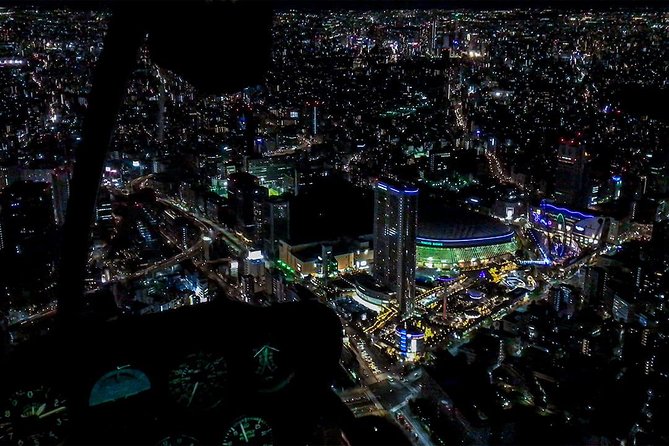
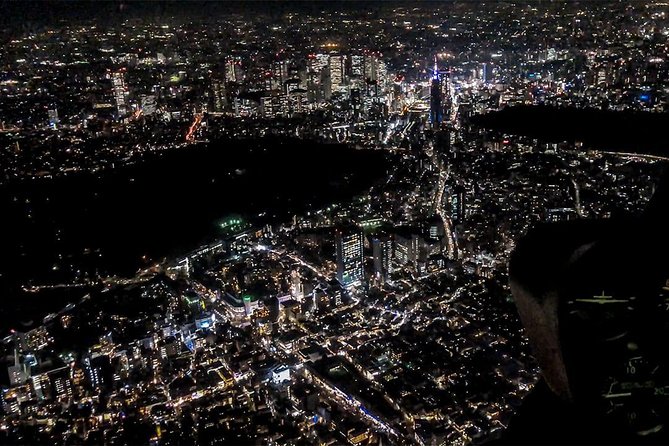
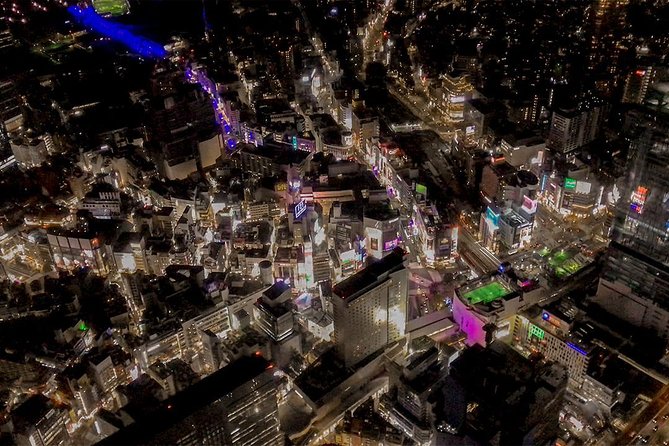
Shinjuku is where the size of Tokyo becomes most obvious. From the air, you can see a dense cluster of illuminated buildings and streets rather than a single postcard landmark.
The district is known for its bright city center, but the helicopter view lets you see beyond the immediate signs and towers. The wider pattern of streets is the real attraction. It shows why Tokyo can feel almost endless at ground level.
Night flights are particularly effective here, though the view is weather-sensitive. Haze or cloud can soften the distant lights. If the sky is clear, Shinjuku should provide one of the most intense sections of the route.
Continuing toward Yokohama Harbour
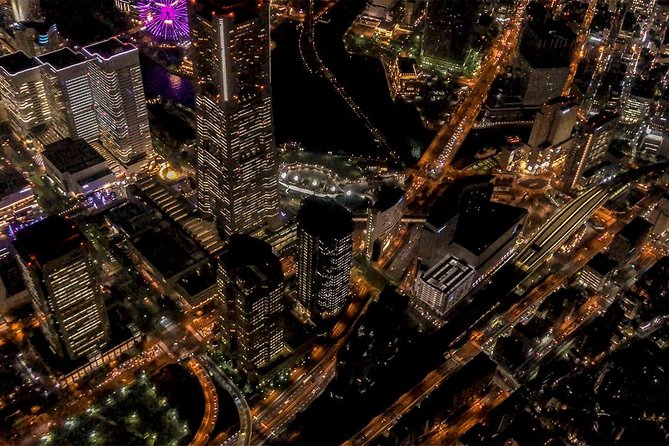
The flight’s reach into Yokohama is a major reason to consider this plan instead of a shorter Tokyo-only outing. Yokohama Harbour brings a different mood, with open water and waterfront lights replacing the tighter concentration of central Tokyo.
You’ll get a broad view of the harbour area while cruising. The contrast between Tokyo’s dense city center and Yokohama’s waterfront is part of the appeal. It also gives the flight a sense of progression, rather than repeating the same type of view for 50 minutes.
The route does not include a landing in Yokohama or time on the ground. This is a sightseeing flight, so the harbour is something you see from above before the aircraft returns to Funabashi.
Why sunset may be the best departure window
One of the most useful tips comes from the experience itself: a sunset departure may offer the strongest visual sequence. You can see the last daylight on the skyline, then watch streets, bridges, towers, and LED screens become more prominent as darkness arrives.
A fully dark flight gives you the clearest city lights, but sunset adds change. The tradeoff is timing. Sunset varies by season, and the most attractive departure window may not always be available. If you want this effect, ask about the sunset option when booking rather than assuming every evening flight is scheduled at that time.
The sunset suggestion is also practical for special occasions. A proposal or anniversary flight can begin with a softer sky and finish with Tokyo illuminated below. One passenger used the flight for a surprise proposal, making the outing a particularly memorable occasion. The operator even congratulated the couple afterward, though no guide or pilot names are provided.
Private space for three people
The activity is private, with a maximum of three people per booking. That is a meaningful advantage over a larger shared flight. You can plan the outing around your own group, and the occasion feels more personal.
The passenger limit also makes the cost easier to understand. At $2,002.26 per group, one person pays a very high amount. Split three ways, the listed price works out to about $667.42 per person before any additional booking costs. For a couple, the per-person price is roughly $1,001.13.
That is still expensive, but a three-person group receives the strongest value. You are paying for privacy, a long flight, and a route covering two major cities. If you only want a short look at Tokyo Tower or Rainbow Bridge, this is more than you need.
The private format is best for a milestone rather than an ordinary sightseeing day. Think proposal, major birthday, anniversary, or a once-in-a-lifetime splurge. For a first visit to Tokyo on a tight budget, I would put this below food, transport, and major city sights.
The practical limits that matter
Weight rules are important here. The stated total weight limit is 220 kilograms per flight, with a maximum of 120 kilograms per passenger, roughly 265 pounds. The tour information also gives a total passenger weight figure of 265 pounds, which appears to be a separate listing detail and may reflect the same safety rules in a different unit.
Because the figures are presented in more than one way, you should confirm the applicable limit for your party before booking. Three people near the individual limit could exceed the total aircraft limit. The operator must work within aviation safety rules, so this is not a detail to leave until arrival.
Passengers who have gone underwater diving during the previous 24 hours cannot take part. This restriction is stated as a safety requirement, so plan your water activities around the flight if both are part of your trip.
Most people can participate, but the activity is still subject to flight operations. The operator may cancel because of poor weather, aircraft problems, or other disruptions. In those cases, you’ll be offered another date or a full refund.
Booking, weather, and cancellation choices
Confirmation arrives within 48 hours of booking, subject to availability. That timing matters if you are building a tightly scheduled Tokyo itinerary. I would avoid placing the helicopter flight on the same day as an important train departure, airport transfer, or timed reservation.
The flight needs good weather. If the forecast looks poor, the outing may be canceled. The information advises checking the forecast if you plan to fly within five days, since bad weather can affect the booking.
You can cancel for a full refund up to 24 hours before the start time. Cancellations made less than 24 hours in advance are not refunded, and changes during that period are not accepted. The cut-off follows local time in Japan.
Because weather can force a change, I would schedule this earlier in your stay rather than on your final night. That leaves room for a new date if conditions are poor.
Who will get the most from this Tokyo helicopter tour
This flight suits you if you value a special setting more than a low price. Couples planning a proposal or anniversary will get the most emotional value from the private cabin and changing night views.
It can also work for a small group of three who want to share one major splurge. The cost becomes easier to justify when divided among the full group, especially since the flight covers Tokyo and Yokohama rather than only one landmark.
You should think twice if you dislike strict schedules, have a tight budget, or mainly want to visit attractions on the ground. The route offers views, not entry to Tokyo Skytree, Tokyo Tower, Shinjuku, Rainbow Bridge, or Yokohama Harbour.
The flight also depends heavily on visibility. The operator provides a refund or alternative date if poor weather cancels the trip, but clouds, haze, or changing conditions can still affect what you see during a flight that goes ahead.
Should you book the Funabashi night flight?
Book it if you want a private, memorable way to see Tokyo and Yokohama together, especially for a proposal or milestone celebration. The 50-minute flight time is generous, and the mix of towers, bridges, dense city lights, and harbour views gives the route real variety.
Skip it if $2,002.26 feels uncomfortable even when split among three people, or if you would rather spend that money on several days of food and sightseeing. You should also avoid relying on it as your only special plan if your schedule cannot handle a weather change.
My practical advice is simple: choose a clear evening, ask about a sunset departure, confirm the weight rules for your group, and allow plenty of time to reach Funabashi Heliport. With those points settled, this becomes a rare chance to see two huge Japanese cities in one moving, private panorama.
FAQ
Where does the helicopter flight begin?
The activity begins at Funabashi Heliport, located at 1-chōme-44-2230 Kanasugi, Funabashi, Chiba 273-0853, Japan.
Where does the activity end?
The flight ends back at the Funabashi Heliport meeting point.
How long is the activity?
The full activity lasts approximately 1 hour 30 minutes, including more than 50 minutes of flight time.
How many people can join the private flight?
A maximum of three people can participate in one booking.
What sights can I see from the helicopter?
The route includes views of Tokyo Skytree, Rainbow Bridge, Tokyo Tower, Shinjuku, and Yokohama Harbour. These are viewed while cruising, not visited on foot.
How much does the flight cost?
The listed price is $2,002.26 per group of up to three people.
Is there a weight limit?
Yes. The stated total flight weight limit is 220 kilograms, with a maximum of 120 kilograms per passenger, or about 265 pounds.
What happens if bad weather cancels the flight?
You’ll be offered an alternative date or a full refund if the activity is canceled because of poor weather.
Newly reviewed around Tokyo
- Tokyo Asakusa:Calligraphy & Make T-shirt Activity★ 5.0 · 62 reviews
- Intercity Shuttle, Tokyo to Haneda /Narita /Yokohama /Makuhari★ 5.0 · 5 reviews
- 1 Hour Travel around Tokyo with a Professional Photographer★ 5.0 · 3 reviews
- Travel Tokyo with Your Own Personal Photographer★ 5.0 · 43 reviews
- Train in Samurai Swordsmanship and Defeat the Demon in Tokyo★ 5.0 · 5 reviews
- Shuttle Van 6hr Tokyo Tour to-and-from Tokyo, Yokohama and Narita★ 5.0 · 9 reviews
- Kickboxing & Body Training with EX-Pro Fighter★ 5.0 · 4 reviews
- Tokyo History: Sensoji Temple & Asakusa District Private Tour★ 5.0 · 28 reviews
Yokohama Tours from Tokyo, compared.
Narita Airport: One Way Private Transfer to Tokyo|Yokohama Hotels
Read our review →
Private Car Tour to see Highlights of Kamakura, Enoshima, Yokohama from Tokyo
Read our review →
Private Kamakura plus Yokohama Tour – English Speaking Driver
Read our review →
Haneda Airport: One Way Private Transfer to Tokyo|Yokohama Hotels
Read our review →
Private Arrival Transfer : Haneda Airport to Yokohama City
Read our review →
4 Day Tour – Mount. Fuji, Tokyo, Hakone, Kamakura and Yokohama
Read our review →
Variety of Tokyo or Yokohama Tours Customizable and Memorable
Read our review →Browse the lists this tour appears in