
Reviewed · TOKYO SUMO EXPERIENCES
Tokyo Sumo Experience with Live Show & Audience Challenge
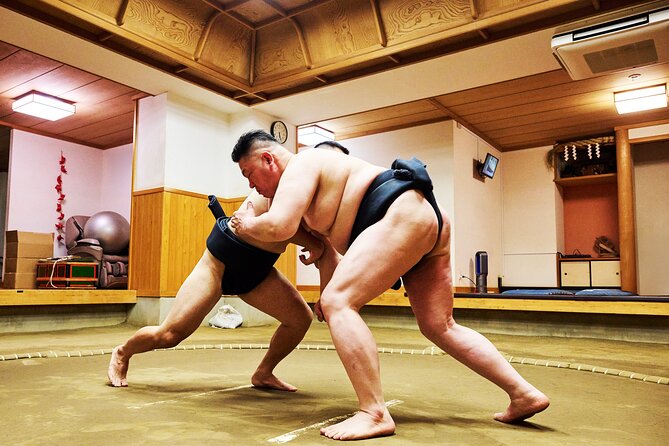
The most memorable part of this Tokyo experience is the chance to watch sumo inside a real stable, then see a one-round match before the wrestlers invite people into the ring. This is not a tournament and the performers are retired wrestlers, but you still get a close look at the sport’s force, rituals, and humor.
I like the clear cultural explanation, which gives the show more meaning than a simple wrestling demonstration. I also like the audience challenge, especially for families and anyone willing to get a little dusty. The main drawback is important: women cannot enter the ring, and the 90-minute visit may feel short if you want a longer lesson or a full tournament.
Key points to know before you book
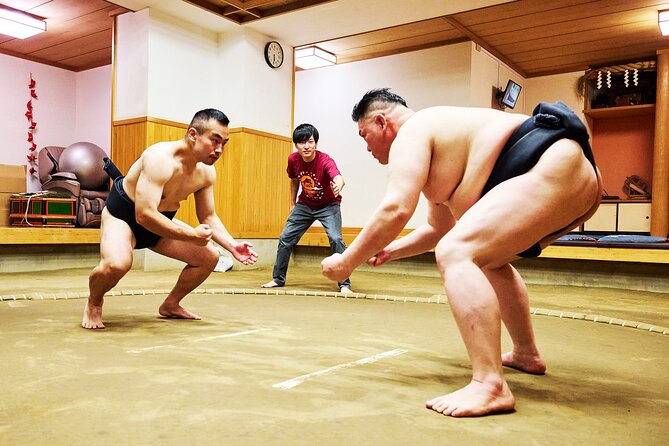
- You visit a real sumo stable: The show takes place inside a stable founded by one of Japan’s legendary sumo champions.
- The wrestlers are retired: You see experienced former wrestlers rather than active competitors in training.
- A one-round match is included: The demonstration gives you a direct look at the sport’s power and style.
- You may enter the ring: Men and boys can try sumo themselves, but clothes may get dirty.
- Women cannot enter the ring: This follows the traditional rule explained for the activity.
- The guide speaks English: A guide leads the history, customs, and audience interaction.
What happens inside the Kiyosumi sumo stable
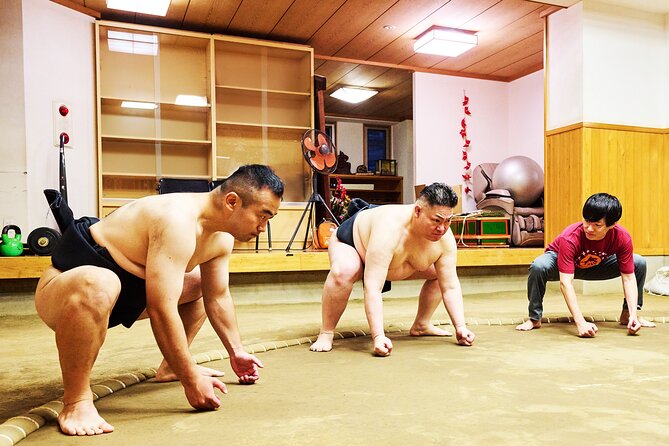
This is a compact Tokyo activity, lasting about one hour and 30 minutes. You meet at an address in Kiyosumi, in Tokyo’s Koto City, near public transportation, and the experience ends at the same place.
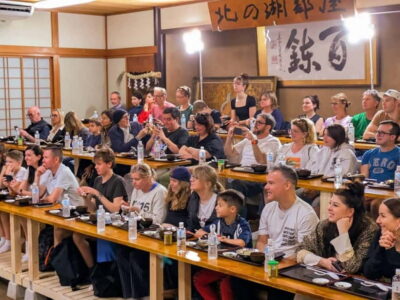
The setting does much of the work. Instead of watching from a large arena, you enter a working-style sumo stable that keeps traditional customs. That gives the visit a more personal scale. You are close enough to see the wrestlers’ size, balance, footwork, and physical control without the distance of a major sporting venue.
The stable was founded by one of Japan’s legendary sumo champions, which adds useful context to the setting. You are not simply sitting in a rented theater for a themed show. At the same time, keep your expectations in check. This is a cultural performance led by retired sumo wrestlers, not a visit to an active training stable. If your main goal is to watch current wrestlers practice, you need to consider another Tokyo option.
The English-speaking guide explains the basic history and customs before the physical part of the show begins. This matters because sumo can look simple at first glance: two large wrestlers push, shove, and try to force one another out of the ring. The guide helps you understand why the ring, gestures, practice, and rules matter.
More Tokyo sumo experiences:
- Tokyo: Sumo Show and Dining Experience
★ 4.8 · 2,742 reviews - the SUMO show
★ 5.0 · 1,960 reviews - Tokyo Shinjuku Sumo Show & Experience with Photo
★ 5.0 · 1,750 reviews
Why the history and customs make the show better
The strongest part of this experience is not just the wrestling. It is the explanation of sumo as a Japanese tradition.
You learn about the sport’s background, its training, and the customs around the ring. The focus leans more toward culture than nonstop wrestling, which is useful if you are visiting Japan for more than a photo opportunity. The guide helps connect the physical demonstrations with the larger role sumo plays in Japanese life.
That balance also makes the experience suitable for people who do not follow professional sumo. You do not need to know the names of champions or understand tournament rankings before arriving. The presentation gives you a basic framework, then lets you watch the former wrestlers demonstrate what the sport demands.
The show is also designed to be entertaining. The wrestlers have large personalities, and the audience challenge brings plenty of laughter. I would describe the tone as educational first, playful second, and competitive only in a very limited sense. You are not entering a serious contest against a current champion.
For families, that mix is useful. Children can see the history and physical action, while adults get a better sense of how sumo works. The short format helps keep the visit manageable during a busy Tokyo day.
The one-round match gives you a close look at sumo
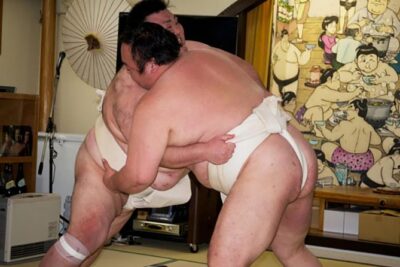
A one-round match is part of the show. It does not recreate a full tournament day, but it gives you a concentrated demonstration of the sport’s central idea: use balance, position, force, and timing to put your opponent outside the ring or onto the ground.
The short match format works well within a 90-minute visit. You see the wrestlers prepare, watch the action, and then have time for explanations and audience participation. You are not waiting through a long series of bouts, so this is a better fit for a first introduction than for someone seeking an entire day of sumo competition.
The physical reality is easy to appreciate at close range. Sumo is not just about being heavy. The wrestlers need control, speed, balance, and the ability to absorb force. Seeing retired wrestlers demonstrate those qualities makes the sport easier to understand than reading about it.
Still, the match is only one part of the visit. If your ideal sumo experience means sitting in a stadium for hours and watching many official bouts, this show will not replace a tournament ticket. If you want a focused introduction with a chance to interact, the format makes more sense.
The audience challenge is the most unusual feature
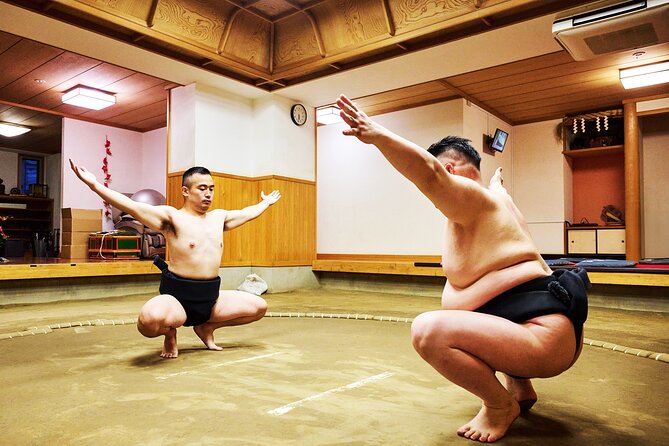
After the demonstration, you may be invited to enter the ring and try sumo against one of the retired wrestlers. This is the part that separates the experience from a standard cultural presentation.
You should treat the challenge as a playful demonstration, not a test of strength. The wrestlers know how to control the exchange, and the point is to let you feel the basic physical idea of sumo. Even a brief attempt can show how difficult it is to move someone who is trained, balanced, and much larger than most people.
The ring is also a traditional space, so there are rules about who may enter. Women cannot enter the ring as part of the customs preserved at the stable. Men and boys may be able to take part, depending on the activity’s arrangements and available volunteers. The supplied information specifically points to the ring challenge as a highlight for men and children.
Wear clothes that can get dirty if you plan to participate. This is practical advice, not a style suggestion. You may be in close contact with the ring surface or the wrestler, so avoid wearing an outfit that needs careful handling.
If you are not eligible to enter the ring, the show still includes the explanation, demonstrations, and match. But the gender rule can affect how your group feels about the experience. Families and mixed groups should discuss that point before booking, especially if one person expects to take part.
More Tokyo shows and performances:
- Mt Fuji & Hakone Cruise, Drum Show Bullet Train 1 Day from Tokyo
★ 4.0 · 7,413 reviews - Mt Fuji & Hakone Cruise, Drum Show Bus 1 Day from Tokyo
★ 4.0 · 1,287 reviews - Tokyo: Sumo Show and Experience in Shinjuku
★ 4.8 · 1,001 reviews - Tokyo:Luxury Sumo Show Experience & Japanese cuisine & Drink
★ 4.7 · 577 reviews
A real stable, but not an active training visit
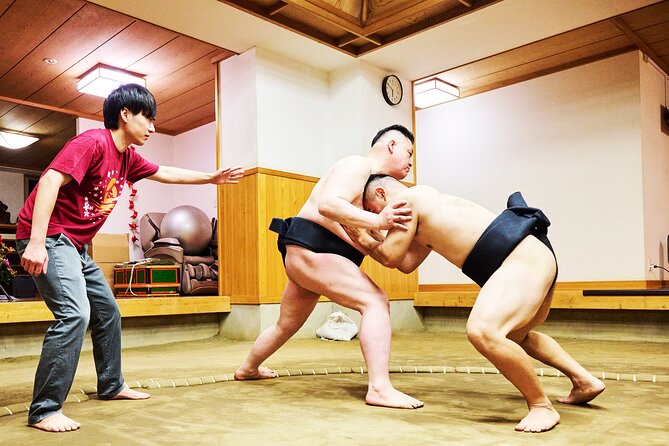
The word stable can create confusion. In sumo, a stable is the place where wrestlers live and train, and the setting here preserves that traditional atmosphere.
This particular activity is performed by retired sumo wrestlers. That means you get people with direct experience of the sport, but you are not watching an active stable’s daily training session. The distinction matters if you are comparing this with an early-morning practice visit.
I like the retired-wrestler format for a first-time visitor because it allows more conversation, explanation, and audience participation. Active athletes have demanding schedules and strict training routines. A presentation led by retired wrestlers can give you more room to learn and laugh.
On the other hand, it is less authentic in the narrow sense of seeing current competitors prepare for a tournament. The activity is best understood as a guided cultural show in a genuine sumo setting. That is still a meaningful experience, but it is not the same product as observing an active stable.
Is $84.78 a fair price for 90 minutes?
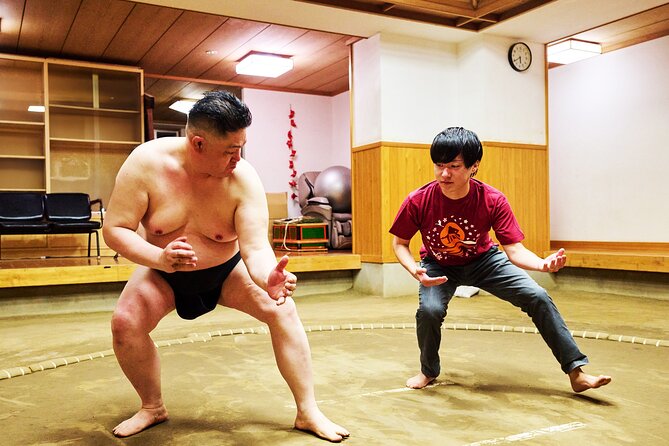
At $84.78 per person, this is not a cheap casual attraction. The value depends on what you want from your Tokyo visit.
You are paying for access to a traditional sumo setting, an English-speaking guide, a live demonstration, a one-round match, and the possibility of entering the ring. That combination is more personal than simply watching a performance from a seat. The chance to be close to retired wrestlers and learn directly from them gives the price a reasonable basis.
The duration is also worth considering. Ninety minutes is long enough for a focused introduction, but short enough to fit before dinner, a museum visit, or another Koto City stop. You do not need to surrender half a day to learn the basics.
The value is weaker if you want a serious sporting event, an active stable visit, or a meal included in the price. Food is not included, and private transportation is not included. You arrange your own way to the meeting point and back.
For a family, the cost can add up quickly, especially if only some members can join the ring. For someone fascinated by Japanese customs, or for a child who dreams of trying sumo, the interactive element may justify the price. I would book it for the access and personal contact, not for the length alone.
Finding the meeting point and planning your visit
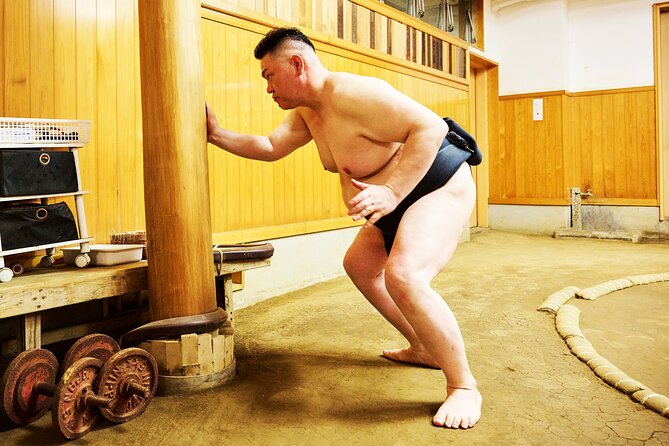
The meeting point is in Kiyosumi, Koto City, at the address listed as Japan, 135-0024 Tokyo, Koto City, Kiyosumi, 2-chōme83 エスペランサタイホウ. The activity is near public transportation, which helps, but you should still allow time to find the exact entrance.
A mobile ticket is provided, so keep your booking available on your phone. Confirmation arrives at booking, which makes the arrangement simple once your time is set.
The experience begins and ends at the same meeting point. There is no private transport, so you need to plan your route independently. That is not a major problem in Tokyo, but it is worth checking the journey before the day of the visit rather than arriving rushed.
The group can have up to 40 people. That is not a tiny private class, so your view and chance to participate may depend on where you are positioned and how many people volunteer. The group limit does keep the event more controlled than a large public show.
Most people can take part in the general experience. The main special rule concerns entering the ring. Women cannot do so, and anyone who tries sumo should wear clothes that can get dirty.
Photo rules and respectful behavior
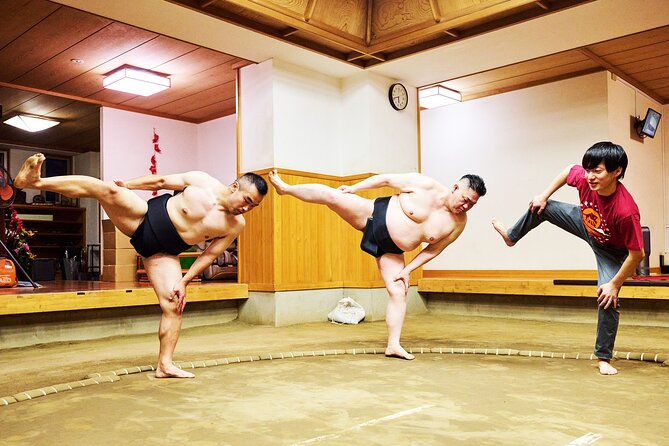
Photos are allowed, but you are asked not to post them online out of respect for the culture. Follow that rule carefully. A camera-friendly experience is not an invitation to treat the stable like a backdrop for social media.
The best approach is to listen when the guide explains customs and to wait for clear permission before photographing a person closely. You are entering a traditional space, and the setting deserves more care than a quick entertainment stop.
This also helps you focus on the parts that photographs cannot capture well: the sound of bodies hitting the ring, the control needed to stop safely, and the humor between the guide, wrestlers, and audience. You can take photos, but the experience is more than a collection of images.
Who will enjoy this Tokyo sumo experience?
I would recommend this activity most strongly to:
- Families with children who enjoy active demonstrations
- First-time visitors who want an introduction to sumo culture
- Adults interested in Japanese tradition but not ready for a full tournament day
- Men and boys who would like a chance to try the ring challenge
- Visitors who prefer a small cultural activity that fits into a larger Tokyo schedule
You should think twice if you need equal ring participation for everyone in your group. The rule barring women from the ring is not a minor detail. You should also choose another option if watching active wrestlers train is your main goal.
The presentation may suit you less if you want a quiet, formal museum-style lesson. The wrestlers’ personalities and the audience challenge make the tone lively. That is part of the appeal, but it will not suit every mood.
A practical booking decision
Free cancellation is available if you cancel at least 24 hours before the local start time. Cancellations or changes made within 24 hours are not refunded or accepted, so keep your Tokyo schedule firm once that deadline passes.
The activity has a five-star rating from 40 reviews, with 100 percent recommending it. The strongest themes are consistent: people value the history, the mix of education and laughter, the entertaining wrestlers, and the chance to take part. One visitor also found the host easy to locate and helpful, while the provider identified the host as Ayaka in its response. Another reference names the host as Aika, so the name may be spelled differently in different accounts.
Should you book this sumo show?
Book it if you want a short, lively introduction to sumo in a real stable, with clear cultural background and a chance to try the sport. The retired wrestlers, one-round match, and audience challenge give you more contact than a standard stage performance.
Skip it if you want an active stable, a full professional tournament, or a ring experience open to every member of your group. At $84.78, the price makes sense for the setting and interaction, not for the 90-minute length alone.
For most first-time visitors who are curious about sumo and comfortable with its traditional rules, this is a practical and entertaining choice. Just arrive ready to listen, respect the customs, and keep your clothes suitable for the ring.
FAQ
How long does the Tokyo Sumo Experience last?
The experience lasts approximately one hour and 30 minutes.
Where does the activity take place?
It takes place in a real sumo stable in Kiyosumi, Koto City, Tokyo. The meeting address is Japan, 135-0024 Tokyo, Koto City, Kiyosumi, 2-chōme83 エスペランサタイホウ.
Does the activity include an English-speaking guide?
Yes. An English-speaking guide leads the experience and explains sumo history and customs.
Are the wrestlers active sumo competitors?
No. The show is performed by retired sumo wrestlers.
Can I enter the sumo ring?
Some participants can enter the ring to try sumo with a wrestler. Women cannot enter the ring as part of the traditional rules described for this activity.
Should I wear special clothes?
No special clothing is listed, but you should wear clothes that can get dirty if you plan to try sumo in the ring.
Are photos allowed?
Yes, photos are allowed. You are asked not to post them online out of respect for the culture.
Is transportation or food included?
No. Meals and private transportation are not included. You make your own way to the meeting point, which is near public transportation.
What is the cancellation policy?
You can receive a full refund if you cancel at least 24 hours before the experience’s local start time. Cancellations or changes made less than 24 hours before the start time are not accepted and are not refunded.
Newly reviewed around Tokyo
- Tokyo Asakusa:Calligraphy & Make T-shirt Activity★ 5.0 · 62 reviews
- Intercity Shuttle, Tokyo to Haneda /Narita /Yokohama /Makuhari★ 5.0 · 5 reviews
- 1 Hour Travel around Tokyo with a Professional Photographer★ 5.0 · 3 reviews
- Travel Tokyo with Your Own Personal Photographer★ 5.0 · 43 reviews
- Train in Samurai Swordsmanship and Defeat the Demon in Tokyo★ 5.0 · 5 reviews
- Shuttle Van 6hr Tokyo Tour to-and-from Tokyo, Yokohama and Narita★ 5.0 · 9 reviews
- Kickboxing & Body Training with EX-Pro Fighter★ 5.0 · 4 reviews
- Tokyo History: Sensoji Temple & Asakusa District Private Tour★ 5.0 · 28 reviews
Tokyo Sumo Experiences, compared.
Tokyo Shinjuku Sumo Show & Experience with Photo
Read our review →

Luxury Sumo Show Experience & Japanese cuisine & Drink
Read our review →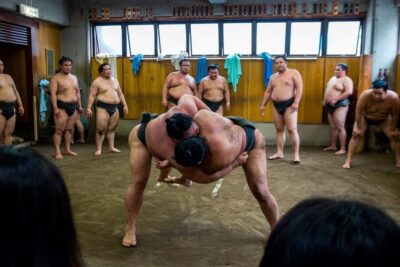
Tokyo Sumo Experience: Chanko & Mochi with a Former Pro
Read our review →
Ultimate Sumo Tournament: Tokyo, Osaka, Nagoya, Fukuoka
Read our review →Browse the lists this tour appears in