
Reviewed · AUDIO TOURS
Tokyo: Open Top Sightseeing Bus with Audio Guide
Tokyo’s best feature here is the open-air view. From the upper deck, you can connect the city’s huge pieces at a glance: Tokyo Tower, Ginza, Tokyo Bay, Rainbow Bridge, and Odaiba. I like the low price and the easy 70-minute format, which is useful on your first day or during a short stay.
I also like the GPS audio system, which supplies commentary in Japanese, English, Chinese, French, Korean, Vietnamese, or Thai. The catch is that this is a sightseeing ride, not a hop-on, hop-off service. You stay aboard, and the recorded commentary may not always match what you are looking at.
Key points to know before booking
- Tokyo Bay and city sights in one ride: The Bay Course links Tokyo Tower, Rainbow Bridge, Odaiba, Ginza, and waterfront views.
- Two routes are available: Choose the Bay Course for water and skyline views, or the City Course for central Tokyo landmarks.
- The bus does not stop for sightseeing: You cannot get off at the attractions during the 70-minute ride.
- Seven audio languages: Commentary is GPS-triggered, but bring earphones with a 3.5mm mini plug or rent them for 100 yen.
- The open roof depends on weather: The tour runs in rain unless conditions become extreme, but the roof may be closed.
- Arrive early at Tokyo VIP Lounge: Check in 20 to 40 minutes before departure, since late arrivals are not accepted.
Why this bus ride works well on a first day in Tokyo
Tokyo can feel like several cities stitched together. One district has office towers, another has old temples, another opens onto the bay, and the streets between them can seem endless. A bus ride helps you get a broad sense of the place before you start exploring on foot.
This is especially useful if you have just arrived after a long flight. You can sit, watch the city pass, and pick out areas you want to revisit later. One hour and 10 minutes is long enough to see a good spread of Tokyo without taking up half your day.
The ride is also a good choice if your energy is limited, if you are traveling with older family members, or if you want a simple activity between more demanding visits. You are not navigating train transfers or searching for a viewpoint. You simply board and look around.
Still, keep your expectations in the right place. This is not a guided walking tour, and it does not give you time inside Tokyo Tower, Zojoji Temple, the Imperial Palace area, or any other sight. Think of it as a moving introduction rather than a full visit.
More Tokyo self-guided and audio tours:
- Tokyo: Open Top Panoramic Sightseeing Bus with Audio Guide
★ 3.8 · 254 reviews - Tokyo: 60min Panoramic Open Top Bus Tour with Audio Guide
★ 4.0 · 40 reviews - Akihabara: Self-Guided Tour with a special brochure
★ 3.7 · 11 reviews
The Bay Course, from Tokyo Station to Rainbow Bridge
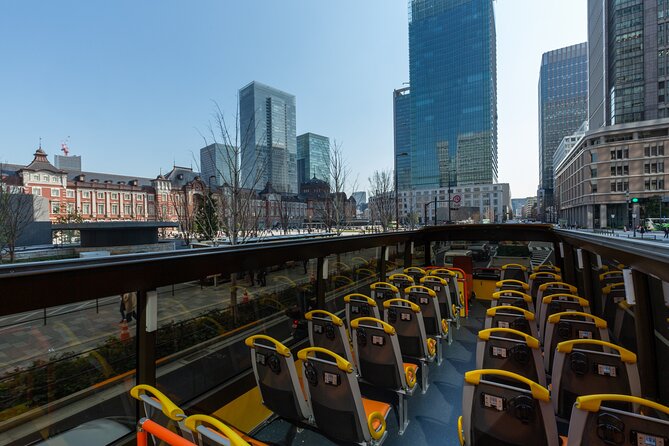
The Bay Course gives you the clearest sense of Tokyo’s variety. It begins near the Tokyo Station Red Brick Station Building, then heads through Marunouchi, one of the city’s major business districts.
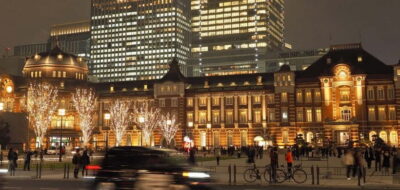
The station building is one of Tokyo’s most recognizable pieces of early modern architecture. From the bus, you get an exterior view rather than a detailed visit. That is enough to place the area in context, especially if you plan to return to Tokyo Station for trains or nearby shopping.
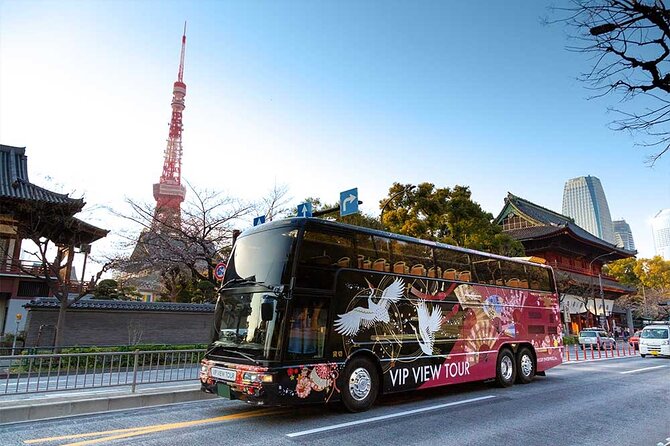
The route continues toward Zojoji Temple and Tokyo Tower. Zojoji brings a traditional religious setting close to Tokyo Tower’s famous orange-and-white structure. This pairing is one of the most useful visual lessons in Tokyo: an old temple and a modern landmark can sit within the same city view.
Tokyo Tower is best appreciated from a little distance. From an open-top bus, you may get angles that are harder to find at street level, though traffic and surrounding buildings can affect the view. Keep your camera ready, but do not expect every sight to appear at the perfect moment.
Crossing the Rainbow Bridge toward Odaiba
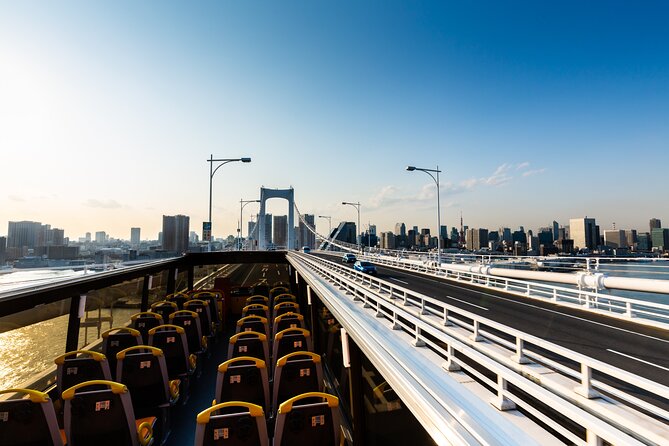
The route then reaches Shibaura and the first level of Rainbow Bridge. The bridge links central Tokyo with the waterfront district of Odaiba, and the ride gives you an unusual sense of the city’s scale.
The bay section is the main reason to choose this course. Tokyo’s waterfront has broad views that you cannot get in the tighter streets of Ginza or Marunouchi. On a clear day, the open upper deck should give you a better sense of the water, the bridge, and the spread of high-rise Tokyo.
The route continues past the Fuji TV Building, the Statue of Liberty replica, and Odaiba Seaside Park. The small Statue of Liberty is a playful landmark, while the waterfront park offers a more open setting than central Tokyo.
Odaiba is not a traditional old-town district. It is a planned waterfront area with modern buildings, broad public spaces, and bay views. The bus lets you see it without committing to a longer visit. If the area catches your interest, you can return later by train or on another outing.
The Bay Course then crosses the second level of Rainbow Bridge, before continuing through Shiodome and Ginza. The two bridge sections help make this more than a standard city circuit. You see Tokyo from the water-facing side, then return toward the central districts.
Ginza and the final stretch through central Tokyo
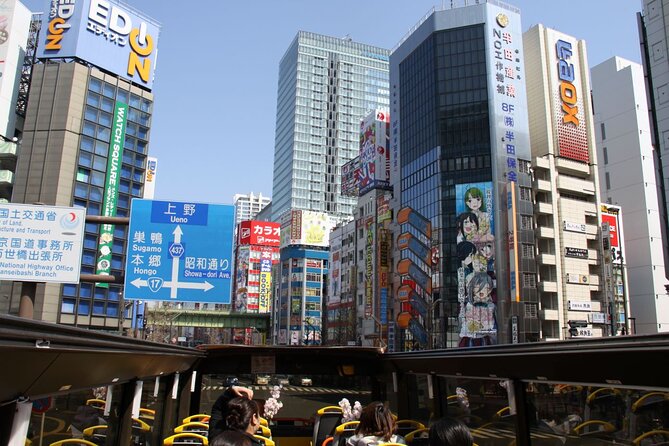
Ginza is one of Tokyo’s best-known shopping and dining areas. From the bus, you see the district as a polished central corridor rather than as a place to browse individual shops.
That distinction matters. This ride gives you an overview, but you will not have time to get off for department stores, cafés, or galleries. If you want to explore Ginza properly, use the bus ride to mark it for a later walk.
The route ends back at the meeting point. Since the experience is not hop-on, hop-off, you cannot use it as transportation between sightseeing stops. The benefit is a fixed, relaxed circuit. The drawback is that your time is not flexible once the bus leaves.
A completely different kind of day in Tokyo:
- Mt Fuji and Hakone 1-Day Bus Tour Return by Bullet Train
★ 5.0 · 26,383 reviews - 1-Day Tokyo Bus Tour
★ 5.0 · 14,250 reviews - Tokyo: teamLab Planets TOKYO Digital Art Museum Entry Ticket
★ 4.6 · 9,779 reviews - Mt Fuji & Hakone Cruise, Drum Show Bullet Train 1 Day from Tokyo
★ 4.0 · 7,413 reviews
What you see on the City Course

The City Course focuses more on central Tokyo. Its listed sights include the Imperial Palace area, Tokyo Midtown, Roppongi, Tokyo Tower, and Ginza.
This route may suit you better if your priorities are the city center, major business districts, and Tokyo’s well-known towers. It offers a different view from the Bay Course, with less emphasis on water and Odaiba.
The Imperial Palace area is important for understanding Tokyo’s political and historical center, though the bus ride is only a passing view. Tokyo Midtown and Roppongi show another side of the city, with modern architecture, offices, shops, and entertainment venues.
Tokyo Tower appears on both route descriptions, making it a central feature of the experience. If seeing the tower is high on your list, either course may work, but the surrounding sights differ.
The supplied route details do not give every street or turn for the City Course. If you are choosing between the two, ask at the meeting point which course is operating at your preferred time and confirm the exact departure information. The Bay Course is the clearer choice if Rainbow Bridge, Odaiba, and Tokyo Bay are your main interests.
The GPS audio guide and what to bring
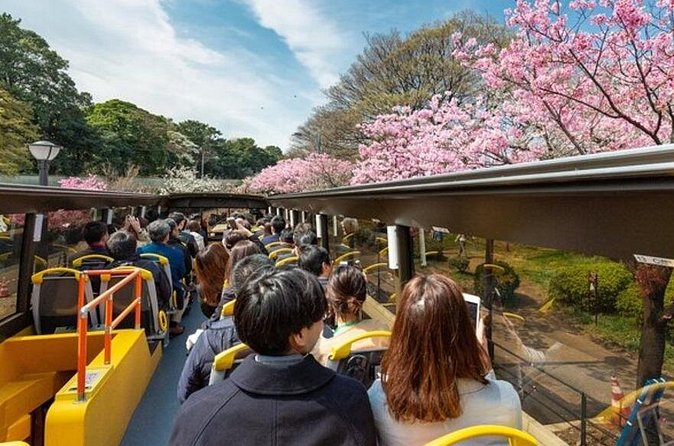
The audio system is designed to start commentary based on the bus’s location. It can provide information in Japanese, English, Chinese, French, Korean, Vietnamese, and Thai.
That setup is convenient because you do not need to follow a live guide while looking around. The system also adjusts to traffic and road conditions, so the timing is intended to follow the moving route.
You should bring your own earphones if possible. The bus supports only 3.5mm mini plugs, not every modern wireless or phone-specific connection. Earphones can be rented for 100 yen, but bringing a compatible pair saves a small purchase and avoids uncertainty at boarding.
Recorded commentary has limits. On a moving bus, a landmark can appear before the explanation, or traffic can change the timing. Keep your eyes up and treat the audio as background context, not as a perfectly synchronized private guide.
The experience includes Japanese-speaking staff for assistance, but it does not include a live guide. If personal stories, questions, or detailed explanations matter most to you, a walking tour with a human guide may be a better fit.
The open-top experience and weather rules

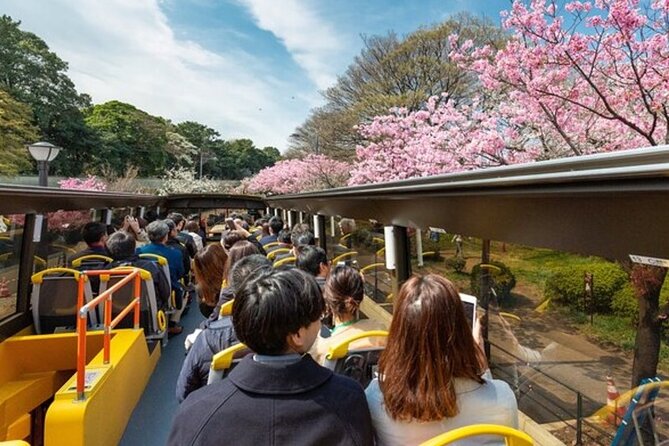
The upper deck is the main attraction. You get a higher view than from a normal car or city bus, and the lack of a roof gives you a stronger sense of Tokyo’s size and movement.
The open top can also make the ride more exposed. Weather matters, especially during rain or strong winds. The tour normally operates rain or shine, but the open top may be closed when it rains, and cancellations are reserved for extreme conditions such as typhoons.
Do not bring an umbrella for use on the bus. Umbrellas, food, smoking, and selfie sticks are not allowed. Dress for the forecast and keep your belongings secure, since the ride is exposed to the weather even when the roof is open.
The schedule can change slightly because of traffic, weather, or other road conditions. Tokyo roads can be slow, so the listed 70 minutes should be treated as an approximate duration rather than a precise promise.
The meeting point near Tokyo Station
You meet at Tokyo VIP Lounge, Japan, 103-0028 Tokyo, Chuo City, Yaesu, 1-chome 5-9, 2nd and 3rd floors. Check the location carefully before leaving, since arriving at the wrong place does not qualify for a refund.
You are asked to check in 20 to 40 minutes before departure. The bus leaves on time and does not wait for late arrivals, even if you contact the operator. Build in extra time for finding the building and reaching the correct floor.
The lounge is a paid facility, but open-top bus customers can use it free of charge starting 40 minutes before departure. Outside that period, a facility fee may apply. The space is shared with other users, so follow the on-site rules and allow time to check in calmly.
The meeting point is near public transportation, which is useful in central Tokyo. The activity ends back at the same location.
Price, group size, and practical value
At $11.71 per person, this is an inexpensive way to see a large part of Tokyo from a different angle. You are paying for a fixed route, an open-top bus seat, and audio commentary, not entry to attractions or a personal guide.
The price works best if you value orientation. A single train ride may cost less, but it will not show you the city continuously or explain what you are passing. A taxi could offer a private view, but would cost much more and would not provide the same upper-deck experience.
The group can reach 40 people. That is small enough to keep the ride manageable, but it is not an intimate tour. Seat choice and visibility may matter, so arriving early for check-in is sensible even though boarding procedures are controlled by the operator.
You may bring one piece of luggage per person. Anything stored in the trunk cannot be reached during the ride, and the combined height, width, and depth must not exceed 155 centimeters. Keep passports, phones, cameras, and other valuables with you.
Free cancellation is available up to 24 hours before the start time. Cancellations made inside that window are not refunded, and late arrival is not covered. If the minimum number of participants is not reached, the operator offers another date or experience, or a full refund.
Who should book this Tokyo bus ride?
I would choose this for a first visit, a short stop in Tokyo, or a low-effort first-day activity. It is also useful if you want to compare the city center with the bay before deciding where to spend your walking time.
The Bay Course is the stronger choice for:
- Rainbow Bridge and Tokyo Bay views
- Odaiba and Odaiba Seaside Park
- A mix of Tokyo Tower, Ginza, and waterfront districts
- A scenic ride with more open space
The City Course is better for:
- The Imperial Palace area
- Roppongi and Tokyo Midtown
- Central Tokyo streets and business districts
- A shorter focus on major city landmarks
I would not book it if you want to enter attractions, take long photo stops, or ask a guide questions along the way. The recorded narration can be slightly out of sync with the view, and repeated music between sections may bother you if you prefer quiet.
Should you book it?
Book this tour if you want a cheap, simple orientation ride with good chances for broad city views. The Bay Course offers the most distinctive scenery, especially around Rainbow Bridge and Odaiba, while the City Course keeps you closer to Tokyo’s central landmarks.
Skip it if your priority is hands-on sightseeing. You cannot get off, the audio is recorded, and traffic or weather can affect the ride. For everyone else, it is a practical way to get your bearings without spending a full day or much money.
FAQ
How long does the open-top bus tour last?
The ride lasts approximately 1 hour and 10 minutes.
Is this a hop-on, hop-off bus?
No. This is a fixed sightseeing ride, and you cannot get off at the attractions during the tour.
What languages are available for the audio guide?
The GPS-enabled audio guide is available in Japanese, English, Chinese, French, Korean, Vietnamese, and Thai.
Do I need to bring earphones?
You should bring earphones with a 3.5mm mini plug. Optional earphones are available for 100 yen.
Where does the tour begin and end?
It begins and ends at Tokyo VIP Lounge in Yaesu, Tokyo. Check in 20 to 40 minutes before departure.
Does the tour operate in bad weather?
The tour operates rain or shine except in extreme conditions such as typhoons. If it rains, the open top may be closed.
Newly reviewed around Tokyo
- Tokyo Asakusa:Calligraphy & Make T-shirt Activity★ 5.0 · 62 reviews
- 1 Hour Travel around Tokyo with a Professional Photographer★ 5.0 · 3 reviews
- Travel Tokyo with Your Own Personal Photographer★ 5.0 · 43 reviews
- Intercity Shuttle, Tokyo to Haneda /Narita /Yokohama /Makuhari★ 5.0 · 5 reviews
- Train in Samurai Swordsmanship and Defeat the Demon in Tokyo★ 5.0 · 5 reviews
- Shuttle Van 6hr Tokyo Tour to-and-from Tokyo, Yokohama and Narita★ 5.0 · 9 reviews
- Kickboxing & Body Training with EX-Pro Fighter★ 5.0 · 4 reviews
- Traditional Japanese Knife Sharpening Class★ 5.0 · 18 reviews
Audio Tours, compared.
Open Top Panoramic Sightseeing Bus with Audio Guide
Read our review →
60min Panoramic Open Top Bus Tour with Audio Guide
Read our review →

Sumo Keiko Training Tour with Audio Guide & Photo
Read our review →Browse the lists this tour appears in