
Reviewed · TOKYO
Urban Geometry with Laurence Bouchard
Tokyo makes more sense when you stop chasing famous sights and start watching its lines, shadows, and reflections. Laurence Bouchard’s four-hour workshop leads you from Ebisu to Yurakucho, using ordinary corners, glass walls, and structured spaces as lessons in seeing.
I like the small maximum of six people, which gives Laurence room to look at your images and offer useful advice. I also like that the workshop is built around skills you can use in any city, not just a set of Tokyo snapshots.
The main consideration is the pace. You will move between several neighborhoods by public transportation, walk on comfortable shoes, and spend much of the morning looking closely at light and composition rather than sightseeing in the usual way.
Key points at a glance
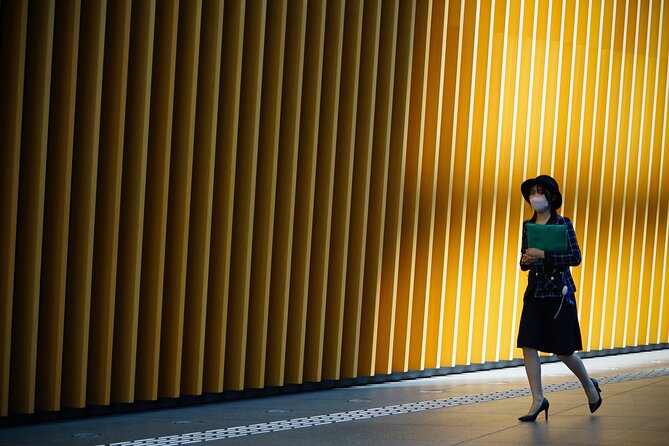
- Start at Ebisu Garden Place: Use the trellised canopy and changing shadows for strong graphic compositions.
- Practice in several Tokyo settings: Move from Roppongi and the National Art Center to the Tokyo International Forum.
- Get individual feedback: Laurence reviews your work and adjusts advice to your camera and level.
- Work in black and white: High-contrast scenes make lines, shapes, and timing easier to study.
- Keep the group small: With no more than six people, there is time for questions and personal guidance.
- Prepare for a mobile morning: Bring a fully charged phone or camera, comfortable shoes, and a Suica or PASMO card if possible.
Why this Tokyo workshop is different
Many Tokyo photo outings send you toward the same familiar views. This one asks you to look at the city as a collection of shapes. A canopy becomes a repeating pattern. A glass facade becomes a wall of reflections. A passageway becomes a study in symmetry and shadow.
That approach is useful because it does not depend on owning an expensive camera. Laurence works with your camera and skill level, so you can take part with the equipment you already use. The goal is not simply to collect attractive pictures. You are practicing how to choose a frame, wait for the right moment, and remove distractions.
The focus on high contrast and black and white also gives the morning a clear purpose. Color can distract you with signs, clothing, and bright storefronts. Without it, you pay more attention to brightness, darkness, texture, and form. Those lessons remain useful long after you leave Tokyo.
The experience lasts about four hours and begins at 9:00 a.m. It is a working photo session, not a general city tour. You should expect instruction, walking, short rides between areas, and time spent making and discussing images.
Other Tokyo days people book alongside this one:
- Mt Fuji and Hakone 1-Day Bus Tour Return by Bullet Train
★ 5.0 · 26,383 reviews - 1-Day Tokyo Bus Tour
★ 5.0 · 14,250 reviews - Tokyo: teamLab Planets TOKYO Digital Art Museum Entry Ticket
★ 4.6 · 9,779 reviews
Ebisu Garden Place begins the lesson
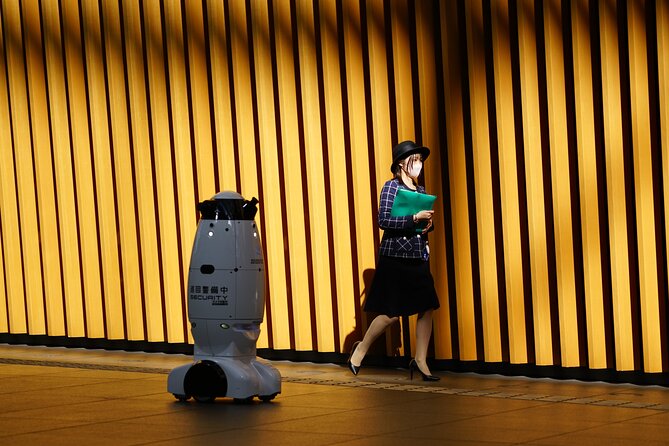
The meeting point is at 4-chōme-2-6 Ebisu, in Shibuya, and the first stop is Ebisu Garden Place. This is a strong opening because the site offers a clear visual subject right away: a broad garden complex with shadows cast by a trellised canopy.
Here, Laurence can help you notice repetition and structure. The canopy creates lines across the frame, while sunlight breaks the pattern into bright and dark sections. You might work on keeping the composition spare, finding a clean angle, or waiting until a person gives the image a sense of scale.
This is also a good place to settle into the workshop. You are not asked to produce a perfect image at once. Instead, you begin testing how small changes in position affect the pattern. Step one way and the lines may overlap. Step another way and the shadows may separate into a more ordered design.
I like this sort of start because it turns a familiar public space into a practical exercise. You do not need a postcard view or a dramatic landmark. You need patience and a willingness to study what is already in front of you.
Roppongi shifts the focus to less obvious corners
The group then heads to Roppongi for several less familiar shooting locations. The supplied details do not specify every exact corner, so you should think of this part as a search for patterns and unusual angles rather than a fixed sightseeing stop.
Roppongi gives the workshop a useful change of pace. After the controlled geometry of Ebisu Garden Place, you can look for different arrangements of lines, surfaces, and people. Laurence may suggest a frame that you would normally walk past, or help you simplify a scene that first appears too busy.
This is where the workshop’s central idea becomes more practical. Tokyo can present too much information at once. Signs, buildings, pedestrians, railings, and reflections compete for your attention. The task is to decide what belongs in the photograph and what does not.
A small group matters here. One person may spot a strong reflection, while another may need help with exposure or framing. With a maximum of six people, Laurence has a reasonable chance to give each participant attention instead of turning the session into a general lecture.
The National Art Center offers glass, light, and scale
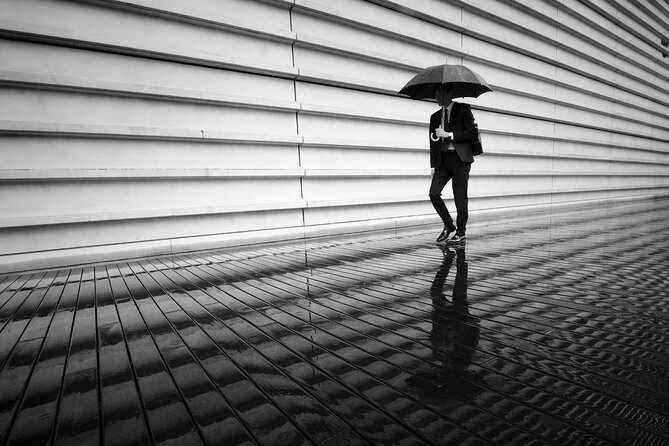
The next major setting is the National Art Center, Tokyo. Its large glass facade supplies a very different subject from the canopy at Ebisu. The building’s scale and transparent surfaces can create reflections, overlapping forms, and strong areas of light and shade.
This is likely to be one of the most rewarding stops if you enjoy architecture. A glass wall can show the outside world while also revealing the structure of the building itself. That creates layered pictures, but it can also make compositions confusing. Laurence’s job is to help you decide where to place the edges of the frame and which shapes deserve attention.
The facade also makes timing important. Shadows change as the morning progresses, and a person passing through the frame can alter the balance of an image. The workshop gives you a chance to practice waiting for that moment instead of pressing the shutter as soon as you see an interesting shape.
One useful detail from the experience is Laurence’s willingness to act as a passerby when a scene needs a human figure. That is a simple but practical touch. A person in the frame can show scale or add movement, and you do not have to wait endlessly for the right stranger to appear.
The National Art Center is also a good test of equipment. You may be working with a phone, a compact camera, or a larger interchangeable-lens camera. Since the advice is tailored to your own gear, you can ask about the tools you actually carry rather than receiving generic camera instruction.
A completely different kind of day in Tokyo:
- Mt Fuji & Hakone Cruise, Drum Show Bullet Train 1 Day from Tokyo
★ 4.0 · 7,413 reviews - Tokyo: Shinjuku Food Tour (13 Dishes at 4 Local Eateries)
★ 5.0 · 6,603 reviews - Tokyo Mt Fuji 5th St & Hakone Cruise Bus Tour w/Bullet Train
★ 4.4 · 5,024 reviews - Flagship 2-Hours Official Street Go-Kart Tour – Tokyo Bay Shop
★ 5.0 · 4,974 reviews
Tokyo International Forum reveals Yurakucho from below
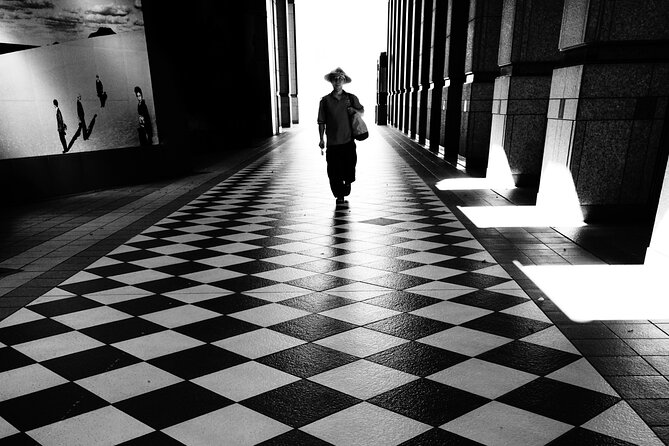
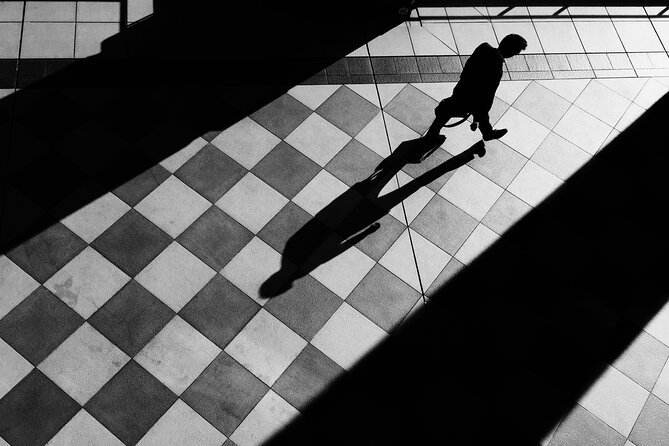
The final photographic setting is the Tokyo International Forum in Yurakucho. The focus here is on its hidden depths, which suggests a more enclosed and structural way of seeing Tokyo.
The Forum is well suited to this workshop because its interior spaces can be read as lines, curves, glass, and repeated architectural elements. You might find that the strongest image is not a broad view of the building, but a cropped section that removes its obvious identity and turns it into an abstract arrangement.
This stop should help you connect the morning’s exercises. At Ebisu, you work with shadows and repetition. In Roppongi, you search for less expected compositions. At the National Art Center, you deal with reflections and scale. At the Tokyo International Forum, those ideas come together in a place where the architecture itself provides the frame.
The activity ends back at the meeting point. Since the route covers Ebisu, Roppongi, and Yurakucho, you should expect transportation between locations rather than one long walk through a single district. A Suica or PASMO card is recommended if possible, which should make those metro connections easier.
What Laurence Bouchard adds to the morning
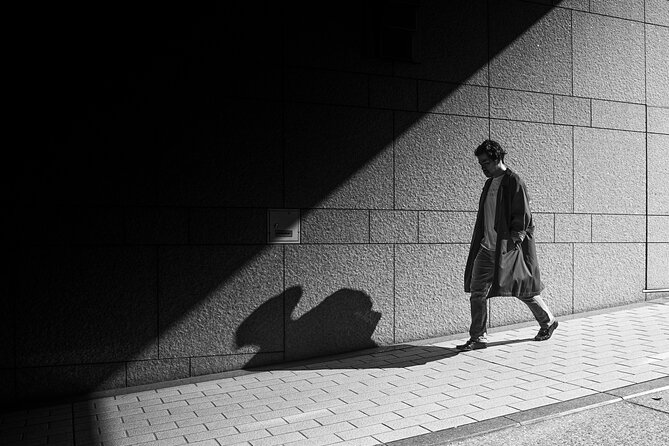
The value of this experience rests heavily on Laurence’s teaching style. You are not simply following a photographer to attractive locations. You receive practical feedback about your own images, including how to improve framing, timing, and the use of light.
That feedback can be especially helpful if you take many photographs but are not sure why some work better than others. Laurence can point to the distracting edge of a frame, the stronger position for a subject, or the moment when a shadow creates a cleaner shape.
The workshop also has a human element. Laurence has modeled for participants in quieter spaces and stepped into a frame when a passerby was needed. Those small actions make the instruction more direct. You can see what he means rather than trying to interpret an abstract explanation.
I would not book this expecting a formal classroom with a long technical presentation. The information provided points to a hands-on morning in which you shoot, receive feedback, and try again. That format suits people who learn by making pictures.
The small group is one of the strongest features. Eight published ratings give the experience a perfect overall score, and the praise centers on the locations, the careful way Laurence encourages you to look, and the quality of his image feedback. Those are the parts I would value most when comparing this workshop with a larger photo walk.
How much value do you get for $130.31?
At $130.31 per person, this is not a cheap way to see Tokyo. It is priced as a specialized workshop, and the value depends on how much you want instruction rather than simple access to places.
You are paying for roughly four hours with a photographer, movement between several areas, a maximum group size of six, and feedback tailored to your camera and ability. If you are already serious about improving your photography, that can be a fair price. One good lesson about composition can affect every future city photograph you make.
The cost is harder to justify if you mainly want landmark coverage or a relaxed morning of sightseeing. The route includes attractive and unusual architectural settings, but the purpose is to photograph them in a deliberate way. You may spend several minutes working one angle instead of moving quickly to the next view.
I see the best value for people who want to return home with a better eye, not just a full memory card. The skills here are portable: finding structure, watching shadows, using reflections, simplifying a frame, and waiting for a subject. You can use them later in Kyoto, Paris, New York, or your own neighborhood.
Who should book this experience?
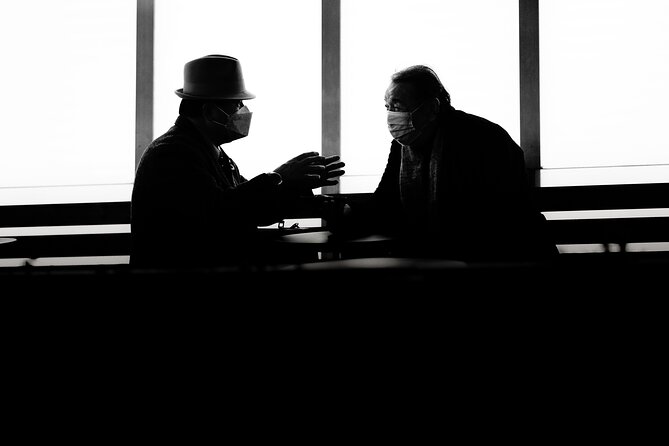
I would recommend it to photographers at beginner or intermediate level who want clear, practical direction. It also suits people who use a phone or a simple camera and want to understand why one composition works better than another.
It is a good match if you enjoy architecture, abstract images, black-and-white photography, or quiet observation. You should be willing to walk, use public transportation, and spend a morning concentrating on details rather than checking off major attractions.
It may be less suitable if you want a broad introduction to Tokyo, a food-focused outing, or a tour centered on famous landmarks. The route is about visual practice. You will see parts of the city, but the camera remains the main subject.
Charge your phone or camera fully before leaving. Bring comfortable shoes. A Suica or PASMO card is useful for the metro, and a mobile ticket is provided for the activity.
Should you book Urban Geometry with Laurence Bouchard?
Book it if you want a focused photography lesson with a small group and a route designed around Tokyo’s architecture and light. The strongest reasons are Laurence’s personal feedback, the chance to work with lines and shadows in several distinct settings, and the useful emphasis on skills that apply beyond Japan.
Skip it if you want a conventional sightseeing tour or would rather move quickly between famous attractions. At $130.31, the price makes sense when you treat the morning as instruction and practice, not simply transportation to attractive places.
Free cancellation is available up to 24 hours before the 9:00 a.m. start time. That gives you some flexibility, but changes or cancellations inside that window are not accepted for a refund.
FAQ
Where does the photography workshop start?
It starts at 4-chōme-2-6 Ebisu, Shibuya, Tokyo 150-0013, Japan.
What time does the activity begin?
The workshop begins at 9:00 a.m.
How long does the workshop last?
The experience lasts approximately four hours.
Where does the activity end?
It ends back at the meeting point.
What locations are included?
The route includes Ebisu Garden Place, Roppongi, the National Art Center, Tokyo, Tokyo International Forum, and Yurakucho.
How many people can join?
The activity has a maximum of six participants.
What should I bring?
Bring a fully charged phone or camera and wear comfortable shoes. A Suica or PASMO card for the metro is recommended if possible.
Can I cancel for a full refund?
Yes. You can cancel at least 24 hours before the experience start time for a full refund. Cancellations or changes made less than 24 hours before the start time are not refunded or accepted.
Newly reviewed around Tokyo
- Ueno and Yanaka Culture Art Walking Tour in Old Tokyo★ 5.0 · 5 reviews
- Sumo Training Watching Experience in Tokyo★ 4.5 · 8 reviews
- Giant Sushi Cooking Class: Make a 1.5m Sushi Roll in Tokyo★ 5.0 · 9 reviews
- 2 Hours Mochi &Nerikiri Making & Matcha Class in Bunkyo★ 5.0 · 21 reviews
- Japanese Sweets (Mochi & Nerikiri) making at a Private studio★ 5.0 · 22 reviews
- Mt Fuji and Kawaguchiko Private Tour★ 5.0 · 10 reviews
- Half-Day Local Tokyo Tour in Adachi Market and Shibamata★ 5.0 · 16 reviews
- Private Full-Day Tour of Tokyo with Hotel Pickup★ 5.0 · 3 reviews