
Reviewed · TOKYO
Tokyo Metropolis
Tokyo’s glass towers, narrow service lanes, salarymen, cooks, and trains give you plenty to photograph, but only if you learn where to look. This workshop turns an ordinary walk from Shinbashi to Yurakucho into a practical lesson in urban composition, with a local photographer showing you how lines, reflections, people, and light can work together.
I like the route for two reasons: it visits Shiodome, Ginza, and the Tokyo International Forum without wasting time on long transfers, and the small format gives you room to ask about your own camera. Guides such as Stephane and Lukasz have been praised for checking images, explaining settings, and finding unusual angles.
The main consideration is its narrow focus. This is a photography lesson, not a general Tokyo sightseeing tour, and the route is mostly modern city scenery. The nonrefundable booking also requires good weather, so you need to choose your date carefully.
Key points at a glance
- Start beside a steam locomotive: Meet at SL Square outside Shinbashi Station at 10:00 a.m., an easy landmark in a busy part of Tokyo.
- Shiodome teaches composition: Spend about an hour working with steel, glass, morning light, lines, and reflections.
- Ginza adds street life: Small lanes provide a change from towers, with cooks, wait staff, and office workers moving through the frame.
- The Tokyo International Forum is the finale: Its huge interior offers strong curves, patterns, and dramatic architectural angles.
- A real photography lesson: The instructor can discuss framing, camera settings, timing, negative space, and how to give a picture a story.
- Good value for a private pair: The price is $158.52 per group of up to two, or about $79.26 each when two people share it.
Why this Tokyo photo walk works
Tokyo can be hard to photograph at first. There is too much going on: signs, cables, glass, concrete, people, trains, and small details packed into one view. Pointing a camera at a tall building often produces a flat picture unless you know how to organize the frame.
That is the useful idea behind this workshop. You are not simply taken to famous viewpoints and told to take pictures. You walk through three connected districts while learning to notice shape, line, reflection, scale, and timing.
The route is especially suited to modern architecture. Shiodome gives you tall office towers and clean surfaces. Ginza brings tighter streets and human activity. Yurakucho finishes with the Tokyo International Forum, where the building itself becomes the subject.
I also like the fact that the walk covers only about 1.3 miles, or 2 kilometers. That is enough distance to change settings and subjects without turning the morning into an endurance test. You will be on your feet for 2.5 hours, but the emphasis is on stopping, looking, and making images.
Other Tokyo days people book alongside this one:
- Mt Fuji and Hakone 1-Day Bus Tour Return by Bullet Train
★ 5.0 · 26,383 reviews - 1-Day Tokyo Bus Tour
★ 5.0 · 14,250 reviews - Tokyo: teamLab Planets TOKYO Digital Art Museum Entry Ticket
★ 4.6 · 9,779 reviews
Meeting at Shinbashi’s steam locomotive
The meeting point is SL Square at the west entrance of Shinbashi Station. The steam locomotive is a practical landmark, especially if this is your first morning in Tokyo and you do not yet feel comfortable with the station system.
The tour starts at 10:00 a.m. From there, your instructor leads you toward Shiodome. The early start matters because morning light can give glass towers more shape and contrast than harsh midday sun. The timing also places you in the city during its working day, when office districts begin to fill with movement.
Guides have included Stephane, Lukasz, and Excel. The exact instructor may vary, but the teaching style described for the experience is hands-on. You should expect to show your camera screen, ask why one frame works better than another, and receive practical suggestions rather than a long technical lecture.
That setup is useful for mixed skill levels. A beginner can ask about basic camera functions, while a more experienced photographer can work on framing and visual ideas. The supplied information does not promise a particular camera system or lens type, so bring the equipment you already understand.
One hour among Shiodome’s towers
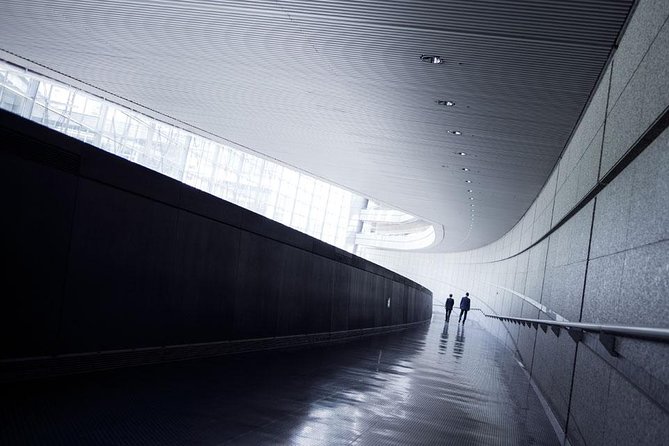
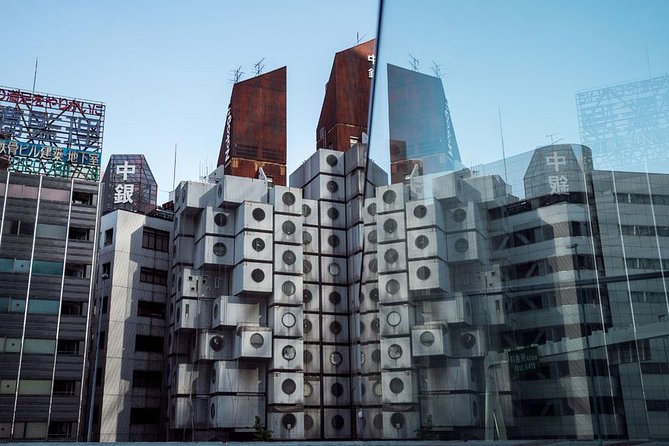
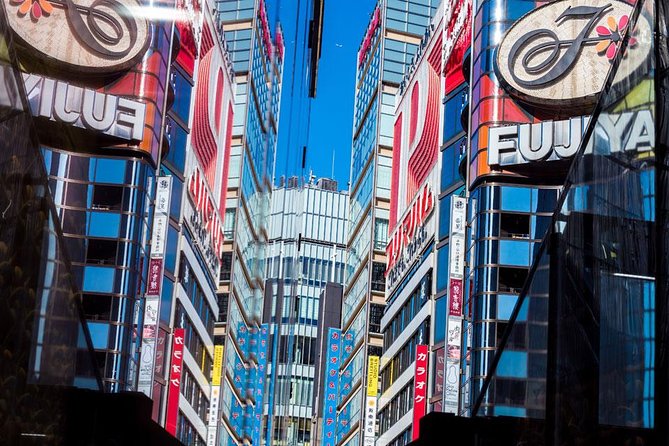
Shiodome is the longest stop, at about one hour. It is a business district built around steel and glass, so this is where the workshop’s architectural focus becomes clear.
Your instructor works with you on composition, especially how to frame a scene. That might mean using a building edge as a strong diagonal, placing a person at the right scale, or waiting for a reflection to connect two parts of the image. The goal is to stop treating a tower as one large object and start breaking it into smaller visual pieces.
The workshop also covers how to create a story with the setting and the people inside it. A photograph of an office tower can feel cold and empty. Add a worker crossing the frame, a reflection from a nearby surface, or a glimpse of activity at street level, and the picture begins to say more about Tokyo.
I find this part most useful for anyone who tends to collect postcard-style images. A tall building straight on is easy to record but often not very memorable. Learning to shift your viewpoint, wait for movement, or use negative space can change the result without requiring expensive equipment.
There is a practical limit here. Shiodome is modern and polished, so anyone hoping for temples, old wooden streets, or traditional neighborhoods will not find that subject matter on this route. The reward is a focused lesson in contemporary city photography.
Ginza’s narrow lanes and working streets
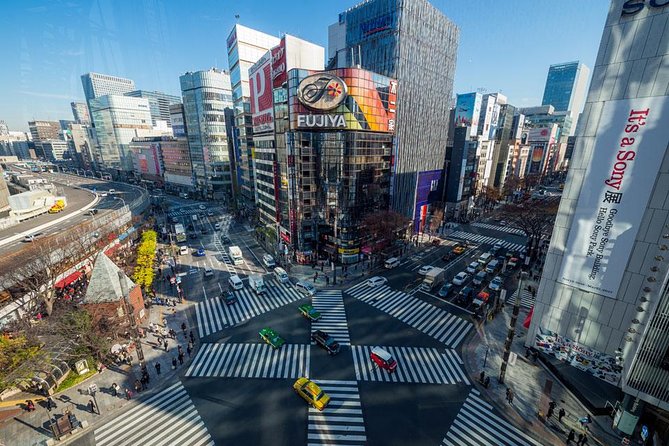
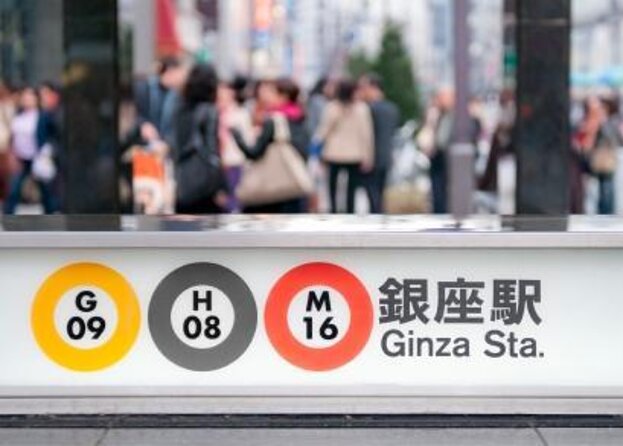
The group then continues into Ginza for about 45 minutes. The visual change is important. You move from broad modern structures to smaller streets, back lanes, and pockets of everyday work.
This is where you can photograph more than architecture. Cooks, wait staff, and office workers go about their day, giving your pictures human scale. You learn to look for the relationship between a person and the built setting, rather than treating people as accidental clutter.
Ginza is also useful for studying contrast. A narrow lane beside a major shopping district can offer a tighter composition than a wide avenue. You might find patterns in signs, repeated windows, bright surfaces, or a person framed between buildings. The guide’s job is to point out these possibilities and help you decide what belongs in the frame.
The instructors have received particular praise for finding less obvious angles without getting in the way of pedestrians. That is a real skill in Tokyo, where sidewalks can be busy and stopping at the wrong place creates a nuisance. You should still be ready to move when needed and follow local courtesy around people at work.
Forty-five minutes passes quickly. If you prefer long, unhurried street photography sessions, this section may feel brief. The advantage is that the route keeps moving and gives you several kinds of subject in one morning.
A completely different kind of day in Tokyo:
- Mt Fuji & Hakone Cruise, Drum Show Bullet Train 1 Day from Tokyo
★ 4.0 · 7,413 reviews - Tokyo: Shinjuku Food Tour (13 Dishes at 4 Local Eateries)
★ 5.0 · 6,603 reviews - Tokyo Mt Fuji 5th St & Hakone Cruise Bus Tour w/Bullet Train
★ 4.4 · 5,024 reviews - Flagship 2-Hours Official Street Go-Kart Tour – Tokyo Bay Shop
★ 5.0 · 4,974 reviews
The Tokyo International Forum’s grand interior
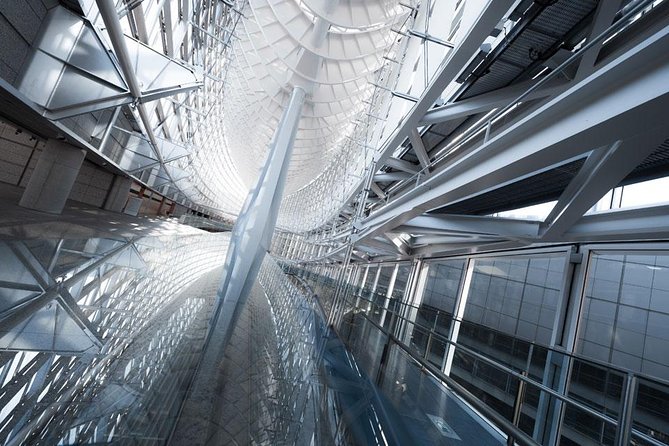
The final stop is the Tokyo International Forum in Yurakucho, with about 45 minutes for photography. The building provides a strong finish because its immense interior offers a different kind of challenge from the street.
Here, look for sweeping lines, repeating forms, glass, open space, and unusual perspectives. The size of the building lets you work with scale. A person placed in the right spot can show how large the structure is, while a close crop can turn the same architecture into an abstract pattern.
This is also a good place to put earlier lessons into practice. You can test symmetry, negative space, reflections, and leading lines. The instructor can help you decide when a centered frame works and when an off-center composition feels stronger.
The ending point is near a major train connection, which is convenient if you have another Tokyo plan afterward. You can continue exploring Yurakucho, return to your hotel, or use the rail network to reach another district.
The tour description does not promise special access or a guaranteed empty interior. The value comes from learning how to photograph the public space as you find it. Conditions can change with crowds and light, so flexibility is part of the exercise.
What you actually learn in 2.5 hours
The strongest part of this experience is its practical teaching. You are not only told where to stand. You work on several skills that carry over to the rest of your trip:
- Composition: Frame buildings, people, and open space so the image has a clear structure.
- Visual storytelling: Use the setting and human activity to suggest what is happening.
- Camera settings: Ask how to use different functions on your own camera.
- Timing: Wait for the right person, reflection, light, or moment of movement.
- Negative space: Leave room around a subject so the image feels deliberate rather than crowded.
- A fresh viewpoint: Look at familiar city forms through lines, patterns, and angles.
The teaching is not limited to beginners. One experienced participant using a Canon camera and Zeiss lenses found the artistic guidance worthwhile, while several less experienced photographers appreciated patient explanations. That range tells you something useful: the workshop is not built around a single technical level.
Still, you should set realistic expectations. Two and a half hours will not turn you into a professional photographer. It can, however, help you notice better subjects and make more confident decisions for the rest of your Tokyo visit.
The value of a small group and private booking
The activity is limited to six people, and the booking price is listed as $158.52 for a group of up to two. For two people, that works out to $79.26 per person. Since the activity is also described as private, only your group participates, which is especially appealing for a couple or two friends who want direct instruction.
The price is reasonable if you intend to use the lesson. You are paying for a professional photography instructor, a planned route, local knowledge, and feedback tailored to your pictures. You are not paying for admission to attractions, since the listed stops are free.
The value is lower if you simply want to walk through these districts without stopping. You could visit Shiodome, Ginza, and the Forum independently, and public transportation is easy to find. The point of booking is the instruction and the effort saved in locating good angles.
Bus fare is not included. The route itself is on foot, and the stated distance is about 2 kilometers, so this is not a major added cost, but you should keep it in mind if you need to reach the meeting point or continue from the ending location.
Who should book this experience
I would choose this workshop if photography is one of your main interests in Tokyo. It suits beginners who want help with basic camera use and composition, as well as experienced photographers who want a different way to read modern architecture.
It is also a good choice for couples. The up-to-two price makes sense for two people who want a private lesson, and you can compare images as you go. A small group also gives you more time to ask questions than a large sightseeing walk would.
You should think twice if your main goal is traditional Japan. This route does not focus on shrines, gardens, old homes, or historic districts. It is about Tokyo as a modern capital, with towers, office workers, reflective surfaces, and engineered spaces.
You should also be comfortable walking and standing for the full 2.5 hours. Most people can participate, but the activity is not built around a vehicle or long seated breaks. Bring a camera or phone you know how to use, since the instructor can give better advice when you can immediately test it.
Weather, timing, and the nonrefundable booking
Good weather is required. If poor weather cancels the experience, you are offered another date or a full refund. That protection applies to a cancellation caused by weather, not to a change of mind.
The booking is nonrefundable and cannot be changed for any reason, so check your schedule before paying. Confirmation is normally provided at booking, though reservations made within one day of the activity are confirmed as soon as possible, subject to availability.
The 10:00 a.m. start is a sensible compromise. You get morning light in Shiodome, then reach Ginza and Yurakucho as the city is active. If you prefer sunrise photography, this is not an early-morning session. If you dislike very early starts, it is easier to manage.
My verdict: a smart lesson for modern Tokyo
Book this tour if you want to return from Tokyo with more than a folder of random building shots. The route is compact, the stops are free, and the instructor’s advice can change how you see lines, reflections, people, and scale for the rest of your trip.
I especially like the combination of Shiodome’s towers, Ginza’s working lanes, and the Tokyo International Forum. It gives you three different photography problems in one morning. Guides such as Stephane and Lukasz have also been praised for patient explanations, image checks, and unusual viewpoints.
Skip it if you want a broad introduction to Tokyo or a tour centered on traditional sights. For photographers, though, the price is fair, the walking distance is manageable, and the private two-person format can make the instruction feel personal rather than rushed.
FAQ
How long is the photography workshop?
The experience lasts approximately 2 hours and 30 minutes.
Where does the tour begin?
It begins at SL Square, the Shinbashi Station West Entrance Square, beside the steam locomotive.
What time does the activity start?
The start time is 10:00 a.m.
Where does the tour end?
It ends at Anthony Caro’s Barcelona Ballad near the Tokyo International Forum in Marunouchi.
Which Tokyo areas does the route visit?
The route includes Shiodome, Ginza, and Yurakucho, with the Tokyo International Forum as the final stop.
How far do you walk?
The average walking distance is about 1.3 miles, or 2 kilometers.
Is the activity suitable for beginners?
Yes. The workshop is intended for beginners and more advanced photographers, with instruction on composition, camera settings, timing, and storytelling.
Is transportation included?
Bus fare is not included. The listed stops do not require admission fees, and the tour itself is conducted on foot.
Newly reviewed around Tokyo
- Tokyo Asakusa:Calligraphy & Make T-shirt Activity★ 5.0 · 62 reviews
- Intercity Shuttle, Tokyo to Haneda /Narita /Yokohama /Makuhari★ 5.0 · 5 reviews
- 1 Hour Travel around Tokyo with a Professional Photographer★ 5.0 · 3 reviews
- Travel Tokyo with Your Own Personal Photographer★ 5.0 · 43 reviews
- Train in Samurai Swordsmanship and Defeat the Demon in Tokyo★ 5.0 · 5 reviews
- Shuttle Van 6hr Tokyo Tour to-and-from Tokyo, Yokohama and Narita★ 5.0 · 9 reviews
- Kickboxing & Body Training with EX-Pro Fighter★ 5.0 · 4 reviews
- Traditional Japanese Knife Sharpening Class★ 5.0 · 18 reviews