
Reviewed · TOKYO GEISHA SHOWS AND DINNERS
Geisha Entertainment Experience in Tokyo
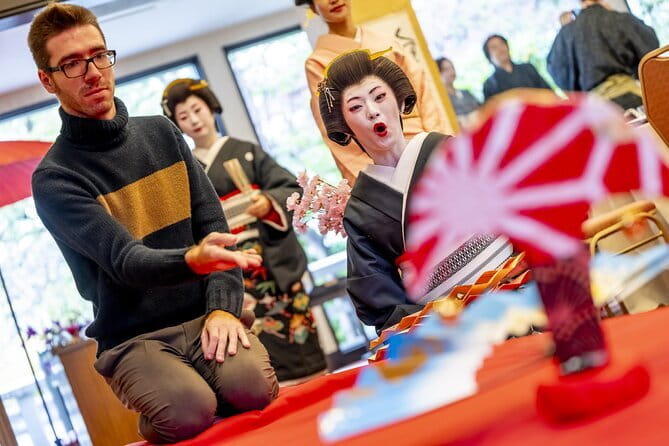
The best part of this experience is its setting: Fukagawa Odori Gekijyo sits within Tomioka Hachimangu Shrine, a 400-year-old place tied to Tokyo’s Edo-period past. You get more than a stage show. Depending on your course, you’ll eat local food, sip matcha, watch graceful dance, hear shamisen music, and take part in traditional games.
I like the clear choice of three main courses. The UME course lasts 30 minutes and keeps things simple with sweets and matcha, while the TAKE and MATSU courses add food and more time for ozashiki entertainment. I also like the friendly, intimate feel described by the program, with explanations of the dances and chances to ask questions.
The main drawback is finding the venue. One visitor had trouble reaching it even with the map link, so allow extra time and check your route carefully. English support may also vary. An English translator was unavailable for one show, though a phone translation app helped.
Key points before you book
- Three experience lengths: Choose UME for 30 minutes, TAKE for 45 minutes, or MATSU for 70 minutes.
- A historic shrine setting: The venue is inside Tomioka Hachimangu, associated with Fukagawa and Edo-period Tokyo.
- Food changes by course: MATSU includes Edo kaiseki and a drink, TAKE includes Fukagawa meshi and a side dish, and UME includes sweets and matcha.
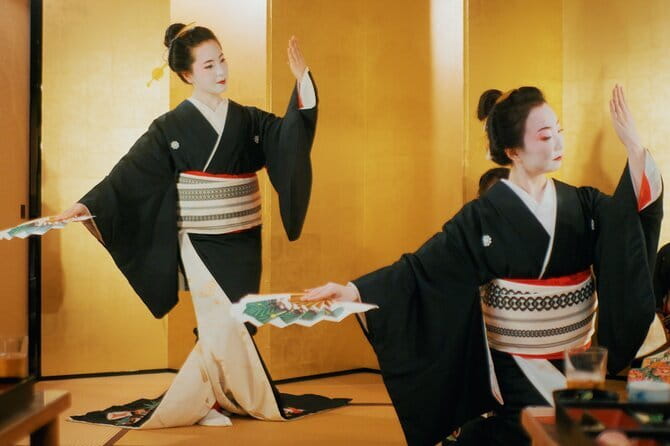
- Traditional entertainment: Expect dance, shamisen, explanations, and ozashiki games on the TAKE and MATSU courses.
- Optional private transport: The TAKE package with hire car includes up to five hours of independent Tokyo touring after the noon experience.
- Good value for culture seekers: At $82.24 per person, the price makes the most sense if you want food, a performance, and hands-on participation in one compact outing.
Entering Fukagawa through Tomioka Hachimangu Shrine
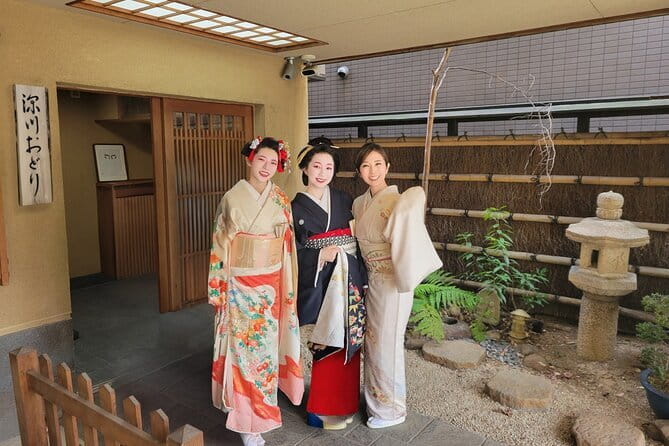
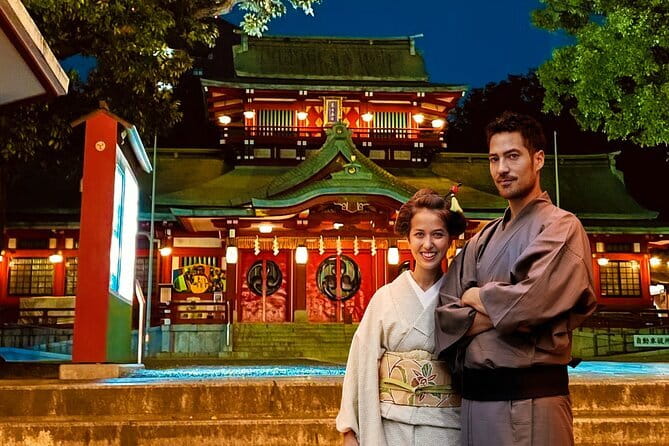
Tomioka Hachimangu Shrine gives this experience a useful sense of place. Built 400 years ago, it symbolizes Fukagawa as it was known in the Edo period. The entertainment venue is within the shrine grounds, so the setting helps connect the performance to old Tokyo rather than placing it in a generic theater.
You should treat the shrine as part of the experience, not simply as an address. The program brings together several pieces of Japanese culture: traditional dance, shamisen music, tea, local food, and the social style of an ozashiki gathering. That combination gives you a broader picture than a performance alone.
The venue can be difficult to locate. One particularly useful warning is to arrive with enough time to get your bearings, especially if you are unfamiliar with the shrine grounds or are relying on a map link. The experience is near public transportation, but that does not guarantee an effortless final approach.
More Tokyo geisha shows and dinners:
- Authentic Geisha Performance with Dinner in Tokyo
★ 4.5 · 101 reviews - Tokyo: Traditional Geisha Experience Show & Japanese Dinner
★ 4.2 · 59 reviews - Asakusa: Geisha Performance and Tea House Experience
★ 5.0 · 52 reviews
What happens during the 30 to 70 minutes
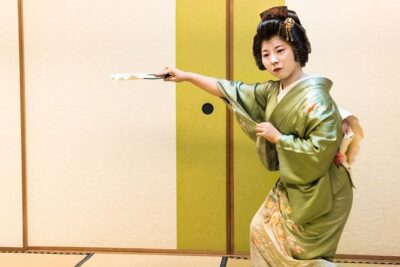
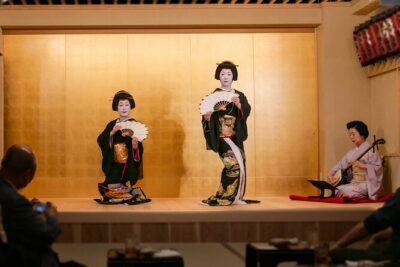
The central stop is Fukagawa Odori Gekijyo. Here you watch traditional performing arts and take part in a small Japanese party known as ozashiki entertainment. The mood is meant to be social and participatory, not a silent concert where you sit and leave.
The exact program depends on your ticket. Dance is central, and shamisen music is part of the performance. You may also see explanations of the movements, the customs, and the ideas behind the entertainment. Several elements are designed to help you understand what you are seeing rather than simply admire costumes and gestures from a distance.
Games are included with the ozashiki entertainment experience on the TAKE and MATSU courses. This matters because it turns the outing into a shared activity. You are not only watching geisha perform. You may also be invited to join in a traditional game and interact with the performers.
The program is short enough to fit into a busy Tokyo day. The UME course takes about 30 minutes, TAKE about 45 minutes, and MATSU about 70 minutes. If you are curious but pressed for time, UME offers a compact introduction. If you want food and participation, TAKE is the middle ground. MATSU gives you the most complete program.
Choosing between UME, TAKE, and MATSU
UME: a 30-minute tea and sweets introduction
UME is the simplest choice. It includes admission, the performance, Japanese sweets, matcha, and a souvenir. The ozashiki geisha entertainment experience is not included in this course, so you should choose it for a short cultural presentation rather than the full interactive party.
This option suits you if tea ceremony, traditional dance, and a calm setting matter more than a meal. It may also work well for a first taste of Japanese performing arts when you have other plans nearby.
The tradeoff is clear: UME is the least expensive style of visit in terms of time and included food, but it does not provide the full entertainment element available with TAKE and MATSU. Check the exact price shown for your chosen option before booking, since the advertised $82.24 is listed as a per-person tour price rather than a separate price for every course.
A completely different kind of day in Tokyo:
- Mt Fuji and Hakone 1-Day Bus Tour Return by Bullet Train
★ 5.0 · 26,383 reviews - 1-Day Tokyo Bus Tour
★ 5.0 · 14,250 reviews - Tokyo: teamLab Planets TOKYO Digital Art Museum Entry Ticket
★ 4.6 · 9,779 reviews - Mt Fuji & Hakone Cruise, Drum Show Bullet Train 1 Day from Tokyo
★ 4.0 · 7,413 reviews
TAKE: the 45-minute middle option
TAKE includes admission, the performance, Fukagawa meshi with a side dish, the ozashiki entertainment experience, and a souvenir. Fukagawa meshi is a local specialty made with rice and clams cooked in a savory broth.
For many people, TAKE will be the sensible choice. You get the local food connection and the games without committing to the longer kaiseki meal. The 45-minute length is enough to make the outing feel substantial while still leaving most of the day open for sightseeing.
The food is also tied to Fukagawa itself, which gives the meal more meaning than a standard snack. You are tasting a local dish while learning about a local style of entertainment in a district linked with old Tokyo.
MATSU: the 70-minute full meal and performance
MATSU is the most complete course. It includes admission, the performance, the ozashiki experience, traditional Edo kaiseki cuisine with Fukagawa meshi, a drink, and a souvenir.
Choose MATSU if the meal is part of your reason for going. Kaiseki is not simply a plate of food. It is a traditional course meal, so the longer time allows the dining element and performance to share the spotlight.
At 70 minutes, MATSU is still compact by Tokyo dining standards, but it asks for a larger block of your day than UME or TAKE. I would choose it for a special cultural outing, a family activity, or a final memorable meal in Tokyo. If you are mainly interested in seeing a dance performance, TAKE may give you better value.
Dance, shamisen, and the social side of ozashiki
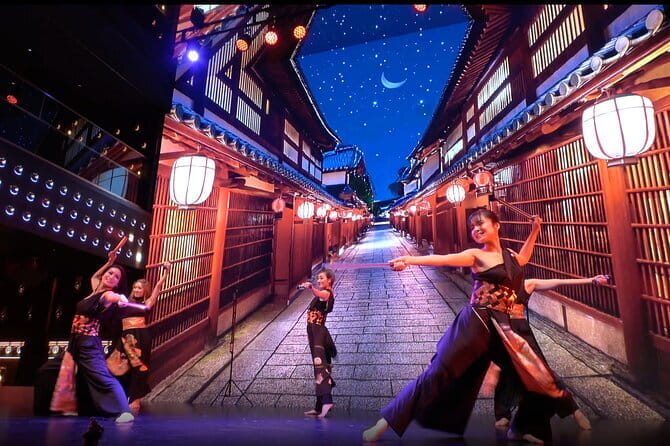
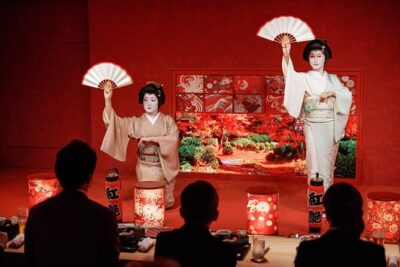
The performance brings together dance and shamisen, the traditional Japanese three-stringed instrument. The dances are presented with explanations, which helps you notice the meaning in the gestures and movements.
That explanation is important. Without context, a short traditional dance can seem beautiful but difficult to read. Here, the program aims to tell you why the performers do things in a certain way and what the customs mean. The result is more useful for a first-time visitor who wants cultural background without sitting through a long lecture.
The ozashiki portion adds a different tone. The word refers to a traditional banquet-room style of entertainment, and this program presents it as a friendly party where people gather, play games, and enjoy the performance. It is less formal than simply watching from a distance.
You should still approach the experience with respect. The value is not in treating geisha arts as a costume photo opportunity. It is in watching practiced skills, hearing the music, learning some social customs, and joining the activities in the way the hosts invite you to participate.
Tea ceremony, sweets, and food with a local connection
The food choices make the packages easy to compare. UME gives you Japanese sweets and matcha. TAKE gives you Fukagawa meshi and a side dish. MATSU adds a traditional kaiseki course, a drink, and Fukagawa meshi.
The tea component can be especially appealing if you want an introduction to Japanese tea ceremony without booking a separate, formal tea lesson. You get the chance to see the customs in context, alongside dance and entertainment.
Food restrictions deserve a little planning. The available information does not specify vegetarian, vegan, allergy, or gluten-free arrangements. One visitor received help finding a vegan restaurant afterward, but that does not mean the course itself can be changed. Contact the provider before booking if your diet is important, and do not count on last-minute substitutions.
The food also affects the value. At $82.24 per person, the experience is not a cheap performance ticket. You are paying for a bundled cultural program with food or tea, a souvenir, and, on two courses, participation in the ozashiki activities. MATSU offers the strongest value if you would otherwise pay separately for a special meal and cultural show.
Language and how much you will understand
The program has English support in some form, but you should not assume that an English translator will be present at every performance. During one show, the translator was away, and phone translation helped the group follow along.
That is a useful practical point. The visual parts of the experience, including dance, music, tea, food, and games, can still be enjoyed without perfect language access. But explanations add real value, so you should be prepared to use a translation app if needed.
The welcoming approach is one of the strongest parts of the program. The hosts explain why things are done in particular ways and invite questions. That makes the experience work for families and first-time visitors who want more than a brief cultural display.
If clear English interpretation is essential to your enjoyment, confirm the language arrangements before paying. The booking confirmation is provided within 48 hours, subject to availability, but that does not guarantee a particular interpreter.
The optional five-hour hire car package
There is a fourth choice: a TAKE course with hire car. The geisha experience begins at 12:00, and afterward you have up to five hours to explore Tokyo independently in a hire car. The driver can speak English.
This package changes the outing from a single cultural stop into a half-day plan. It could be useful if you want to connect the shrine visit with other Tokyo sights and prefer private transport. The driver’s English ability also removes one concern for people who find navigation or communication tiring.
You should read the package details carefully. The core geisha experience remains the TAKE course, while the hire car comes afterward. The information provided does not name the route, sightseeing stops, vehicle size, or exact drop-off arrangements, so you should not assume the driver provides a guided tour of Tokyo.
The five-hour option may offer good value for families or small groups who already know where they want to go. It is less useful if you enjoy building your own route by train, or if your Tokyo plans are already fixed around a different neighborhood.
Who will enjoy this most
I would recommend this experience to you if you want a cultural activity that combines performance, food, and participation. It suits first-time visitors who would like an introduction to geisha arts without arranging several separate bookings.
Families can also find plenty to enjoy. The games make the outing more active than a standard theater show, and the shorter UME and TAKE options are easier for children with limited patience. Adults with a strong interest in traditional arts may prefer MATSU, since it offers the longest program and a full meal.
It is less suitable if you want a large-scale stage production, a long historical lecture, or a completely flexible schedule. The experience is compact and focused. You should also avoid booking it as a casual stop if you dislike searching for a venue or if you need guaranteed English interpretation.
Everyone receives a souvenir, which gives the visit a small physical reminder of the day. The souvenir is not described in detail, so you should regard it as a pleasant extra rather than a major part of the value.
Practical details that matter on the day
The experience is available with a mobile ticket, which keeps the entry process simple. Confirmation is sent within 48 hours, subject to availability, so do not assume your place is final until confirmation arrives.
Most people can participate, and the venue is near public transportation. Still, allow extra time for the walk from the station and the search around the shrine grounds. The location warning is the most important practical point in the whole booking.
The experience is non-refundable and cannot be changed for any reason. That means you should confirm your date, number of people, course, and language needs before booking. If your schedule is uncertain, this is not a good activity to reserve far ahead without checking your plans carefully.
The optional period-drama-style short movie is not included. A professional cameraman can film it for an extra cost, but the supplied details do not state the price or length. Treat it as an add-on rather than part of the main experience.
Should you book the geisha entertainment experience?
Book it if you want a small, welcoming introduction to Japanese traditional arts with real food, tea, dance, music, and games. The location inside Tomioka Hachimangu gives the outing a strong connection to Fukagawa, and the program does a good job of making geisha entertainment understandable to first-time visitors.
For most people, I would choose TAKE. It includes Fukagawa meshi, the ozashiki experience, the performance, and a souvenir in a manageable 45 minutes. Choose UME if you mainly want tea, sweets, and a brief cultural stop. Choose MATSU if the meal matters as much as the performance. Pick the hire car version only if you already have a clear plan for the extra five hours.
The price is fair when you use the experience as a combined meal and cultural activity, not merely as a short show. Just plan for the difficult-to-find venue, check English support, and remember the strict cancellation terms. If those details suit your day, this is an unusually personal way to spend an hour in Tokyo.
FAQ
Where does the geisha experience take place?
It takes place at Fukagawa Odori Gekijyo, located within the grounds of Tomioka Hachimangu Shrine in Tokyo.
How long does the experience last?
The UME course lasts about 30 minutes, the TAKE course about 45 minutes, and the MATSU course about 70 minutes.
What food is included with the MATSU course?
MATSU includes traditional Edo kaiseki cuisine with Fukagawa meshi, a drink, and a souvenir.
What is included with the TAKE course?
TAKE includes admission, the performance, the ozashiki geisha entertainment experience, Fukagawa meshi with a side dish, and a souvenir.
What does the UME course include?
UME includes admission, the performance, Japanese sweets, matcha, and a souvenir. The ozashiki geisha entertainment experience is not included.
Is an English-speaking driver available?
The driver for the TAKE course with hire car can speak English.
Can I use a mobile ticket?
Yes. The experience includes a mobile ticket.
Can I cancel or change my booking?
No. The experience is non-refundable and cannot be changed for any reason.
Newly reviewed around Tokyo
- Tokyo Asakusa:Calligraphy & Make T-shirt Activity★ 5.0 · 62 reviews
- 1 Hour Travel around Tokyo with a Professional Photographer★ 5.0 · 3 reviews
- Travel Tokyo with Your Own Personal Photographer★ 5.0 · 43 reviews
- Intercity Shuttle, Tokyo to Haneda /Narita /Yokohama /Makuhari★ 5.0 · 5 reviews
- Train in Samurai Swordsmanship and Defeat the Demon in Tokyo★ 5.0 · 5 reviews
- Shuttle Van 6hr Tokyo Tour to-and-from Tokyo, Yokohama and Narita★ 5.0 · 9 reviews
- Kickboxing & Body Training with EX-Pro Fighter★ 5.0 · 4 reviews
- Traditional Japanese Knife Sharpening Class★ 5.0 · 18 reviews
Tokyo Geisha Shows and Dinners, compared.
Authentic Geisha Performance with Dinner in Tokyo
Read our review →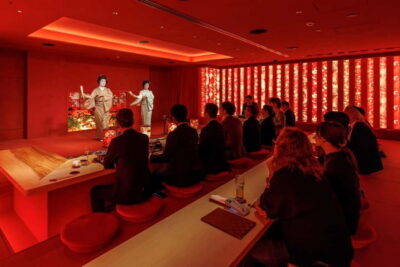
Traditional Geisha Experience Show & Japanese Dinner
Read our review →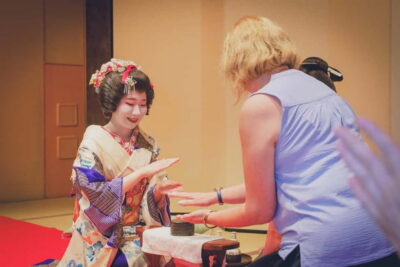
Tokyo Traditional Geisha Show and Japanese Fine Dining Experience
Read our review →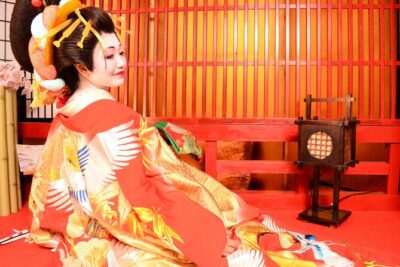
Tokyo Geisha or Oiran Dress-Up Experience and Professional Photos
Read our review →
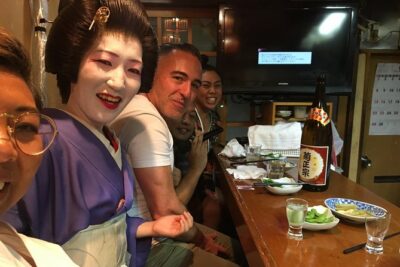
An Enchanted Evening with Geisha – A Rare Experience in Tokyo
Read our review →Browse the lists this tour appears in