
Reviewed · NIKKO DAY TRIPS FROM TOKYO
Exciting Nikko – One Day Tour from Tokyo
Nikko packs Japan’s sacred history into one beautiful day. You’ll see the red Shinkyo Bridge, the gold Buddhas of Rinnoji, Toshogu’s wild carved animals, and forest shrines tied to Nikko’s three holy mountains. The train ride from Tokyo adds a useful look at Japan beyond the capital.
I like the private format, since your group can move at its own pace with a professional guide. I also like the clear route through Nikko’s main religious sites, including Taiyu-in, which many rushed day trips skip. The catch is the long day, stair-heavy visits, and some confusion over exactly which transport and admission costs are covered, so confirm the inclusions before paying.
Key points to know before you go
- A full Nikko circuit in about 10 hours: You visit five important sights, with roughly three hours of scheduled sightseeing before allowing for transport and transitions.
- A private guide for your group: Only your party takes part, and guide Yumiko Sano has led the tour with a patient, professional approach.
- The train ride is part of the appeal: The journey from Asakusa gives you a change of pace and a look beyond central Tokyo.
- Toshogu is the main event: Expect colorful carvings of animals, plants, and imaginary creatures at Japan’s most elaborate shrine.
- Stairs are part of the deal: Comfortable shoes and moderate fitness matter, especially around the shrine and temple grounds.
- Check the cost breakdown: The tour states that transport and admission are included, but one booking experience reported paying extra for train tickets, entrance fees, and the guide’s lunch.
Why Nikko makes a strong day trip from Tokyo
Nikko is not just another collection of Japanese temples. It is a major religious center tied to the mountains north of Tokyo, and its shrines and temples form a UNESCO World Heritage area designated in 1999.
That cultural weight matters, but you do not need a background in Japanese religion to enjoy the visit. The appeal is easy to grasp: brilliant lacquer, carved animals, incense-filled temple halls, old trees, stone paths, and a setting that feels far removed from Tokyo’s city streets.
The route also gives you a useful contrast. Tokyo is modern, crowded, and fast. Nikko offers a quieter setting where the buildings are designed to be seen slowly, one gate, carving, and lantern at a time. You still have only one day, but the change in mood is part of the reward.
This is a private activity, so your group will not be folded into a large coach party. That can make a real difference at a place with many small details. A good guide can point out what you would otherwise walk past, then adjust the pace if one shrine catches your interest.
More Nikko day trips from Tokyo:
- Nikko: Kegon Falls, Lake Chuzenji & Toshogu Temple
★ 4.6 · 1,577 reviews - Tokyo: Nikko Toshogu Shrine and Kegon Waterfall Tour
★ 4.5 · 1,266 reviews - From Tokyo: Nikko World Heritage Site Private Full-Day Trip
★ 4.9 · 243 reviews
Starting at Asakusa at 9:00 am
The meeting point is the Tobu Tourist Information Center at 1-4-1 Hanakawado in Asakusa. The start time is 9:00 am, and the tour returns to this same meeting point at the end of the day.
You need to arrange your own way from your hotel to Tobu Asakusa Station. That cost is not included. Give yourself enough time to reach the station without rushing, since the experience begins there and not at your hotel.
The rail journey is more than a practical transfer. It lets you see some of the countryside between Tokyo and Nikko, and one direct booking experience specifically praised the train ride as part of the day. The trip takes you out of the capital before the main sightseeing begins, which helps Nikko feel like a real excursion rather than a distant suburb.
The tour lasts about 10 hours, so you should think of it as a full day out. You will not have much spare time for wandering, shopping, or a leisurely restaurant stop. Lunch is not included, and the schedule leaves you responsible for arranging it within the day.
Shinkyo Bridge: Nikko’s red gateway
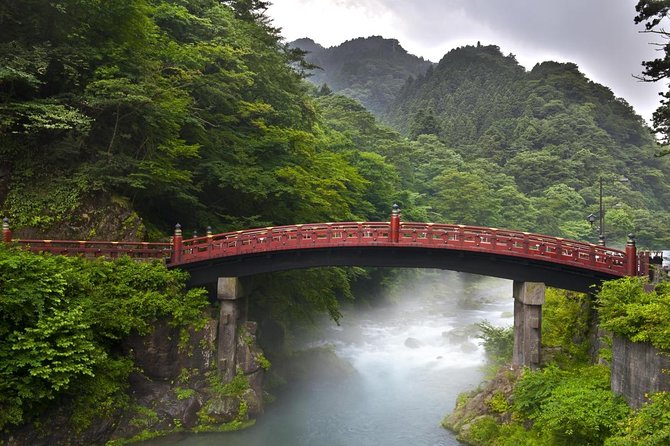
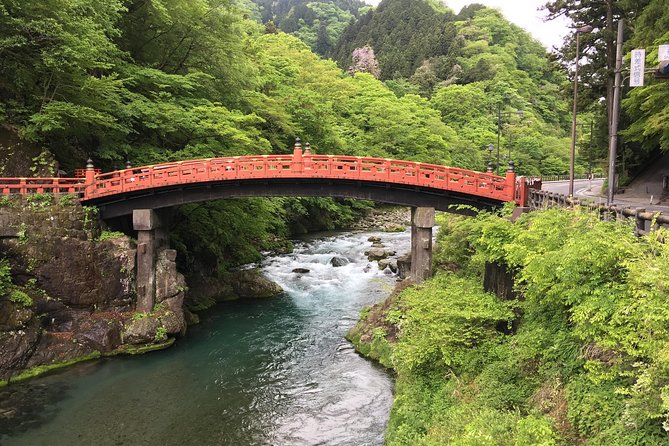
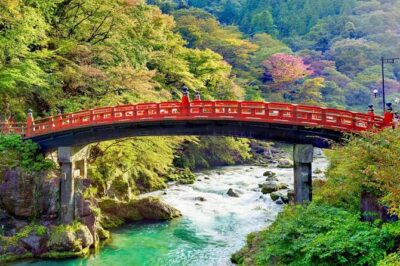
The first stop is Shinkyo Bridge, one of Nikko’s best-known photo spots. Its vermilion-red lacquer makes a sharp contrast with the river and surrounding trees, and it gives you an immediate sense that you have entered a place of ceremony.
You have about 30 minutes here. Admission is listed as free, so this is a straightforward opening stop rather than a long visit. Use the time for photographs and for your first explanation of Nikko’s religious setting.
The bridge works well at the start because it is visually simple. After the city-to-country train ride, you are looking at one strong image: a red bridge associated with the entrance to Nikko’s sacred area. It is also a good place to settle into the walking pace before the more detailed temple visits begin.
Do not expect a long exploration here. Thirty minutes is enough for the bridge and photographs, but not for a broad walk through the surrounding area. The value comes from its position in the route and its striking appearance, not from the length of the stop.
Rinnoji Temple and its three golden Buddhas
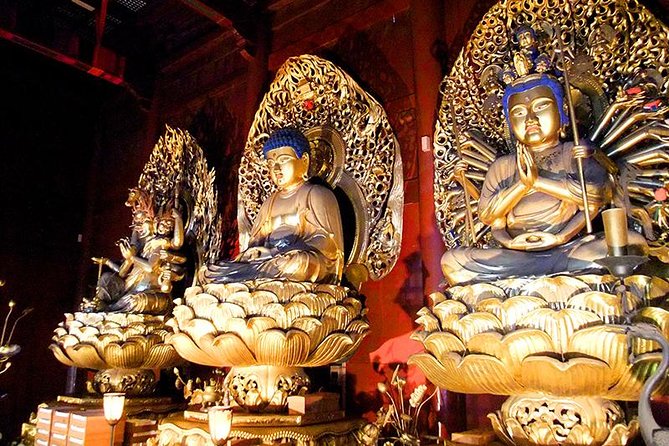
Next comes Rinnoji Temple, which traces its history back more than 1,200 years. The key sight is a group of three golden Buddhist deities, an interior display that gives this stop a very different feel from the open-air bridge.
The scheduled time is 30 minutes, with admission listed as free. That is a short visit for a temple with such an old religious tradition, so listen closely to the guide and focus on the main hall and the three figures.
This is one place where a guide earns the fee. The statues are visually impressive, but their religious meaning is not always obvious if you simply walk in, take a photograph, and walk out. A professional guide can give you a basic framework for understanding what you are seeing without turning the visit into a lecture.
The temple stop also helps break up the day. Shinkyo Bridge gives you an exterior landmark, while Rinnoji shifts your attention to Buddhist art and worship. The mix keeps the route from feeling like five versions of the same shrine.
More 1 Day Tours in Tokyo:
- Mt Fuji and Hakone 1-Day Bus Tour Return by Bullet Train
★ 5.0 · 26,383 reviews - 1-Day Tokyo Bus Tour
★ 5.0 · 14,250 reviews - Mt Fuji & Hakone Cruise, Drum Show Bullet Train 1 Day from Tokyo
★ 4.0 · 7,413 reviews - Tokyo: DisneySea 1-Day Passport
★ 4.5 · 2,726 reviews
Toshogu Shrine, Nikko’s most elaborate stop
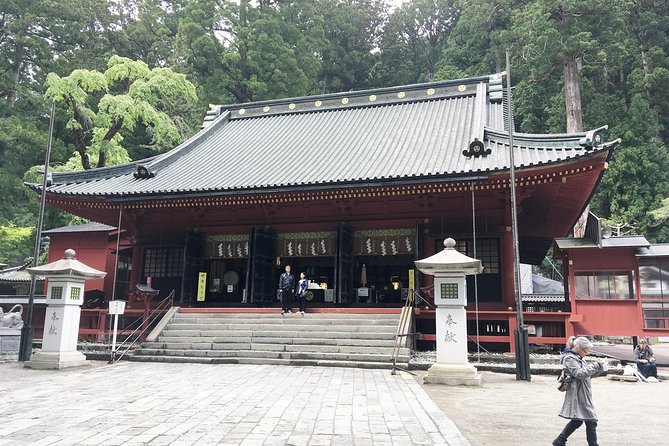
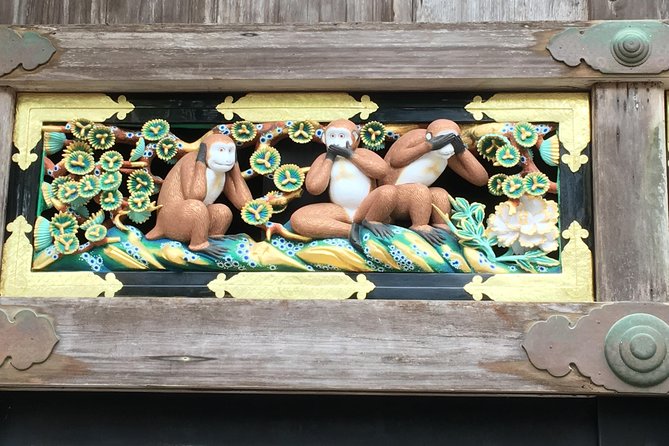
Toshogu Shrine is the centerpiece of the tour, and you have about one hour here. It is known for colorful and elaborate carvings of plants, animals, and imaginary creatures, including the kind of small details that reward close attention.
This is not a plain wooden shrine. Expect a dense display of decoration, gates, carvings, and painted surfaces. The visual style is deliberately grand, and Toshogu feels more ornate than the simpler religious buildings elsewhere in Nikko.
A useful way to approach the visit is to let the guide explain the major features, then spend a few quiet moments looking on your own. You can easily become overloaded by the decoration if you rush from one carving to the next. One hour gives you a good introduction, but it is not enough for every corner of a large complex.
The route can involve steps, and that matters here. A direct booking experience described the shrine visit as a good workout and warned that the steps may be difficult for some people. Wear shoes with a firm grip, and do not treat this as a flat museum visit.
The stated admission arrangement deserves attention at this stop. The tour information says transportation and admission fees are included, but one person reported paying extra for train tickets and entrance fees for both the traveler and guide, as well as the guide’s lunch. That account conflicts with the stated inclusions. I would ask the provider for a written cost breakdown before departure, especially for Toshogu, where entrance charges could affect the total value.
Futarasan Shrine and Nikko’s sacred mountains
Futarasan Shrine receives about 30 minutes. It is linked to Nikko’s three sacred mountains and is now also associated with love, giving this stop a gentler character than the grand ceremonial style of Toshogu.
The shrine offers a useful reminder that Nikko is not only about elaborate carvings. Its religious identity is tied to the mountains, forests, and older traditions of worship. You are seeing a living sacred place, not just a historic building preserved for photographs.
Thirty minutes is enough for a focused visit, but it does not leave room for a long walk around the grounds. Stay with the guide and use the time to ask questions. Since the shrine’s modern association is love, it may also appeal to couples or anyone interested in the everyday beliefs that sit alongside formal religious history.
Futarasan is especially valuable in the sequence because it connects the buildings to their setting. Toshogu can feel visually intense. Here, the connection to the mountains gives you a broader idea of why this area became important in the first place.
Taiyu-in and the third Tokugawa shogun
The final listed sightseeing stop is Taiyu-in Temple Niomon, visited for about 30 minutes. It is connected with the grave of the third shogun of the Tokugawa dynasty.
This stop adds political history to the religious route. Toshogu is famous for decoration and ceremony, while Taiyu-in points you toward the powerful Tokugawa family and the people who shaped Japan’s early modern government.
The provided details do not specify every feature you will see at Taiyu-in, so it is best to think of this as a focused stop rather than a complete tour of the temple grounds. The name Niomon refers to a gate, and the visit may center on the approach and the temple’s connection with the shogun’s grave.
Its inclusion is a strength for people who want more than the two most famous Nikko sights. It also means the day has very little slack. If you spend extra time at Toshogu, you may need to keep moving to stay on schedule.
What the private guide adds
The biggest practical advantage here is having one guide for your group rather than joining a large shared party. You can ask questions as they arise, and the guide can help connect the Buddhist temple stops with the Shinto shrines.
Guide Yumiko Sano is specifically associated with the tour. The available feedback describes her as professional, patient, and pleasant, qualities that matter on a long day with many steps and several religious sites.
A guide is most useful at Toshogu and Rinnoji, where there is plenty to see but limited time. At Shinkyo Bridge, you mainly need a short orientation. At Futarasan and Taiyu-in, context helps explain how the sites relate to Nikko’s sacred mountains and the Tokugawa family.
Because the activity is private, the experience is best for a family, couple, or small group that values personal attention. It may be less attractive if you prefer to explore every site slowly and independently. The fixed 10-hour route keeps you moving.
Price, meals, and the question of value
The listed price is $267.13 per person. That is a serious day-trip cost, so value depends on what is truly included and how much you value a private guide.
You are paying for a full day from Tokyo, a professional guide, private participation, transportation connected with the tour, and admission fees as stated. You also get a carefully chosen route through Nikko’s major cultural sites instead of spending time sorting out the order yourself.
But lunch is not included, and your hotel-to-Asakusa transport is separate. More importantly, the conflicting account about train tickets and entrance fees needs attention. If those costs are added, the final price can rise sharply. Ask these questions before booking:
- Are all train tickets from Asakusa to Nikko and back included?
- Are entrance fees for every listed site included?
- Is the guide’s transportation and admission covered without an extra charge to you?
- How is lunch handled during the day?
The tour is booked an average of 129 days ahead, which suggests that you should not leave it until the last minute if your Tokyo dates are fixed. Confirmation is normally sent at booking, though bookings made within three days of travel may receive confirmation within 48 hours, subject to availability.
The cancellation rule is strict. The experience is non-refundable and cannot be changed for any reason. Only book once your date, meeting point, and group plans are firm.
Who will get the most from this Nikko day
I would choose this tour if you want Nikko’s major religious sights in one organized day and prefer having the background explained as you go. It is also a good fit if you are traveling with family or friends and want a private setup rather than a large group.
The tour suits you particularly well if:
- You have one free day from Tokyo.
- You want both Buddhist temples and Shinto shrines.
- You like scenic train travel as part of the outing.
- You want to see Toshogu without planning the route yourself.
- You can handle a moderate amount of walking and stairs.
- You prefer a guide who can answer questions during the visit.
I would hesitate if you dislike tightly timed days, need a long lunch break, or want to explore each complex at your own pace. The schedule is full, and five stops in one day means you get an introduction rather than a slow study of Nikko.
Families should note that children must be accompanied by an adult. The activity is near public transportation, but the route still calls for moderate physical fitness. The temple and shrine grounds are not simply a series of flat indoor rooms.
Should you book this Nikko tour?
Book it if you want a private, guide-led introduction to Nikko and you are comfortable with a long day, a set schedule, and stairs. Toshogu, Rinnoji, Shinkyo Bridge, Futarasan, and Taiyu-in give you a strong first look at the area’s art, religion, and Tokugawa connections.
Before committing, get the transport and admission details confirmed in writing. That one step matters because the stated inclusions and one account of extra charges do not match. If the advertised costs are honored, the private guide and efficient route can make the $267.13 price reasonable for a first visit. If major train and entrance fees are added, compare the total with arranging Nikko independently.
FAQ
Where does the tour start?
It starts at the Tobu Tourist Information Center at 1-4-1 Hanakawado, Taito City, Tokyo, near Tobu Asakusa Station.
What time does the tour begin?
The start time is 9:00 am.
Where does the tour end?
The activity ends back at the meeting point in Asakusa.
How long does the tour last?
The tour lasts about 10 hours.
Is this a private tour?
Yes. Only your group participates in the activity.
Is lunch included?
No. You are responsible for your lunch.
Is transportation from my hotel to Asakusa included?
No. Transportation between your hotel and Tobu Asakusa Station is not included.
Are children allowed?
Yes, but children must be accompanied by an adult.
Newly reviewed around Tokyo
- Tokyo Asakusa:Calligraphy & Make T-shirt Activity★ 5.0 · 62 reviews
- Intercity Shuttle, Tokyo to Haneda /Narita /Yokohama /Makuhari★ 5.0 · 5 reviews
- 1 Hour Travel around Tokyo with a Professional Photographer★ 5.0 · 3 reviews
- Travel Tokyo with Your Own Personal Photographer★ 5.0 · 43 reviews
- Train in Samurai Swordsmanship and Defeat the Demon in Tokyo★ 5.0 · 5 reviews
- Shuttle Van 6hr Tokyo Tour to-and-from Tokyo, Yokohama and Narita★ 5.0 · 9 reviews
- Kickboxing & Body Training with EX-Pro Fighter★ 5.0 · 4 reviews
- Traditional Japanese Knife Sharpening Class★ 5.0 · 18 reviews
Nikko Day Trips from Tokyo, compared.

Nikko Toshogu Shrine and Kegon Waterfall Tour
Read our review →
Edo Wonderland Edomura Cultural Theme Park Ticket
Read our review →
Chartered Private Tour – Tokyo to Nikko, Toshogu, Edo Wonderland
Read our review →
One Day Private Tour to Nikko With English Speaking Driver
Read our review →Browse the lists this tour appears in